


The Zapotec Rugs of Teotitlan del Valle in Oaxaca
Teotitlán del Valle at a Glance
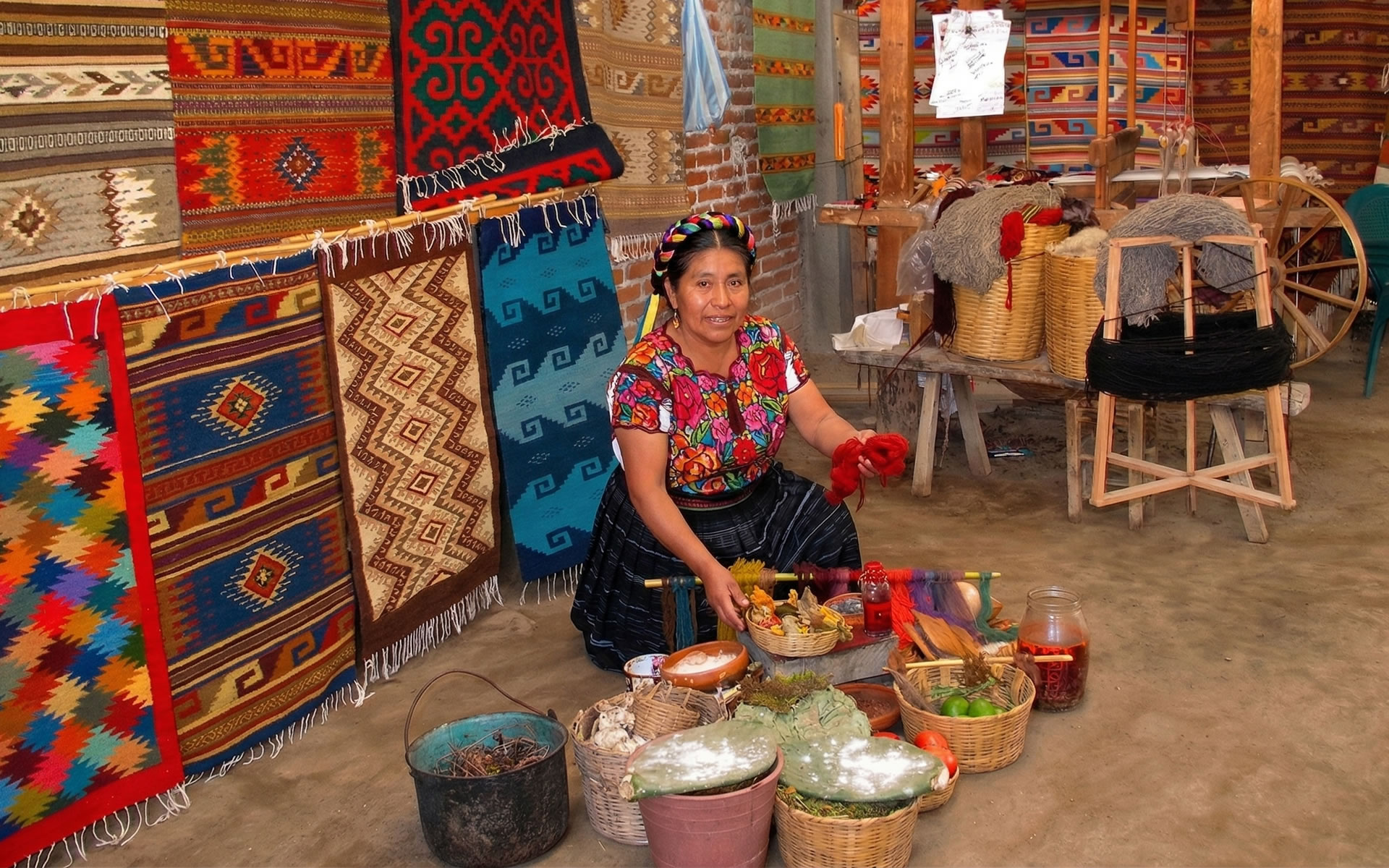
Nestled in the Tlacolula Valley just 29 km (18 mi) east of Oaxaca City, Teotitlán del Valle (Zapotec name: Xigie, “under the stone”) is one of Oaxaca’s most authentic living artisan communities. With around 6,000 residents, almost every family weaves. The tradition dates back over 2,500 years to pre-Hispanic Zapotec times, with the Spanish-introduced pedal loom blending with ancient techniques. Today the town feels like a living museum: you walk past open doorways where grandmothers, parents, and children work side-by-side on looms, dyeing wool in backyard cauldrons with cochineal and indigo. It’s not a tourist factory — it’s home.
The Weaving Families — Keepers of the Tradition
Weaving here is generational and deeply personal. Here are some of the most respected families you can visit (most welcome visitors with advance notice or during open workshops):
- Porfirio Gutiérrez & Familia
World-renowned natural-dye revivalists. Porfirio and his siblings have led the return to 100% natural dyes and are frequent exhibitors in museums across Mexico and the U.S. Their workshop focuses on education and cultural preservation. - Isaac Vásquez García & La Cúpula
Master dyers for generations. Demetrio Bautista Lazo’s family runs workshops and a small B&B; they demonstrate every step from shearing sheep to boiling cochineal. - Fe y Lola Rugs (four-generation family)
Strong emphasis on sustainable, non-toxic natural dyeing. Their workshop on Francisco I. Madero 55 offers immersive experiences where you can try the loom. - Women’s Cooperatives (La Grana Tejidos, Vida Nueva)
Empowering women weavers who preserve traditional designs while innovating with contemporary color palettes. They often run group demonstrations and sell directly. - Gutiérrez, Méndez López, and Montaño families
Countless other multi-generational homes open their patios — just knock politely and you’ll be welcomed with a smile and a cup of tejate.
The Zapotec Symbols — Every Rug Tells a Story
Unlike purely decorative rugs, Teotitlán designs carry deep cosmology, history, and daily life. Common symbols and their meanings:
- Grecas (step-fret meanders)
The most iconic. These continuous geometric patterns represent the cycle of life: four ascending lines symbolize birth, youth, adulthood, and old age (the longest line = wisdom). Directly inspired by Mitla ruins. - Pyramids
Represent Monte Albán, the ancient Zapotec capital and center of power, politics, and economy. - Lightning (zig-zag)
Symbol of Cocijo, the Zapotec god of rain and fertility — essential for the corn harvest. - Ojo de Dios (God’s Eye / Diamond)
Protection and the ability to “see the unseen.” Often placed in the center for spiritual safeguarding. - Corn Plant
The most sacred: roots in the underworld, stalk on earth, pollen reaching the sky — the full cycle of life and sustenance. - Mountains, Deer, Birds, and Agave
Daily life in the valley; mountains remind us of pilgrimage routes, deer represent grace and the hunt, agave the plant that gives everything from fiber to mezcal.
Natural Dyes vs. the Reality of Commercial Dyes Today
Traditional natural dyes are what made Teotitlán famous: cochineal insects (deep reds & pinks), indigo (blues), marigold & wild tarragon (yellows), pecan shells & madrone bark (browns), mosses, and bujuco. The process is slow, seasonal, and expensive — but the colors are alive and change beautifully over time.
In 2026 the reality is nuanced: Many prestigious families (Porfirio Gutiérrez, Fe y Lola, Isaac Vásquez) have fully returned to 100% natural dyes for premium pieces and cultural certification. However, roughly half the rugs sold in town still use synthetic/aniline dyes because they are faster, brighter, cheaper, and more resistant to fading in strong sunlight. Always ask: “¿Son tintes naturales o comerciales?” Honest weavers will tell you — and the price difference is obvious. Natural-dye rugs command 2–3× the price but support the revival of ancestral knowledge and are better for the environment and your health.
Current Prices (March 2026)
Prices vary by size, complexity, wool quality, and dyes. Expect to pay:
- Small wall hangings or mats (2×3 ft): 800–2,500 MXN (synthetic) / 2,500–4,500 MXN (natural)
- Standard room rugs (4×6 ft): 3,500–7,000 MXN (synthetic) / 8,000–14,000 MXN (natural)
- Large or custom pieces (6×8 ft+ with intricate grecas): 12,000–25,000+ MXN for museum-quality natural-dye work
Cash only in most family workshops. Bargaining is gentle (10–20% possible on synthetic pieces). Buying directly from the family supports the community far more than middlemen in Oaxaca City.
How to Get There from Oaxaca City
The trip takes 35–50 minutes and is easy and inexpensive:
- Colectivo (shared taxi) — 35 MXN one way
Fastest and most comfortable. Catch them at the northeast corner of the Eduardo Vasconcelos baseball stadium (Blvd. Eduardo Vasconcelos) or near the second-class bus terminal. Tell the driver “Teotitlán del Valle” — they drop you right in the village center. - Second-class bus (GOMA or similar) — 20 MXN one way
Leaves from the same stadium area or Central de Autobuses. Slightly slower but very reliable and scenic. - Private driver or tour — 500–800 MXN round-trip (or 1,500–3,000 MXN for a half-day tour including waiting time)
Ideal if combining with Tlacolula market (Sundays) or Mitla.
Return transport runs until 7–8 PM. Once in town everything is walkable or a quick 10 MXN mototaxi ride.
Practical Tips for Your Visit
• Visit the small Community Museum (Museo Comunitario) for Zapotec artifacts and weaving history — free or small donation.
• Best days: Weekdays for peaceful workshops; Sundays for the lively town atmosphere + nearby Tlacolula market.
• Wear comfortable shoes — many workshops have dirt patios.
• Bring small bills and patience — the weavers love to explain every step if you show genuine interest.
• Combine with a mezcal tasting or a hike up Cerro Picacho for valley views.
Teotitlán isn’t just about buying a rug — it’s about meeting the families who have kept Zapotec stories alive in every thread for millennia. When you walk out with one of their “magic carpets,” you carry home a piece of living Oaxaca heritage.


