

Who built Monte Albán?
Introduction to Monte Albán
Imagine standing on a mountaintop, the wind whispering through ancient stones, as you gaze out over the verdant valleys of Oaxaca. This is the experience awaiting you at Monte Albán, one of Mesoamerica’s most captivating archaeological sites. Perched 400 meters above the valley floor, this pre-Columbian city isn’t just a collection of ruins—it’s a window into a vibrant civilization that shaped the region for over a millennium. But who were the visionary builders behind this marvel? Let’s embark on a journey through time to uncover the story of Monte Albán and the people who brought it to life.
Nestled in the southern Mexican state of Oaxaca, Monte Albán sits at an elevation of about 1,940 meters above sea level. Its strategic location at the convergence of the Valley of Oaxaca’s three arms—Etla, Tlacolula, and Zimatlán-Ocotlán—provided both defensive advantages and panoramic views. Today, it’s a UNESCO World Heritage Site, drawing visitors from around the globe who come to marvel at its pyramids, plazas, and intricate carvings. As we explore its origins, you’ll see how this site embodies the ingenuity and resilience of its creators.
The Zapotec Founders
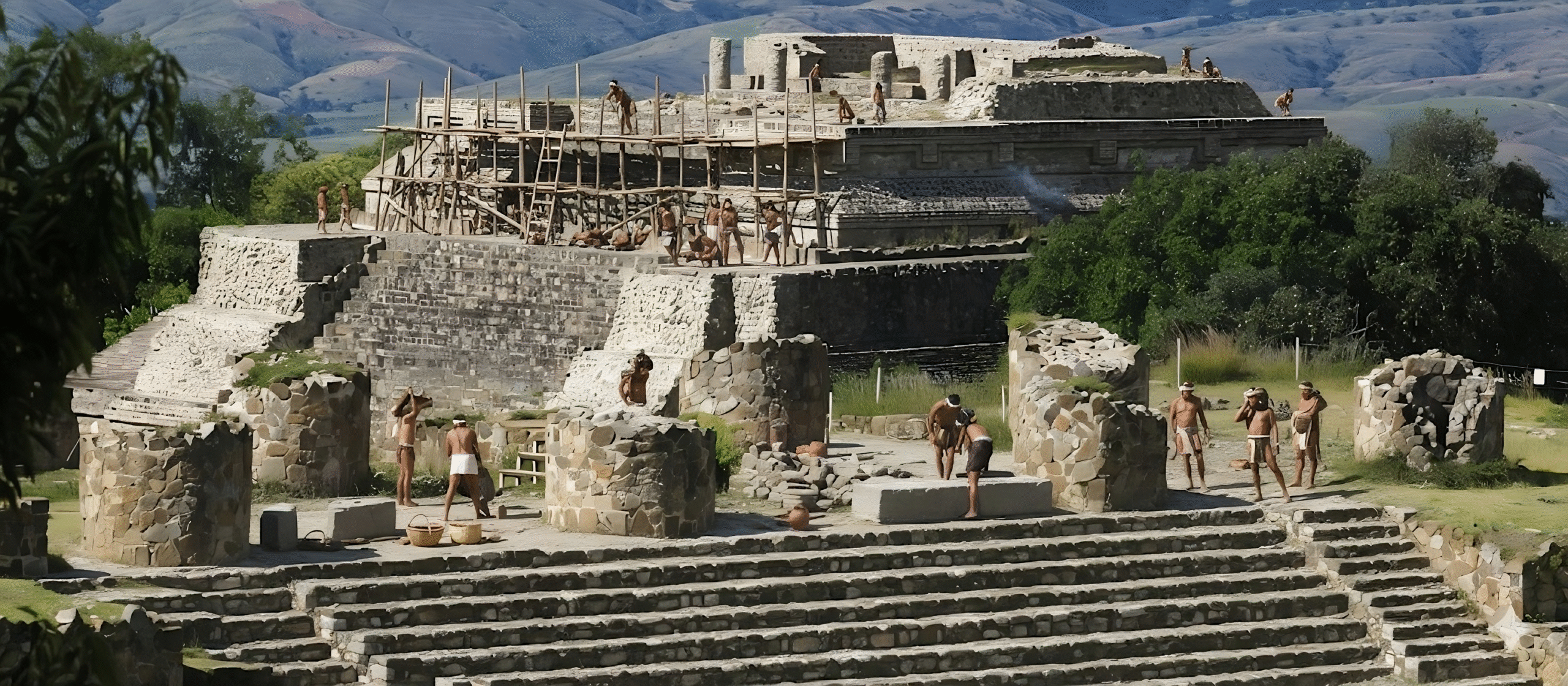
The story of Monte Albán begins around 500 BC, during the late Middle Formative period. It was the Zapotec people, an indigenous group known for their advanced societal structures, who founded this city. The Zapotecs, who referred to themselves as the “cloud people,” chose this uninhabited mountaintop for their new capital, leveling the ridge to create a grand ceremonial center. This decision wasn’t arbitrary; it came amid regional competition and warfare among chiefdoms in the Valley of Oaxaca.
Evidence points to elites from nearby San José Mogote playing a key role in its establishment. A rapid population shift, often called the “Monte Albán Synoikism,” saw thousands relocating to the site, swelling its numbers to around 5,200 by 300 BC. The Zapotecs’ engineering prowess is evident in the artificial terraces, dams, and canals they carved into the mountain, transforming a rugged landscape into a thriving urban hub. Their self-identification as cloud people might stem from their high-altitude dwellings, symbolizing a connection to the heavens.
While the Olmecs influenced early Mesoamerican cultures and the Mixtecs later reused parts of the site, it was unequivocally the Zapotecs who built and developed Monte Albán into a powerhouse. Their society was hierarchical, with nobles overseeing construction that relied on commoner labor. This collaborative effort created a city that served as the political, economic, and religious heart of the Zapotec world.
 There is a problem at Monte Albán.
Monte Albán doesn’t explain itself.
Turn your phone into the guide the site is missing.

Opens instantly·No sign-up·Upgrade to 5 or 16 stops·One download for your group
A guide in your pocket.
Your visit, on your terms.
- 1Open the OracleStart in your browser. No sign-up to try it.
- 2Find your placeFollow the map or choose the structure in front of you.
- 3Press play and exploreHear Los Danzantes, with narration, music and sound.
The video couldn’t load. Please check your connection and try again.
A Timeline of Growth and Glory
Monte Albán’s history unfolds across several phases, each marking advancements in architecture, population, and influence. In its earliest stage, Monte Albán I (500–100 BC), the site saw rapid growth with the construction of the Main Plaza, a vast 300 by 150-meter space capable of hosting large gatherings. By Monte Albán II (100 BC–AD 200), the population had surged to over 17,000, making it one of Mesoamerica’s largest cities.
The Early Classic period, Monte Albán IIIA (AD 200–500), represented the zenith of Zapotec power. The city dominated the Oaxacan highlands and maintained diplomatic ties with distant Teotihuacan, as seen in shared artistic motifs and trade goods. Expansions included monumental staircases, temples, and elite residences with subterranean tombs. The Late Classic phases (AD 500–1000) brought challenges, with declining influence leading to abandonment around AD 900–1000.
Even after the Zapotec decline, the site wasn’t forgotten. During the Postclassic period, Mixtec elites repurposed tombs for burials, leaving behind exquisite artifacts. Small-scale reoccupations continued into the Colonial era, underscoring Monte Albán’s enduring spiritual significance.
Architectural Marvels and Innovations
Walking through Monte Albán today, you’re surrounded by architectural wonders that speak to the Zapotecs’ sophistication. The Main Plaza, blanketed in white plaster, is flanked by platforms and mounds. Monumental buildings like the North and South Platforms rise imposingly, accessed by grand stairways that invite you to climb and reflect.
Standout features include the ballcourts, where ritual games were played, and Building J, an arrow-shaped structure adorned with over 40 carved “conquest slabs” depicting subjugated places. These slabs hint at military expansions, showcasing the Zapotecs’ reach. Temples often featured two-room designs with porches and sanctuaries, possibly honoring ancestors and deities like Cocijo, the rain god.
Residential areas reveal social stratification: elites lived in multi-room adobe houses with patios and tombs, while commoners occupied simpler dwellings on terraces. The site’s design considered earthquakes, with thick, sloped walls ensuring longevity. Astronomical alignments, such as Building J’s orientation to the star Capella, suggest advanced knowledge of the cosmos.
Notable discoveries, like Tomb 7 unearthed in 1932, yielded treasures including gold, jade, and turquoise artifacts from Mixtec burials. These finds, now in museums, offer glimpses into the opulence of ancient elites.
Cultural Significance and Legacy
Monte Albán wasn’t just a city; it was a cultural beacon. As a ceremonial center, it hosted rituals that unified the community, fostering a shared identity. Its influence extended through trade and diplomacy, interacting with Teotihuacan and beyond. The site’s bas-reliefs, hieroglyphs, and urns reflect a rich artistic tradition, with early writing systems emerging here.
Today, Monte Albán stands as a symbol of Mesoamerican heritage, recognized by UNESCO for its universal value. It illustrates the evolution of urban society in Mexico, from chiefdoms to complex states. Visiting feels personal—like connecting with ancestors who shaped this land. Whether you’re a history buff or a casual traveler, the site’s serenity invites contemplation.
In Oaxaca’s modern context, Monte Albán complements the colonial charm of nearby Oaxaca City, blending pre-Hispanic and Spanish influences. Conservation efforts ensure its preservation, allowing future generations to experience its magic.
Planning Your Visit to Monte Albán
If this tale has sparked your wanderlust, visiting Monte Albán is straightforward. Just 9 km west of Oaxaca City, it’s accessible by bus or tour. Wear comfortable shoes for exploring the expansive site, and don’t miss the on-site museum housing artifacts. Sunrise or sunset visits offer the most enchanting light, enhancing the warm, inviting atmosphere.
As you wander the plazas, let the stones tell their story. Monte Albán reminds us of human potential—to build, innovate, and endure. It’s a place where history feels alive, inviting you to become part of its ongoing narrative.