

Alfonso Caso: The Archaeologist Who Brought Monte Albán to Life
Early Years in Mexico City
Born on February 1, 1896, in the bustling heart of Mexico City, Alfonso Caso Andrade grew up in a large family that valued education and curiosity. From a young age, he showed a keen interest in learning, excelling in his studies and eventually pursuing a law degree at the National University of Mexico, which he completed in 1919. His brother, Antonio Caso, was already making waves as a philosopher, setting a family tone of intellectual pursuit. Alfonso started teaching logic and law at the university, but his path was about to take an unexpected turn toward the ancient world.
During his university days, Alfonso was part of a vibrant group called Los Siete Sabios, or the Seven Sages of Mexico. This circle of young intellectuals organized cultural events and discussions, fostering a love for knowledge that went beyond textbooks. It was here that he met people who would influence his life, including Vicente Lombardo Toledano, who later became his brother-in-law. These early experiences built a foundation of discipline and broad thinking that would serve him well in his future endeavors.
Life in early 20th-century Mexico City was full of change, with the echoes of the Mexican Revolution still fresh. Alfonso’s legal background gave him a structured way of approaching problems, something that would later shine in his archaeological work. But it was a simple visit to a remote site that sparked his true passion and set him on a course to Oaxaca’s highlands.
The Spark of Archaeological Interest
Around 1921, while working as a young lawyer, Alfonso visited the hilltop ceremonial center of Xochicalco in Morelos. The site’s intricate art and architecture left him mesmerized, igniting a deep curiosity about Mexico’s pre-Hispanic past. This wasn’t just a casual interest; it prompted him to dive into self-study of ancient ruins and hieroglyphs. By 1926, he was taking formal classes at Mexico’s Museo Nacional, learning from experts like Eduard Seler, Hermann Beyer, and Manuel Gamio.
Debating ideas with his mentors, Alfonso honed his skills and earned a master’s degree in philosophy with a focus on archaeology by age 29. His first published work on pre-Hispanic games like patolli demonstrated a rigorous, fresh approach that marked him as a rising star. He believed in the internal evolution of Mesoamerican cultures, drawing from linguistics, ethnography, and history to build a fuller picture.
This period of growth led him to Oaxaca, where the ancient city of Monte Albán called. In the late 1920s, the site was known but largely unexplored. Alfonso’s legal mind and newfound archaeological expertise positioned him perfectly to lead what would become one of Mexico’s most important digs. His involvement started modestly but grew into a lifelong commitment to unveiling the Zapotec legacy.
How He Got Involved with Monte Albán
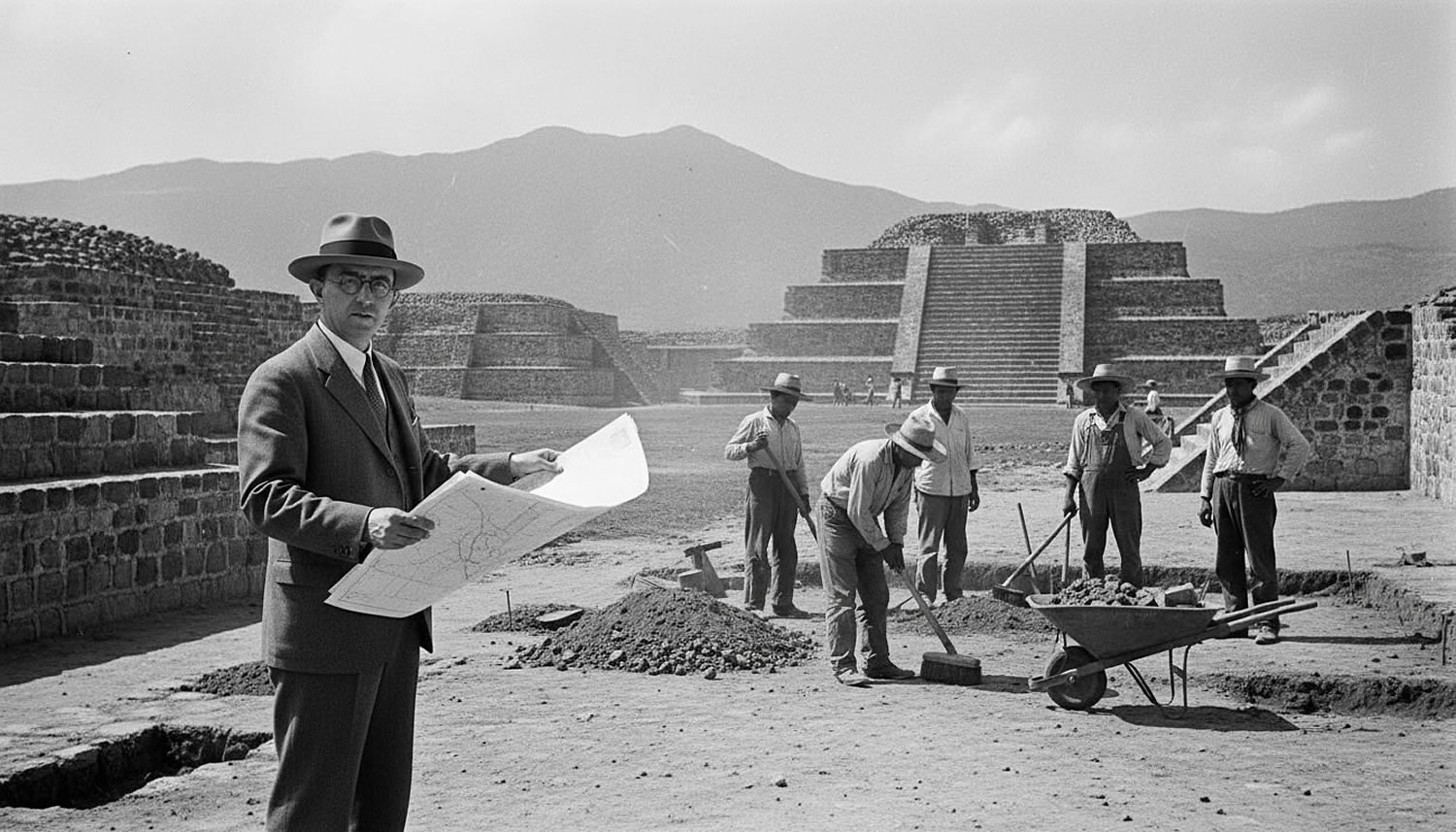
Alfonso’s journey to Monte Albán began in earnest around 1930, when he took on the role of directing excavations at the site. At the time, Monte Albán was a mysterious hilltop complex overlooking the valleys of Oaxaca, built by the Zapotec people centuries before the arrival of the Spanish. Previous explorers had noted its importance, but systematic work was needed. Alfonso, with his background from the Museo Nacional, was appointed to lead the project, drawing on government support to fund the efforts.
The excavations kicked off in 1931, and what started as a seasonal dig turned into a 20-year adventure. Alfonso’s team used innovative methods for the era, including careful mapping and detailed record-keeping. One of the highlights came in 1932 when they uncovered Tomb 7, a treasure trove of gold jewelry, intricate carvings, and offerings that revealed the wealth and artistry of the ancient inhabitants. This discovery put Monte Albán on the world map and solidified Alfonso’s reputation.
Living in Oaxaca during the digs, Alfonso immersed himself in the local culture, learning from Indigenous communities and incorporating their insights. He established the site’s chronology, dividing it into five phases that traced its development from around 500 BCE to the Spanish conquest. His work wasn’t just about digging; it was about protecting and restoring the monuments for future generations to appreciate.
Key Discoveries and Contributions
Beyond Tomb 7, Alfonso’s teams explored other sites in Oaxaca’s Mixteca region, like Yucuita and Monte Negro. He deciphered Mixtec codices, ancient painted books that told stories of kings and kingdoms. His books, such as “Las exploraciones de Monte Albán” and “Urnas de Oaxaca,” shared these findings with the world, blending facts with accessible narratives.
Alfonso also recognized the Olmec as Mesoamerica’s “mother culture” and proposed theories on Zapotec influence that, though debated at first, have stood the test of time. His interdisciplinary style helped paint a vivid picture of pre-Hispanic life, from calendars to religious practices. These contributions extended to education, where he taught courses that inspired a new generation of archaeologists during field trips to the site.
In leadership roles, he founded the Instituto Nacional de Antropología e Historia in 1939 and directed it, shaping Mexico’s approach to heritage preservation. Later, as rector of the National Autonomous University of Mexico, he championed academic freedom. His work with Indigenous issues through the Instituto Nacional Indigenista showed a commitment to living cultures as well.
Legacy in Oaxaca and Beyond
Alfonso Caso’s efforts transformed Monte Albán from a forgotten ruin into a UNESCO World Heritage site, drawing visitors from around the globe to experience Oaxaca’s rich history. The treasures from Tomb 7 now shine in the Regional Museum of Oaxaca, a testament to his careful work. He passed away on November 30, 1970, but his influence lives on in every stone uncovered and story told.
Today, when you walk the grand plazas of Monte Albán, you can feel the echo of Alfonso’s dedication. His life reminds us that curiosity and hard work can unlock the past, connecting us to the vibrant cultures that shaped Mexico. For anyone visiting Oaxaca, understanding his story adds a layer of warmth to the ancient stones.
Alfonso’s family continued his legacy, with his daughter Beatriz Caso becoming involved in cultural pursuits. Honors from institutions like the United States National Academy of Sciences recognized his global impact. In Oaxaca, his name is synonymous with the pride of Zapotec heritage.