How Do I Get to Hierve el Agua? Is It Open Right Now?
I check Hierve el Agua as part of Oaxaca Today, our live MAHC travel board for current closures, road conditions, transportation problems, and other issues that could affect your trip. If you want to know whether Hierve el Agua is open at the moment you are planning to go, check the latest completed update before leaving Oaxaca.
Check Hierve el Agua’s current status on Oaxaca Today →
The quick answer: how should you get to Hierve el Agua?
Hierve el Agua is about 70 kilometers east of Oaxaca City, above the community of San Isidro Roaguía in the municipality of San Lorenzo Albarradas. Distance makes it look close on a map. Mountain roads make it feel farther.
If you want the easiest day, hire a private driver. If you want simple logistics at a lower price, take a shuttle or group tour. If your priority is saving money and you do not mind waiting, take public transport through Mitla. If you are a confident mountain driver and want to combine several places at your own pace, renting a car works well.
What I would not do is treat Hierve el Agua as a quick half-day stop. Allow a full day from Oaxaca City unless you are using a direct private transfer and doing nothing else.
First: what exactly is Hierve el Agua?
The name means “the water boils,” but the water is not hot. Oaxaca’s tourism office places the spring water at approximately 22 to 25°C. The name comes from the bubbling appearance of the mineral springs where the water emerges from the ground.
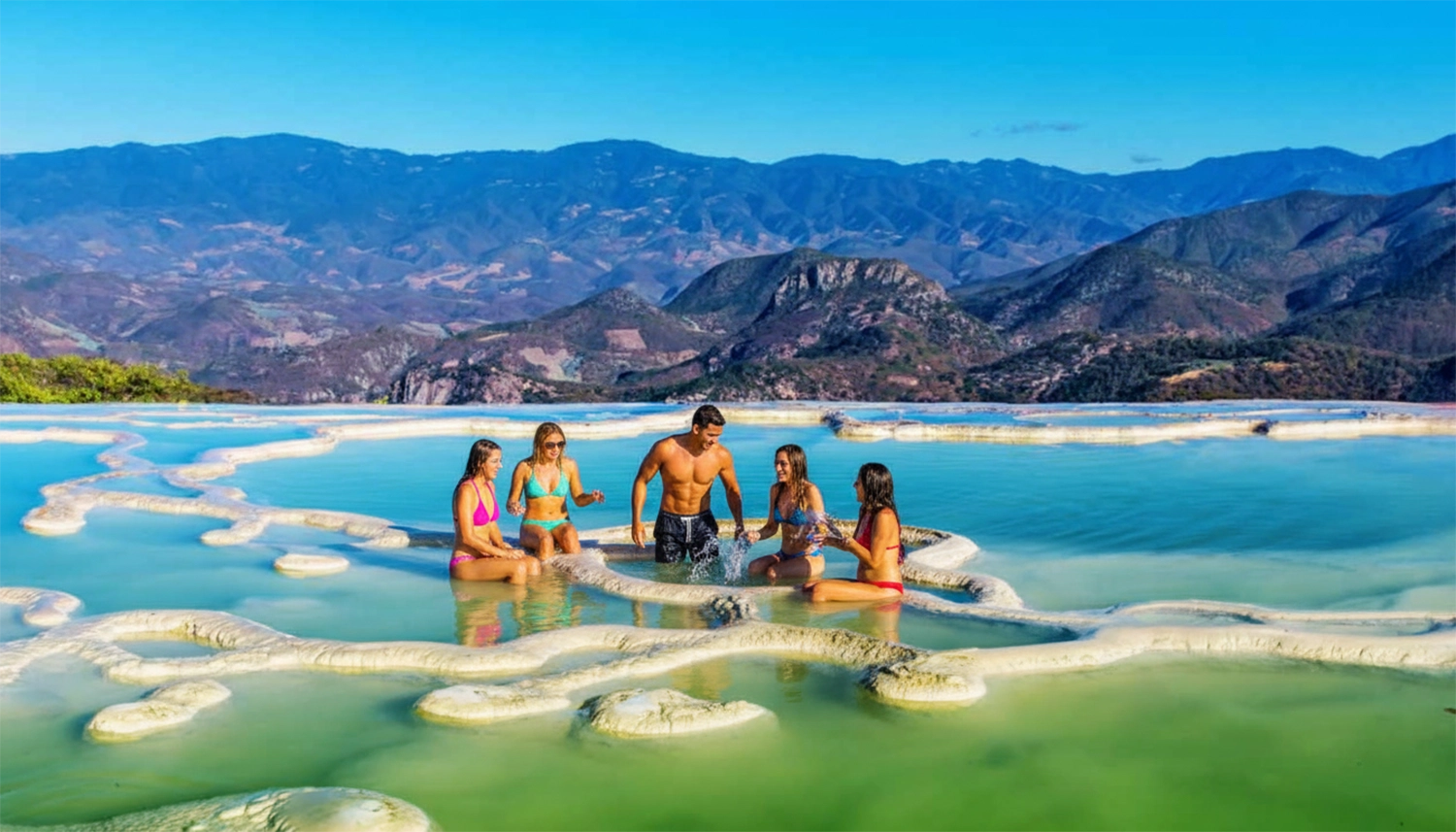
The famous “petrified waterfalls” are mineral formations. Carbonate-rich spring water has flowed over the cliffs for a very long time, depositing layer after layer of minerals until the cliff faces came to resemble enormous waterfalls frozen in stone. Oaxaca’s tourism authority identifies two principal formations, approximately 30 meters and 12 meters high.
At the top are the pools that appear in almost every photograph of Hierve el Agua. Some are naturally formed or modified mineral basins, and the views across the valley are extraordinary. You can swim in designated pools when conditions permit, but do not arrive expecting thermal baths. The water often feels cool.
Hierve el Agua is also an archaeological site
The geology gets most of the attention, but Hierve el Agua also contains an important pre-Hispanic hydraulic landscape of channels and terraces associated with ancient occupation of the area.
You will often hear these described simply as an ancient Zapotec irrigation system. That is one major archaeological interpretation, and research has proposed use of the hydraulic works beginning many centuries before the Common Era.
But the story is not completely settled. Other archaeological research has argued that the mineral-rich water would have been poorly suited to crops and that at least some of the terraces and channels may instead have been used to produce salt through solar evaporation.
The safest way to understand the site is therefore as an important pre-Hispanic hydraulic system whose precise functions have been debated. That makes Hierve el Agua more interesting, not less: people were actively shaping and using this unusual mineral landscape long before it became one of Oaxaca’s most photographed attractions.
Is Hierve el Agua open right now?
Yes, as of October 27, 2026. Current visitor reports show normal access.
But Hierve el Agua is not managed like a federal archaeological zone with a single national ticket office and rigid schedule. The site and access road involve local communities, and disputes between communities have caused closures in the past. Oaxaca can also experience road blockades unrelated to Hierve el Agua itself.
That is why an article saying “it is open” can never guarantee what will happen three months from now. Before leaving Oaxaca City, do one of these three things:
- Ask your hotel, local guide, or driver whether people entered that day or the day before.
- Check the most recent visitor reports from the last few days, not reviews from six months ago.
- Check whether current Hierve el Agua shuttles and tours are operating. If multiple operators are running the route normally, access is usually normal.
Opening hours: why different websites give different answers
This is one of the most confusing parts of planning Hierve el Agua. Current 2026 sources do not all publish the same opening hours.
Some locally focused listings and Google Maps currently show approximately 7:00 AM to 6:00 PM. TripAdvisor currently lists 9:00 AM to 5:00 PM. Oaxaca’s official tourism page describes the attraction and its services but does not publish a definitive daily timetable.
My recommendation is simple: treat 9:00 AM to 5:00 PM as your safe planning window unless you have confirmed broader hours locally. Do not organize an independent trip around arriving at 5:30 PM because one website says the gates close at six.
The best time to arrive is generally early in the day. The site becomes considerably busier once organized tours arrive, usually from late morning onward.
Current 2026 entrance fees and costs
One reason travelers report different “entrance prices” is that you normally pay more than once.
| Charge | Typical 2026 amount | What it is |
|---|---|---|
| San Lorenzo community road fee | About 20 MXN per person | Collected on the road toward Hierve el Agua |
| Hierve el Agua access | About 50 MXN per person | Entrance to the community-managed site |
| Parking | Roughly 50–150 MXN | Varies with vehicle type and current local rates |
| Local guide | Around 400 MXN per group | Optional; local community guides may guide inside the site |
These are locally controlled charges, so take extra pesos rather than arriving with exactly 70 MXN in your pocket. Bring cash and preferably small bills. Do not depend on finding an ATM, reliable card terminal, or strong mobile signal at the site.
Which transportation option is best?
| Option | Approximate cost | Best for | Main drawback |
|---|---|---|---|
| Private driver | Varies widely; transport-only can begin around 1,700 MXN, while full private guided days cost much more | Couples, families, photographers, maximum flexibility | Most expensive |
| Direct shuttle | Around 550 MXN round trip on a current direct service | Travelers who want Hierve el Agua without a five-stop tour | Fixed days and times |
| Group tour | Often about 400–750 MXN per person before admissions and meals | Solo travelers and first-time visitors | Less time and control at each stop |
| Public transport via Mitla | About 100–125 MXN each way before community entrance fees | Budget travelers | Waiting, rough pickup ride, long travel day |
| Rental car | Rental + fuel + community fees + parking | Independent travelers combining several valley stops | Mountain driving and road conditions |
Option 1: Private driver
If I wanted the smoothest possible day, this is the option I would choose.
You choose your departure time, avoid waiting for shared vehicles to fill, keep your belongings in one vehicle, and can decide whether you want to stop at Mitla, Teotitlán del Valle, a mezcal palenque, or the Tule tree.
Do not confuse a transport-only private driver with a full private guided tour. A simple round-trip driver may be quoted around the low thousands of pesos for the vehicle, while full-day private tours with guide, multiple stops and a dedicated vehicle can cost several thousand pesos more.
One important detail: outside tour guides may not necessarily guide you through the actual Hierve el Agua grounds. Local community guides handle guiding inside the site. Your driver or tour guide can still give you context before you enter.
Option 2: Direct shuttle or group tour
A direct shuttle is an excellent middle ground if Hierve el Agua is the only place you really care about. One current Oaxaca service advertises a 550 MXN round-trip shuttle with approximately three hours at the site, leaving on selected days. Admission is paid separately.
The classic group tours are different. They often combine Hierve el Agua with Mitla, Teotitlán del Valle, Santa María del Tule and a mezcal stop. Current 2026 examples begin around 400 MXN per person, while others run closer to 750 MXN or more depending on what is included.
Before booking, ask three questions:
- How much actual time do I get at Hierve el Agua?
- Are the community entrance fees included?
- Are the mezcal, textile, or restaurant stops optional experiences or long mandatory sales stops?
A five-stop tour is efficient, but it is not the same experience as spending three relaxed hours at Hierve el Agua.
Option 3: Public transport through Mitla
This is the cheapest independent route and it absolutely works, but you need to understand the second half of the trip.
- Oaxaca City to Mitla: take a second-class bus toward Mitla. Current 2026 reports place the fare at roughly 20–30 MXN. Buses can be boarded around the Eduardo Vasconcelos stadium area and from the second-class terminal/Central de Abastos area. A colectivo taxi to Mitla is faster and typically costs around 50 MXN.
- Mitla to Hierve el Agua: near the Mitla transport area, look for the shared pickup-style trucks going to Hierve el Agua. They typically leave when enough passengers have accumulated. Current fares are around 75 MXN per person each way.
- Community fees: expect the separate road and site charges on the way in.
- Return: do not wait until closing time to start thinking about transportation. Shared trucks become less predictable late in the day. Aim to begin your return by mid-to-late afternoon.
The shared vehicle from Mitla is often a modified pickup with bench seating in the rear. The final mountain road is winding and can be rough, dusty or bumpy depending on conditions.
This is a great budget adventure for independent travelers. It is less attractive for anyone with significant mobility problems, back problems, severe motion sickness, or a strong dislike of waiting in parking lots for strangers to fill the remaining seats.
Option 4: Rental car and self-driving
Driving yourself gives you the most freedom, particularly if you want to combine Hierve el Agua with Mitla, Teotitlán or another stop in the Tlacolula Valley.
The route follows the Oaxaca-Mitla corridor before climbing toward San Lorenzo Albarradas and San Isidro Roaguía. The final mountain section is narrow and curving, and road surfaces can change. Expect rough patches, potholes, dust, fog or rain depending on the season.
The payments along this route that travelers often call “tolls” are primarily community access and road fees, not ordinary federal highway tolls.
Download the route offline before leaving Oaxaca City. Cell coverage becomes unreliable in the mountains. Leave early and try to complete the mountain section in daylight.
How much time do you actually need at Hierve el Agua?
I would allow at least two to three hours at the site.
That gives you time to see the upper pools, walk the mineral terraces, take photographs, look across the valley and explore some of the trails. If you want to descend toward the lower viewpoints, swim and eat, three hours is much more comfortable than ninety minutes.
The descent toward the lower views of the petrified waterfall is optional. The trail is steeper, rockier and more exposed than the easy walking around the upper area. Remember that every meter you walk down has to be climbed again.
Can you swim?
Yes, swimming is normally permitted in designated pools when local conditions allow it.
But again: this is not a hot spring spa. The water is roughly 22–25°C and can feel quite cool, particularly on a cloudy or windy mountain day.
Respect all posted conservation rules. Local authorities have restricted creams and lotions in the pools to protect the mineral water, so do not assume you can cover yourself in sunscreen and immediately jump in. Use a hat and sun-protective clothing, and follow whatever instructions are posted at the pools that day.
Accessibility and safety
The upper part of Hierve el Agua is much easier than the lower hiking route, but this is still a natural mineral landscape with uneven surfaces. It is not a fully accessible paved attraction.
The lower trail includes steep and irregular terrain and is not appropriate for every visitor. You can still enjoy major views and the pool area without completing the full descent.
Around the cliff edges and mineral terraces, use common sense. Rocks can be slick when wet, there are exposed drops, and the midday sun can be strong even when mountain air feels cool.
Do not count on strong mobile service. If you arrive with a private driver, agree on your meeting point and return time before separating.
What to bring
- Cash in small bills: for community fees, food, bathrooms, guides and transportation.
- Water: especially if you plan to hike below the pools.
- Hat and sun protection: there is little shade on parts of the terraces.
- Good shoes: the mineral surfaces and trails can be uneven or slippery.
- Swimsuit and towel: if you want to enter the pools.
- Light layer: mountain weather can be cooler and windier than Oaxaca City.
- Offline maps and saved contact numbers: mobile signal is unreliable.
- Motion-sickness medication if needed: the climb from Mitla has plenty of curves.
Should you combine Hierve el Agua with Mitla?
Yes. Of all the possible combinations, Hierve el Agua + Mitla makes the most sense geographically and culturally.
Mitla sits on the route and gives you one of Oaxaca’s most important archaeological sites, with its extraordinary geometric stone mosaics. Hierve el Agua gives you an entirely different landscape of geology, archaeology and community management.
If you have a private driver, you can also add Teotitlán del Valle or a mezcal producer without turning the entire day into a race. With public transportation, I would keep the plan simpler. Hierve el Agua plus Mitla is already a substantial day.
My recommendation
If this is your first visit to Oaxaca and your budget allows it, I would choose a private driver or a direct shuttle rather than spending a large part of the day negotiating transportation.
If budget matters more than comfort, the Mitla bus plus shared pickup is completely workable. Just leave Oaxaca early, carry cash and do not make your return dependent on the last possible vehicle of the day.
Most importantly, do not visit Hierve el Agua only for the Instagram pool. Walk far enough to actually see the petrified cascades. Look at the channels in the landscape. Notice the extraordinary mineral deposits. Give yourself time to understand why people were using and modifying this place long before tourists ever arrived.
That is when Hierve el Agua becomes much more than a beautiful swimming hole.