

Why is the Ethnobotanical Garden in Oaxaca so special?

A garden that challenges first impressions
Many visitors arrive expecting the familiar script of a botanical garden: bright flower beds, manicured lawns, and easy beauty. The Jardín Etnobotánico de Oaxaca often does the opposite. From outside the walls and even along its internal paths, it can feel austere at first, full of spines, stones, and plants that do not compete for attention in the way tropical ornamentals do.
That initial disorientation is not a design flaw. It is the point. The garden is an ethnobotanical space, meaning its central subject is the relationship between people and plants: how Oaxacans have used native species for food, medicine, construction, dyes, ritual, and everyday survival across millennia. In a city famous for its cuisine, crafts, and ancient history, this garden acts like a living index of where those traditions begin.
A landscape of civic memory and resistance
The garden’s importance starts with the ground itself. The site sits directly behind the Templo de Santo Domingo de Guzmán, within the historic Santo Domingo complex. For centuries, the area served practical functions connected to the former monastic grounds, and later it was occupied by the Mexican military for more than 120 years.
When the military vacated the space in the early 1990s, proposals emerged for private, high-capital redevelopment. The project that ultimately prevailed was driven by civil society, including the Oaxacan artist Francisco Toledo and the civic organization PRO-OAX, with a vision centered on cultural and natural heritage rather than asphalt and exclusivity. In other words, the garden was a public victory before it was a garden in the botanical sense.
This backstory matters when you walk through the gates. You are not simply entering a curated plant collection. You are stepping into a reclaimed civic space that reframed what the center of Oaxaca City could be: a place where history, conservation, and public access win against short-term development pressure.
Design that reveals history instead of covering it
The garden’s design is frequently described as subtle, but it is anything but simple. Rather than constructing new monuments, the garden integrates uncovered traces of older infrastructure, including channels and stonework tied to earlier phases of the site’s use. This creates a setting where the built environment is meant to recede so that the story can surface.
The landscape language also speaks in Oaxacan geometry. Step-fret motifs associated with Mitla appear as rhythms in paths and water features, turning movement through the garden into a kind of reading. Instead of signage-heavy interpretation, the space communicates through pattern, placement, and guided storytelling. It is a garden that asks you to slow down and notice why a plant is planted here, and why a line turns there.
A compact microcosm of Oaxaca’s biodiversity
One reason the Jardín Etnobotánico is celebrated internationally is that it compresses an enormous range of Oaxacan environments into a small urban footprint. The garden is widely cited as covering 2.3 hectares and presenting a concentrated view of the state’s native flora. Visitors encounter desert-adapted cacti and agaves, alongside species associated with more humid regions of Oaxaca, making the walk feel like a botanical journey across landscapes.
Ethnobotany gives this diversity a human spine. In Oaxaca, plants are not only “nature,” they are cuisine, craft, trade, and medicine. Agaves connect directly to mezcal culture. Nopal and cochineal speak to historic dye economies. Medicinal herbs reflect living knowledge systems that still circulate through markets and households. The garden’s best moments come when you realize you are looking at a living library of daily life, not a decorative collection.
Where agriculture in the Americas becomes visible
Few gardens can honestly claim to be an entry point into the origins of agriculture. The Oaxaca Valley can. Near Mitla, Guilá Naquitz cave has yielded some of the earliest known evidence of domesticated plants in the Americas, including very early squash remains and some of the earliest documented evidence associated with maize domestication. This is not a distant, abstract story for Oaxaca; it is part of the region’s deep timeline.
The garden interprets that legacy by foregrounding culturally foundational plants as meaningful artifacts. When you see ancestral gourds, corn relatives, or other staples presented without theatrical decoration, you are being asked to see them as historical infrastructure. These plants made settlement possible, shaped cuisines, and supported the growth of civilizations that later built places like Mitla and Monte Albán.
Art, cochineal, and the fountain that turns history red
Visitors who expect “spectacle” often find it in one of the garden’s most striking works: La Sangre de Mitla, a fountain designed by Francisco Toledo. Water moves across a monumental surface and is tinted red using cochineal, the insect-based dye historically produced from insects that live on nopal cactus. The effect is unmistakable, and it is not simply decorative.
Cochineal was one of the great economic engines of colonial-era Mexico. Across different accounts of the period, it is consistently described as among the most valuable exports from New Spain, often noted as second only to silver in importance. It was prized internationally for producing an intense, stable red used in European textiles and art, and it became deeply entangled with wealth, status, and empire. In the context of Santo Domingo and its surrounding history, the fountain reads like a reminder that local biodiversity and labor helped finance colonial splendor.
Why the guided tour is part of what makes it special
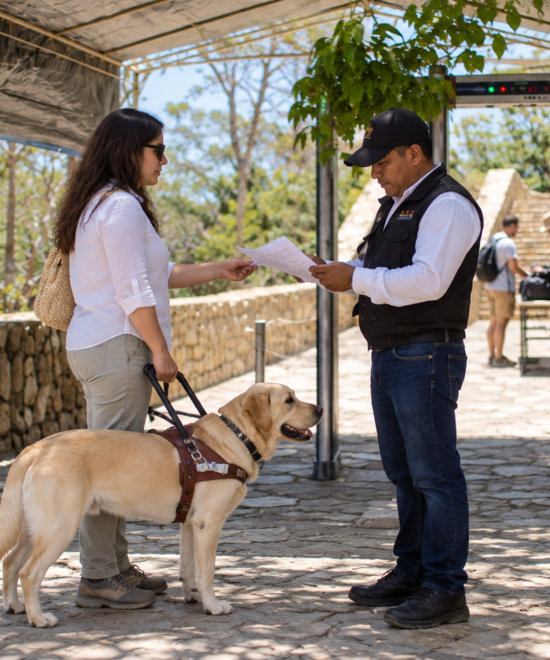
The garden is famous for requiring guided visits, and it is easy to see why some travelers hesitate. Yet the guided format is one of the clearest expressions of the garden’s mission. Without heavy signage, the space stays visually calm. The interpretation is carried orally, like a conversation, connecting scientific names to cultural uses, regional histories, and living traditions.
A plant that looks like a thorny sculpture might be explained as a “living fence” tradition, a food source, a medicine, or a dye. A cactus bed might become a story about rescued plants moved from threatened sites. In practice, the guide turns the garden from a quiet collection into a vivid narrative about Oaxaca itself, told through texture, ecology, and memory.
A garden that looks forward
Although it is rooted in history, the Jardín Etnobotánico is not a nostalgic project. Its conservation work, propagation efforts, and educational mission point toward the future of Oaxaca’s biocultural heritage. Accounts of the garden’s infrastructure highlight sustainability features such as solar energy and a greenhouse designed to support plant communities that do not naturally thrive in the city’s climate, using strategies like geothermal cooling rather than conventional air conditioning.
In that sense, the garden is special for a final reason: it models what a modern urban heritage site can be. It is not only about preserving an image of the past, but about keeping relationships alive: between landscapes and cities, between people and plants, and between knowledge and the next generation of visitors who arrive curious enough to look past first impressions.