

The Zapotec Language - Origins and what makes it different
More than a single language
Zapotec is not one uniform language but a diverse family of tonal languages rooted in Oaxaca, shaped by mountain geography, ancient writing, and the living identities of dozens of communities.
Visitors often hear the phrase "the Zapotec language," but this convenient label hides a remarkable level of diversity. Mexico's National Institute of Indigenous Languages recognizes 62 Zapotec linguistic variants, and speakers from distant communities may not understand one another without using Spanish. For that reason, linguists often describe Zapotec as a language continuum or a closely related group of languages rather than a single standardized tongue.
The name Zapotec is also an external label with roots in Nahuatl and colonial Spanish. Individual communities frequently use local names for their own speech, including forms such as Diidxazá, Didza Xidza, and many others. These names reflect an important reality: each variety belongs to a particular community, landscape, and history.
Deep roots in the Oto-Manguean family
Zapotec belongs to the Oto-Manguean language family, one of the oldest and most internally diverse language families in Mesoamerica. Its distant ancestors were spoken thousands of years ago, possibly among early agricultural communities living between the valleys of Puebla and Oaxaca. Reconstructed vocabulary connected with maize suggests that these languages developed alongside some of the earliest farming traditions in the region.
Within the Oto-Manguean family, Zapotec is closely related to Chatino. Linguists estimate that their common ancestor began dividing into separate branches roughly three thousand years ago. From that point, generations of migration, local innovation, and contact with neighboring peoples gradually produced the many Zapotec varieties heard today.
How Oaxaca's landscape shaped its diversity
Oaxaca's geography helps explain why Zapotec became so varied. The state is crossed by steep mountain ranges, narrow valleys, river basins, and isolated highland communities. Before modern roads and transportation, villages separated by only a modest distance could have limited contact for generations.
Over time, pronunciation, vocabulary, and grammar developed differently from one valley to another. Varieties spoken in the Sierra Norte, the Central Valleys, the Sierra Sur, and the Isthmus of Tehuantepec now preserve distinct linguistic histories. This diversity is not evidence of a language breaking down. It is evidence of communities adapting their speech to their own social worlds over centuries.
Tone, voice, and powerful sound contrasts
One of the most noticeable differences between Zapotec and languages such as English or Spanish is tone. In many Zapotec varieties, changing the pitch of a syllable can change the meaning of a word or mark a grammatical distinction. Some varieties use high, low, and rising tones, while others have more elaborate systems involving several tones and complex combinations.
Vowels may also be pronounced with different voice qualities. A vowel can be spoken normally, interrupted by a glottal closure, or produced with a creaky or rearticulated sound. Consonants often contrast through a system known as fortis and lenis. Fortis sounds are generally longer or stronger, while lenis sounds may be shorter, voiced, or more softly articulated.
These features give Zapotec languages a rich sound structure. They also make careful listening essential, since a difference that seems subtle to an unfamiliar ear can completely change meaning for a fluent speaker.
A different way of building sentences
Many Zapotec varieties usually place the verb before the subject and object. A basic sentence may therefore follow a Verb-Subject-Object pattern rather than the Subject-Verb-Object order common in English and Spanish. Speakers can adjust this order to highlight a topic or emphasize particular information.
Zapotec verbs carry a great deal of grammatical information. Prefixes can indicate whether an action is completed, habitual, possible, ongoing, or in a particular state. In some verbs, the beginning of the root itself changes according to the grammatical form being expressed. This tightly organized verbal system is one of the features that makes Zapotec grammar especially distinctive.
From spoken language to carved stone
The history of Zapotec is inseparable from the history of writing in ancient Oaxaca. A carved monument from San José Mogote, dating to the late seventh or sixth century BCE, contains one of the earliest known examples of writing in Mesoamerica. The image combines a defeated figure with a calendrical name, showing that writing was already connected with identity, political power, and public memory.
At Monte Albán, Zapotec rulers expanded this tradition through carved monuments, calendrical signs, personal names, and records of conquest. The inscriptions used both symbols representing ideas and signs connected with spoken sounds. Although the script has not been completely deciphered, scholars have identified elements that reflect Zapotec vocabulary and sentence structure.
For modern visitors, these carvings create a direct connection between language and place. The stones of Monte Albán were not silent decoration. They communicated names, dates, authority, ancestry, and political history to the people who gathered in the city's plazas.
A living language of modern Oaxaca
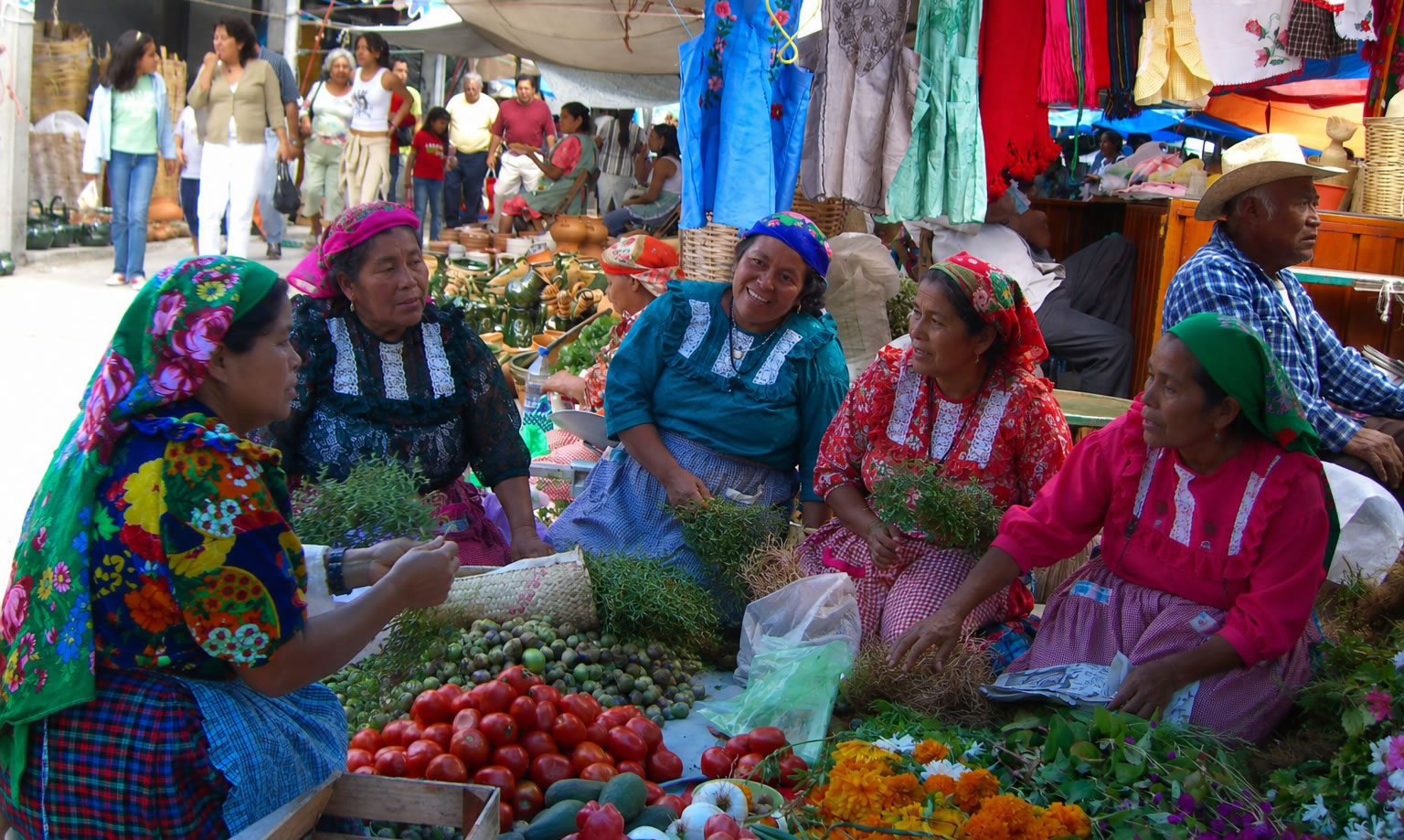
According to Mexico's 2020 census, 490,845 people aged three and older reported speaking a Zapotec language. Most also speak Spanish, but thousands remain primarily or exclusively Zapotec speaking. The overall number is substantial, yet the situation differs greatly among communities. Some varieties maintain active use across generations, while others are now spoken mainly by older adults.
Community teachers, writers, musicians, researchers, and families are responding through language classes, books, recordings, digital media, and locally created educational materials. These efforts recognize that protecting Zapotec means more than preserving vocabulary. It means supporting the right of each community to transmit its own voice, knowledge, and understanding of Oaxaca to future generations.