


Digital Nomads in Oaxaca: what you need to know and is it a viable option
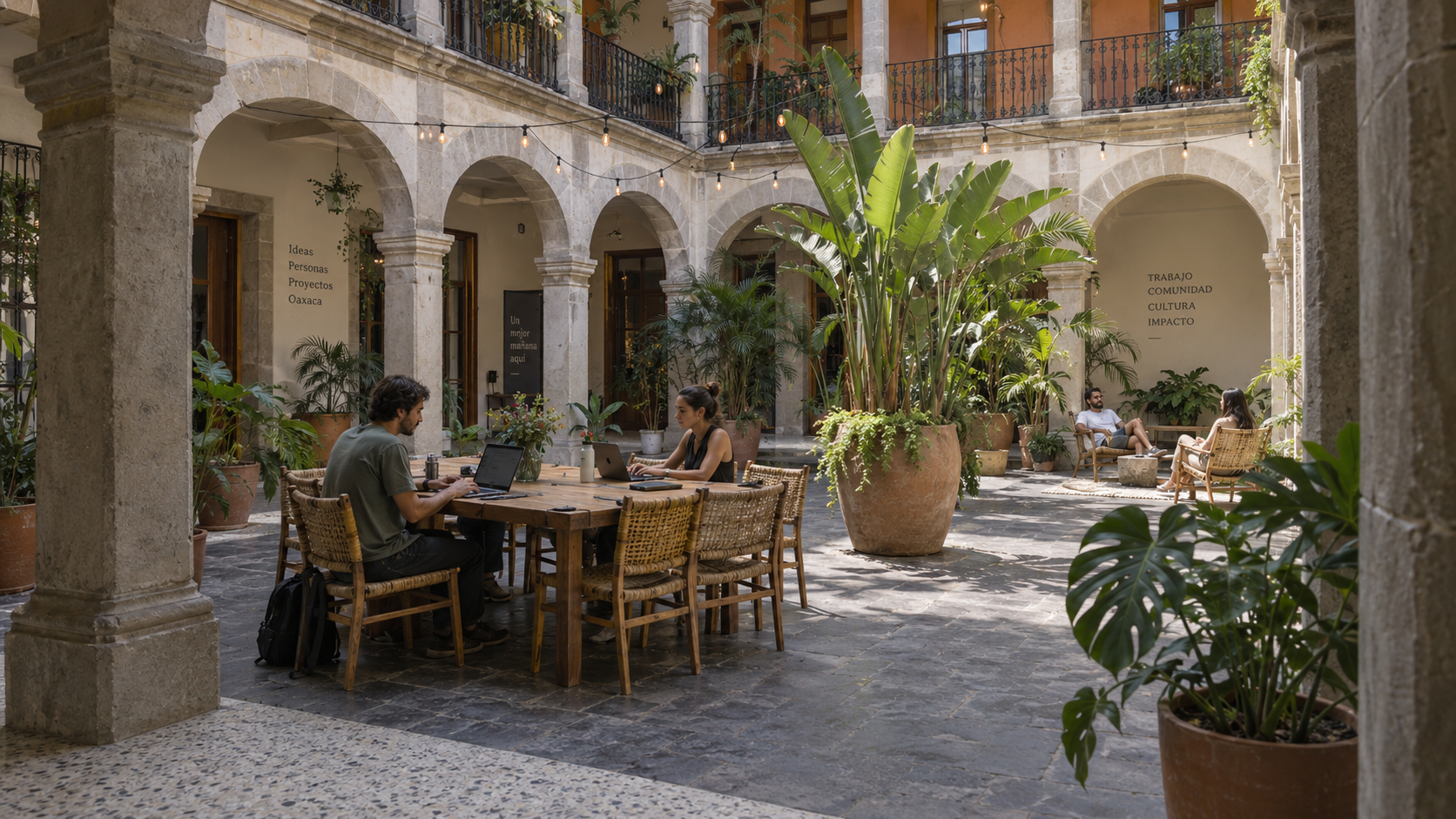
Is Oaxaca a good place for digital nomads?
Oaxaca can be an excellent base for digital nomads, but reliable internet, housing costs, water availability, immigration rules, and the impact of tourism on local communities all deserve careful consideration before making the move. Oaxaca de Juárez offers a rare combination of cultural life, extraordinary food, a walkable historic center, nearby archaeological sites, and an expanding infrastructure for people who work online. At the same time, it is not a destination where every apartment automatically has fast internet or uninterrupted municipal services.
For someone prepared to choose accommodation carefully and adapt to local conditions, Oaxaca is certainly viable for remote work. It is particularly attractive for people who value culture and daily life outside a conventional resort environment. The important point is to arrive understanding that Oaxaca is a living city and not simply an inexpensive office with good weather.
- Internet: Good connections are available, but quality varies significantly between buildings.
- Coworking: Oaxaca has an established and growing coworking culture.
- Cost: It can still be affordable by international standards, although central housing has become considerably more expensive.
- Culture: Few remote-work destinations offer the same concentration of food, history, markets, festivals, crafts, and archaeological heritage.
- Infrastructure: Water distribution can be irregular, especially during the dry season.
- Long stays: Immigration and tax questions deserve attention before turning a short visit into a long-term move.
Why Oaxaca attracts remote workers
The attraction begins with the city itself. Oaxaca's historic center and the archaeological site of Monte Albán have been jointly recognized as a UNESCO World Heritage Site since 1987. The city remains a center of economic, cultural, religious, and social activity, with markets, museums, galleries, churches, restaurants, workshops, and public plazas concentrated within a relatively compact area.
That compactness makes daily life convenient for people without a car. A remote worker can often walk to a cafe, market, restaurant, gym, or coworking space and still have access to destinations such as Monte Albán, artisan communities in the Central Valleys, and nearby mezcal-producing areas on days off. Oaxaca also offers something harder to quantify: everyday contact with traditions that are still very much part of contemporary local life rather than attractions created specifically for visitors.
Internet and coworking: check before you book
Internet infrastructure has improved considerably in parts of Oaxaca City. Dedicated coworking facilities and some recently renovated accommodations offer fiber connections suitable for video meetings, cloud-based work, and large file transfers. The problem is inconsistency. A connection that works extremely well in one building may be substantially slower only a few blocks away.
If your income depends on staying online throughout the workday, do not choose accommodation based only on a listing that says "Wi-Fi included." Ask for a recent speed test from the exact room or apartment. It is also sensible to arrive with a backup plan, such as a Mexican mobile data connection that can be used as a hotspot if the main service fails.
Coworking spaces can reduce much of this uncertainty. Modern spaces in Oaxaca increasingly provide high-speed internet, meeting areas, ergonomic desks, and private booths for calls. They also give newcomers an easy way to meet other remote workers without having to turn a neighborhood cafe into an eight-hour office.
- Request an actual internet speed test before booking long-term accommodation.
- Ask whether the connection is fiber, cable, satellite, or mobile based.
- Check whether there is backup power or backup internet if your work is time sensitive.
- Keep mobile data available for important meetings.
- Use a coworking space for work that requires dependable bandwidth or privacy.
How much does it cost to live in Oaxaca?
Oaxaca is often described as inexpensive, but that description needs context. A visitor earning in US dollars, euros, or pounds may find everyday expenses relatively affordable. A furnished property marketed specifically to foreign visitors, however, can cost far more than a comparable long-term local rental. Prices also rise sharply in the historic center and other neighborhoods popular with international visitors.
As a broad planning estimate rather than a fixed price guide, a single remote worker may spend approximately $1,200 to $2,500 USD or more per month depending on accommodation, eating habits, coworking needs, transportation, and travel. People renting locally and cooking regularly can spend less. Someone choosing premium furnished accommodation, frequent restaurant meals, private transportation, and organized excursions can easily spend more.
| Expense | Planning range per month | What affects the price |
|---|---|---|
| Accommodation | $500 to $1,200+ USD | Location, lease length, furnishings, utilities, and short-term rental premiums |
| Coworking | $100 to $400+ USD | Hot desk, dedicated desk, meeting space, or private office |
| Food and groceries | $200 to $600+ USD | Local markets and cooking versus frequent restaurant dining |
| Transport, phone, and daily expenses | $150 to $300+ USD | Walking, taxis, mobile data, fitness, deliveries, and personal habits |
These figures should be treated as budgeting guidelines, not guaranteed market rates. Housing and hospitality prices change quickly, particularly around major events and holiday periods.
Housing and the gentrification question
Housing is one of the most sensitive parts of the digital nomad conversation in Oaxaca. Residents, journalists, and local authorities have raised concerns about gentrification, tourism pressure, rising rents, and the conversion of residential properties into short-term visitor accommodation. These concerns are especially visible in areas close to the historic center, where demand from tourists and international residents is strongest.
A responsible long-term visitor can reduce some of that pressure through everyday choices. Consider hotels, guesthouses, purpose-built coliving properties, or rentals where there is no indication that established tenants have been displaced to create tourist accommodation. Spending money at neighborhood markets, independent restaurants, family businesses, and local service providers also distributes the economic benefits of a stay more widely.
- Compare several housing options instead of immediately booking the most visible short-term rental.
- Learn enough Spanish to handle everyday interactions respectfully.
- Buy from local markets and locally owned businesses when practical.
- Remember that local wages are very different from international remote-work salaries.
- Treat residential neighborhoods as communities rather than tourist zones.
Water is a real consideration
Water availability is an issue that remote workers should understand before arriving. Oaxaca has experienced serious supply problems, particularly during periods of drought and the dry season. In 2024, the state government introduced emergency measures including mobile water tanks and tanker deliveries to support neighborhoods affected by shortages.
Conditions have improved in some areas. In 2025, Oaxaca's water authority reported a substantial reduction in neighborhoods classified as critically undersupplied following new wells, rehabilitation work, and other infrastructure improvements. Even so, scheduled distribution, storage tanks, cisterns, and water trucks remain part of everyday water management in parts of the metropolitan area.
For a digital nomad, this means asking accommodation providers how water is stored and supplied, rather than assuming continuous municipal pressure. It also means using water carefully. Shorter showers, reasonable laundry habits, and avoiding unnecessary consumption are simple ways visitors can adapt to local conditions.
Visas and longer stays
Mexico does not currently have a visa formally called a digital nomad visa. The official visitor category without permission to undertake remunerated activities allows stays of up to 180 days, subject to immigration requirements. Because the rules are framed around the type of activity and remuneration, anyone intending to work remotely from Mexico should confirm how the rules apply to their particular employment arrangement with a Mexican consulate before traveling.
People intending to remain in Mexico for more than 180 days may consider temporary residency. This status is intended for stays longer than 180 days and up to four years. Financial solvency requirements apply and can change, so applicants should check the current requirements of the consulate where they plan to apply rather than relying on figures published in older travel articles.
Do not assume there is a simple 183-day tax rule
Taxation is another area where online advice can be misleading. Mexican fiscal residence is not determined simply by counting 183 days. Article 9 of Mexico's Federal Tax Code considers whether a person has established a home in Mexico and, when a person also has a home in another country, where that person's center of vital interests is located.
Factors can include whether more than half of annual income comes from Mexican sources and whether Mexico is the principal center of professional activities. Individual circumstances and tax treaties can make the situation more complicated. Anyone planning to live and work from Oaxaca for a significant period should obtain advice from a qualified professional familiar with both Mexican taxation and the tax system of their home country.
Healthcare and everyday practicalities
Oaxaca City has private doctors, clinics, pharmacies, dental services, and hospitals, making routine medical care reasonably accessible for visitors. More complex specialist treatment may sometimes require travel to a larger medical center. International health insurance or travel medical coverage is therefore worth considering for anyone staying for an extended period.
Visitors should also remember that tap water is generally not used for drinking. Purified water is widely available in large refillable containers known as garrafones. Normal city precautions are sensible as well, including watching personal belongings in crowded areas and using established transportation options at night.
So, is Oaxaca a viable digital nomad base?
Yes, for many remote workers it is. Oaxaca offers coworking infrastructure, increasingly strong internet options, excellent food, a compact urban core, and access to one of Mexico's most culturally significant regions. A person with dependable accommodation, confirmed internet access, a backup mobile connection, and a realistic budget can work comfortably from the city for weeks or months.
It is less suitable for someone expecting completely predictable infrastructure or assuming that every service will operate exactly as it does in a major North American or European city. Water schedules, occasional internet interruptions, traffic, festivities, street noise, and the rhythms of everyday Oaxacan life are part of the experience.
The strongest reason to choose Oaxaca is not simply that living costs may be lower. It is the possibility of spending meaningful time in a city connected to thousands of years of regional history while participating in a vibrant contemporary culture. Remote workers who arrive prepared, respect local communities, conserve resources, and engage with Oaxaca beyond the international visitor bubble are far more likely to find it a rewarding place to live and work.
- Choose Oaxaca if: culture, food, history, walkability, and a slower rhythm matter to you.
- Prepare carefully if: your job requires uninterrupted video calls or large daily data transfers.
- Budget realistically: central furnished housing is no longer uniformly inexpensive.
- Check your status: immigration and tax obligations become more important as a stay becomes longer.
- Be considerate: water conservation and responsible housing choices matter in Oaxaca.


