


Introducing the MAPSA Registry: A New Epigraphy Platform for Monte Albán Researchers
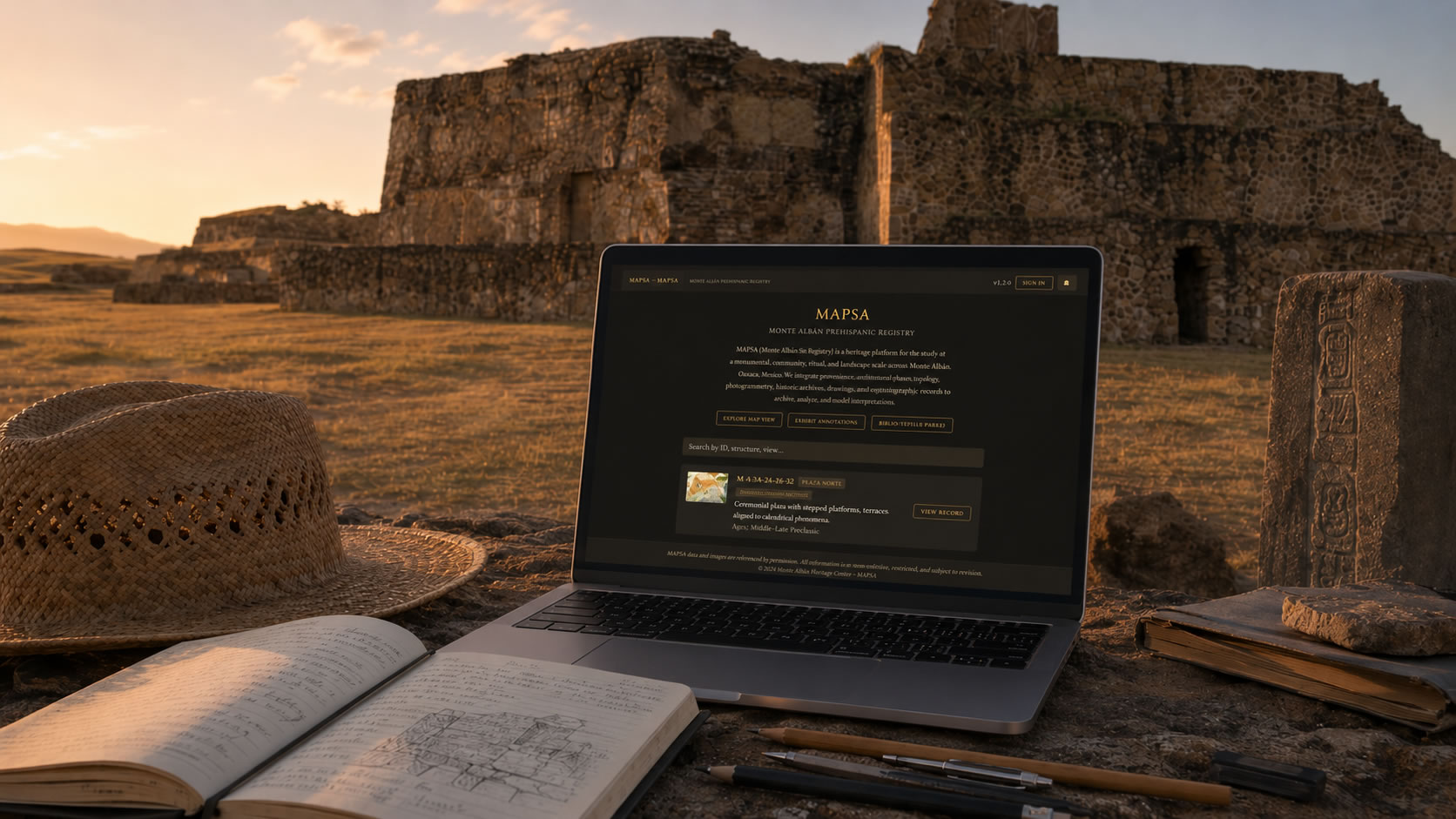
A new chapter for Monte Albán research
I am excited to introduce the MAPSA Registry, a first of its kind digital scholarly platform created to document, analyze, and discuss the carved inscriptions of Monte Albán. For me, this project represents one of the most meaningful steps we can take toward making the study of Monte Albán’s inscriptions more visual, more collaborative, and more transparent. It brings together field documentation, high-resolution photography, careful tracing, scholarly interpretation, and citation tools in one shared digital space.
Monte Albán has always inspired deep curiosity. From its position above the Valley of Oaxaca to its carved monuments and architectural planning, the site continues to invite new questions about early urban life, political organization, and writing in Mesoamerica. The MAPSA Registry is being built to support that curiosity with a new kind of research environment, one where close looking and scholarly discussion can happen side by side.
Why this project matters
The idea behind MAPSA began with a simple but important problem. The inscriptions on Building J’s conquest slabs and other carved monuments at Monte Albán have been studied for nearly a century, but researchers have not had a shared visual workspace where they can examine the same photograph, identify the same carved forms, compare interpretations, and cite each other’s work at the level of individual elements. MAPSA was created to help solve that problem.
Until now, much of the discussion around these inscriptions has depended on published drawings, photographs, diagrams, and numbering systems that are not always aligned. One researcher may be referring to a line drawing from one publication, while another may be studying a photograph taken under different lighting conditions. That can make scholarly disagreement more difficult than it needs to be. MAPSA gives researchers a common visual reference, so when someone discusses a carved element, everyone can know exactly which part of the inscription is being examined.
How the MAPSA Registry works
The registry treats each inscription as a record. A record is a single carved surface documented with site photography, traced contour overlays, and structured metadata. Within each record, the carved surface is divided into identifiable elements, meaning the visible shapes, lines, and forms that appear on the stone. Each element can be numbered, described, reviewed, and connected to annotations or proposed scholarly groupings.
One of the most important parts of the system is that it separates what is observed from what is interpreted. The photograph is the base layer. Traced contour overlays sit above it and make carved lines easier to see, especially on eroded surfaces. Where part of the original carving may have been damaged, inferred reconstructions can appear as a separate toggleable layer that is clearly marked as interpretive rather than evidential.
A platform built for uncertainty
What excites me most about MAPSA is that it does not try to hide uncertainty. In the study of ancient inscriptions, uncertainty is not a weakness. It is part of the evidence. A carved line may be damaged, a surface may be eroded, or two scholars may agree on the shape of an element while disagreeing about whether it belongs to a larger sign cluster. MAPSA was designed to preserve those distinctions instead of flattening them into a single final answer.
A researcher can agree with a segmentation but disagree with a grouping. Another researcher can accept a grouping but propose a different reading. Multiple competing interpretations can coexist in the same record, with each one attributed to a specific scholar or publication. This makes the registry more than a digital archive. It becomes a living scholarly workspace where interpretations can be compared, challenged, refined, and cited responsibly.
The interactive viewer
The MAPSA viewer is being designed to make close visual study easier and more intuitive. On desktop, hovering over the photograph highlights individual elements with a glow effect. Clicking an element locks the selection and opens its description, confidence level, preservation notes, and related annotations in the sidebar. Established scholarly groupings appear as a browsable grid, allowing users to highlight several related elements at the same time.
On mobile, the same functionality works through tap selection and pinch-to-zoom. This is important because access matters. A graduate student, a visiting researcher, or someone beginning to explore Zapotec epigraphy should be able to approach the material clearly, without needing to reconstruct decades of scholarship from scattered publications before they can begin asking good questions.
Where the project stands now
The first record in the registry is MA-BJ-NW-SLAB-02, a conquest slab on the northwest face of Building J. It is currently in active development with 29 identified elements, 8 established scholarly groupings based on Javier Urcid’s standard format diagram, and the full overlay system operational. This first record is the foundation for a much larger registry that can grow across the Building J corpus and eventually expand to other inscription clusters at Monte Albán.
I also want to be clear about the timeline. The MAPSA Registry is not expected to be ready for public use until around Christmas 2026. That time is important because this project deserves careful review, testing, and refinement before it is shared more widely. We are continuing to strengthen the visual layers, improve the annotation workflow, review the scholarly groupings, and make sure the platform is as responsible as the inscriptions themselves require.
MAPSA is being developed by the Monte Albán Heritage Center, with site photography and field documentation conducted on the ground in Oaxaca. The platform is built with a modern digital infrastructure using Next.js, Supabase, and Vercel, with the database designed to support future institutional access. My long-term goal is for MAPSA to become a serious research tool and a welcoming starting point for students, scholars, and readers who want to understand how Monte Albán’s inscriptions are studied.
What MAPSA is, and what it is not
It is important to say that MAPSA does not claim to decipher or translate the inscriptions. That work belongs to the epigraphers, archaeologists, and specialists who study these monuments. What MAPSA does is document, segment, organize, and make scholarly readings easier to compare. It gives researchers a structured space where evidence and interpretation can remain connected, but not confused with one another.
For me, that distinction is essential. MAPSA is not about replacing the scholar. It is about giving scholars, students, and institutions a better tool for working with complex visual evidence. It helps preserve uncertainty, creates a shared reference point, and makes the Building J corpus more accessible to the next generation of researchers.
Looking ahead
I am proud of what the MAPSA Registry is becoming, and I am even more excited for what it can become after launch. Around Christmas 2026, my hope is to begin opening the door to a new way of engaging with Monte Albán’s inscriptions, one that is careful, transparent, interactive, and grounded in Oaxaca. This is a project built with respect for the site, for the scholarship that came before it, and for the researchers who will continue asking questions in the future.
Monte Albán has always asked us to look closely. MAPSA is my way of helping us look together. I believe this registry can become an important bridge between field documentation, digital humanities, archaeological research, and public access. Most of all, I believe it can help make the study of these extraordinary carved stones more open, more precise, and more collaborative than ever before.


