


The Tapetes de Arena of Oaxaca: The Ephemeral Sand Art of Día de Muertos
The Short Answer
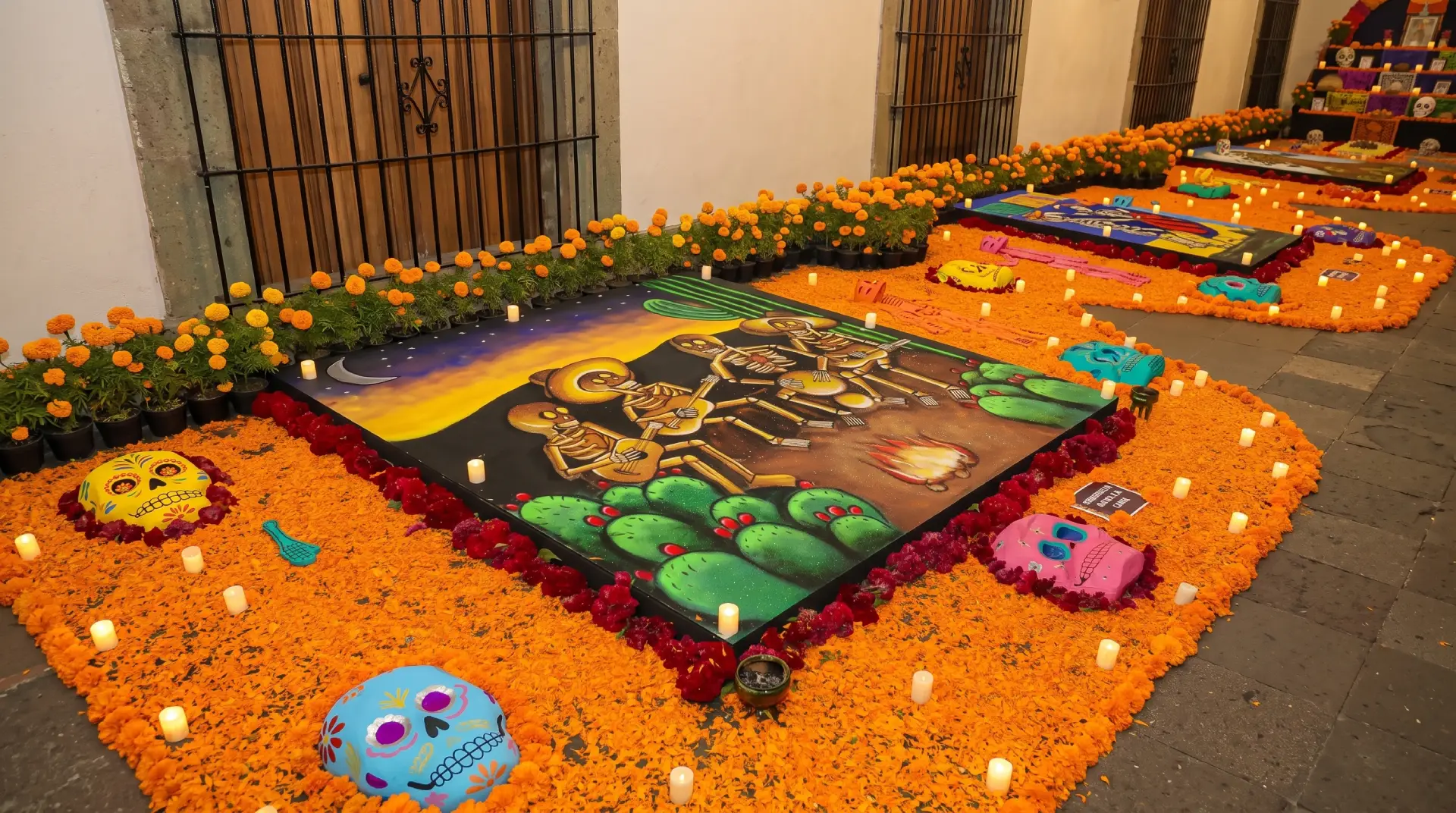
Tapetes de arena are Oaxaca’s sand tapestries: pictures laid on the ground with colored sand, sawdust, lime, brick dust, glitter, seeds, and flowers. Their oldest job is not tourism. In the Central Valleys they belong to the funeral, especially the levantada de cruz on the ninth day after burial. The image sits where the body lay. Then the sand is gathered into a cross and carried to the grave, a return of dust to dust. During Día de Muertos the same craft steps into public view. You will see it in the Historic Center, in barrios such as Jalatlaco, and in towns such as Santa Cruz Xoxocotlán, Villa de Zaachila, and Macuilxóchitl. Universities and art schools help build the monumental plaza pieces. The village tapete still exists. The city tapete is the cousin that learned to speak to a crowd.
Where the Tradition Comes From
Communities in Santa Cruz Xoxocotlán and other valley towns describe a double root. Before the colony, offerings were set on the earth itself, the place people come from and return to. After the Spanish arrived, that floor offering met the Catholic novenario and the Passion of Christ. A lime cross was drawn where the body would rest during the wake. Nine days of prayer followed the burial, recalling both the months in the womb and the time a shadow needs to leave the house. On the ninth morning a specialist, the tapetista, laid a picture over that cross: the Virgin of Juquila, the Virgin of Soledad, San Judas, Christ, the nails, the cock, the ladder, the chalice. Black ground could stand for Mary’s mourning. Green could stand for Calvary. The letters D.E.P., Descanse en Paz, often found a corner.
Artists who still work funerals, among them families from Xoxocotlán and Zaachila, say the tapete stands for the person and for the soul that lingered in that exact rectangle of floor. Compadres or madrinas of the cross gather the sand at night. The next day, or at midnight in some towns, it goes to the tomb. The house is cleared. The dead are given a map and an escort. That is the original purpose. Día de Muertos borrowed the language because both rites speak of a journey, a body that returns to earth, and a beauty that is not meant to be stored.
Why They Make Them, and What Happens After
They make them to honor, to finish a novena, and to say that life is brief. “Polvo somos y al polvo retornaremos” is the phrase you hear in Xoxocotlán. The tapete is an ofrenda you walk around, not a painting you hang. In a funeral it also gathers the community. Neighbors pray. Food is shared. Godparents take on the work of lifting the sand so the immediate family can grieve. Some tapetistas are called again at forty days or at the cabo de año, the first anniversary.
Afterwards the public tapetes of Muertos meet a quieter end. Feet, wind, and street sweepers finish what the ritual began. Monumental pieces in Plaza de la Danza or the Zócalo are usually built in the last days of October and left through November 2 or 3, sometimes a day longer. Then they are dismantled. No museum keeps the original. Photographs remain. The sand goes back to being sand. That vanishing is the point, not a flaw.
When They Appear
Funeral tapetes appear whenever someone dies, all year. Día de Muertos tapetes cluster in a short window. Work often starts a few days before October 31. In 2025, Xoxocotlán’s traditional contest asked secondary and high school students to mount their pieces between 6:00 a.m. and noon on October 31. Jalatlaco has unveiled large barrio tapetes as early as October 27. State and city programs have shown monumental carpets from October 31 to November 3. Huajuapan’s Mixtec displays have stayed up through the close of the Fieles Difuntos days. You will not usually find the big public carpets weeks in advance, and you will not find them weeks after. Come in the last days of October and the first days of November.
Where to See Them: City, Barrios, and Pueblos
They are not only a centro spectacle. The Historic Center is the easiest place for a visitor: Plaza de la Danza beside La Soledad, the Plaza de Armas and Zócalo, and sometimes the Panteón General. Barrio Jalatlaco has become famous for long street carpets that tell local stories, including the old river that once divided the neighborhood from the city.
The pueblos keep the older grammar. Santa Cruz Xoxocotlán remains a heartland of the traditional funeral tapete and now runs a municipal contest titled in the spirit of “Todo vuelve a su origen.” Villa de Zaachila has produced tapetistas who take valley funeral motifs, Zapotec grecas, and the Danza de la Pluma onto public floors and even to international carpet conventions. Macuilxóchitl collectives have built giant skulls and ofrendas in the capital. Mitla may add sand tapestries to its season of tombs and processions. The Mixteca, including Huajuapan de León, has its own monumental school-and-collective projects. Tlacolula has hosted tapetes made by Zaachila artists for civic events beyond November. The craft lives wherever a rezador, a tapetista, and a family still know the ninth day.
Universities, Schools, and the Public Floor
The leap from house floor to plaza owes a great deal to artists and students. From the 1980s onward, painters and teachers began placing tapetes in the zócalo for Muertos. The Facultad de Artes Plásticas y Visuales of the Universidad Autónoma Benito Juárez de Oaxaca, the CEDART Miguel Cabrera, and earlier the Escuela de Artes Plásticas have sent teams to Plaza de la Danza. Japanese-born teacher Zhinzaburo Takeda and the workshop of Juan Alcázar are often named among those who helped the monumental public style take root. In Huajuapan, students and teachers of the Escuela Normal Experimental have worked with the collective Rutas de Arena. Xoxocotlán now invites secundaria and bachillerato students into a formal contest with rules against plastic, resin, and Styrofoam.
So the honest map is this. The tapete is native to valley funerals and still exists in the pueblos. It is not “just the center.” The center, the barrios, the universities, and the town halls have given it a second life as seasonal public art. One version prays over a single name. The other teaches a plaza how brief we are.
How It Fits Día de Muertos
An ofrenda in the house feeds the guest. Copal scents the path. Cempasúchil marks the road. The tapete is the picture of the road itself, or of the saint who watches it, or of the region the dead once called home. Walking around a tapete in Plaza de la Danza is a public version of standing at the edge of a velorio. You look down. You keep your feet off the faces if you can. You remember that the image will be gone by the time the souls are asked to leave on November 2.
If you want the funeral original, ask in Xoxocotlán or Zaachila about levantadas de cruz. Those happen on their own calendar, whenever a family needs them. If you want the festival cousin, come late October. Start at Plaza de la Danza, walk Jalatlaco at dusk, and ride out to Xoxocotlán for the contest and the cemetery night. Take photographs. Leave the sand where it lies. Tomorrow it will already be becoming earth again, which is the oldest sentence the tapete knows how to write.


