


What is a "Mojiganga"? The History of Oaxaca’s Giant Dancing Puppets
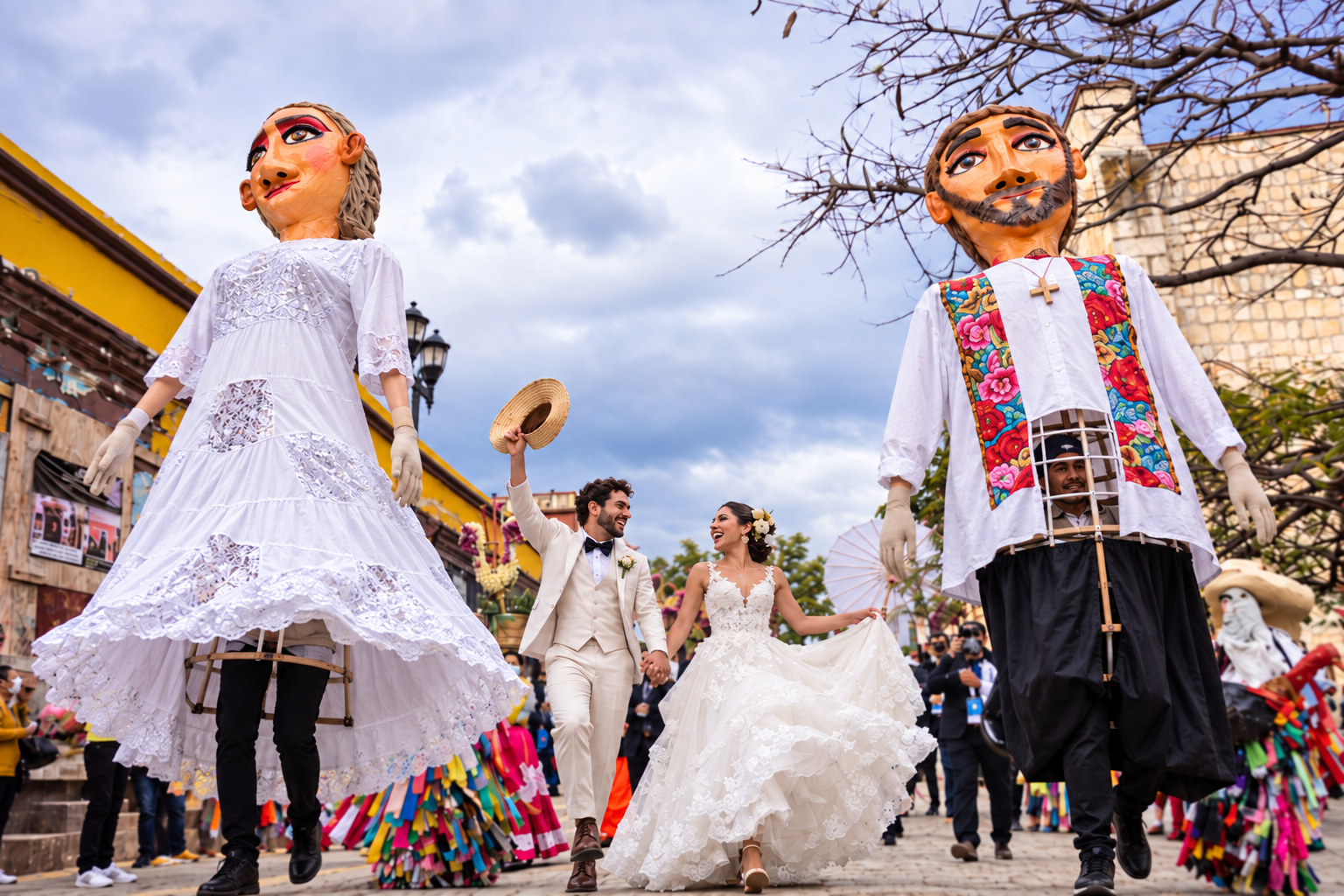
The giants that dance through Oaxaca
If you spend enough time in Oaxaca, sooner or later you may see a human figure several meters tall spinning above a crowd. Its enormous arms swing outward as a brass band plays behind it, and somewhere inside the figure a person is carrying the entire structure and making it dance. Visitors often call these figures mojigangas, but in Oaxaca you will also hear another, more locally specific name: monos de calenda.
The terms are sometimes used interchangeably, but they do not always describe exactly the same thing. Giant festive puppets exist in several parts of Mexico, and the broader mojiganga tradition has developed differently from one region to another. Oaxaca's monos de calenda belong to this larger family of giant processional figures, yet they have distinctive construction techniques and a particularly close relationship with the Oaxacan calenda, the traditional street procession that announces and accompanies community celebrations.
Where did mojigangas come from?
The Mexican tradition belongs to a much older history of giant figures used in European festivals and religious processions. Spanish traditions of giants and oversized comic figures arrived in Mexico during the colonial period, where they became incorporated into local celebrations. Mexico's Secretaría de Cultura today recognizes mojigangas as part of a living tradition found in several states, including Guanajuato, Guerrero, Morelos, Nayarit, Oaxaca and Mexico City.
In Oaxaca, the figures became closely connected with religious festivities and calendas. Historical interpretations link Oaxaca's giants to colonial evangelization and Catholic processions, but what developed here was not simply a copy of a Spanish custom. Oaxacan communities transformed the figures through local craftsmanship, dress, music, humor and movement until the giants became recognizable elements of the state's own festive culture.
Monos de calenda and mojigangas: what is the difference?
This is where the terminology becomes interesting. Research published by the Universidad Nacional Autónoma de México records Oaxacan puppet maker José Octavio Azcona distinguishing the mono de calenda from mojigangas made in central and western Mexico. A traditional Oaxacan mono has a lightweight torso framework made from carrizo, or cane, with a papier-mâché head and fabric clothing. The person dancing it supports the structure on the shoulders.
One of its most distinctive details is surprisingly easy to miss. Traditional monos de calenda have an opening around the puppet's belly or navel through which the person inside can see. Their fabric arms hang freely and swing as the dancer turns the figure. Mojigangas from other Mexican traditions may instead have arms controlled with long rods, heavier structures and a viewing opening concealed behind fabric rather than the characteristic "belly button" of the Oaxacan mono.
In everyday conversation, however, the distinction is not always maintained. You may hear visitors, event organizers and even participants use "mojiganga" as a general word for a giant dancing puppet. In Oaxaca, mono de calenda is the more precise local term when speaking about the figures specifically associated with the calenda tradition.
How does a giant puppet dance?
A mono de calenda is not operated from a distance. The dancer, sometimes called a monero, enters beneath the clothing and carries the framework on the shoulders. From there, balance and body movement bring the giant to life. As the dancer turns, the puppet's loose arms fly outward and its clothing swirls around the hidden performer.
That construction helps explain the wonderfully exaggerated movement of the figures. They do not simply walk in a parade. They spin, sway and respond to the rhythm of the band, becoming dancers in their own right. The apparent simplicity hides both physical effort and skill, especially when a procession travels through crowded streets.
When are monos de calenda used?
Their traditional home is the calenda, a community procession associated especially with religious and patron saint festivities. A calenda moves through streets and plazas with music and other festive elements, publicly announcing a celebration and drawing the community into it. Monos may appear alongside brass bands, marmotas, lanterns, dancers and participants wearing regional clothing.
Today their role extends beyond patron saint festivals. In Oaxaca City and surrounding communities, monos de calenda can appear at weddings, graduations, anniversaries and other celebrations. Wedding figures are sometimes created to represent the couple themselves, turning the giant puppets into playful oversized portraits that dance ahead of or among the wedding party.
Where can you see them in Oaxaca?
For travelers, Oaxaca City is one of the easiest places to encounter monos de calenda. Public processions frequently pass through the Centro Histórico during major festivities, and the Guelaguetza season in July is particularly rich in street events. Official Guelaguetza activities have included delegation parades featuring marmotas, lanterns and monos de calenda accompanied by wind bands.
They are not limited to the capital. Patron saint celebrations in communities across the Central Valleys and elsewhere in Oaxaca provide a more traditional context for seeing giant figures as part of community life. There is no single permanent daily "mojiganga show" that visitors need to find. The figures make the most sense in motion, surrounded by music and people during the celebration for which they were created.
More than a giant puppet
It is tempting to see a mono de calenda simply as a wonderful photo opportunity, but the figure represents something much deeper. Its cane framework and papier-mâché head preserve artisanal knowledge, while its movement depends on a performer who understands how to balance and dance with the structure. Its clothing can evoke regional identity, recognizable characters or the people being celebrated.
Most importantly, the mono belongs to a living procession. Like the music of the brass band and the movement of the crowd, it exists to travel through public space and make a celebration visible. That is why seeing one standing still is never quite the same as watching a giant suddenly begin to spin in the middle of an Oaxacan street.


