


The Ethics of Photography During Oaxaca’s Día de Muertos
The Short Answer
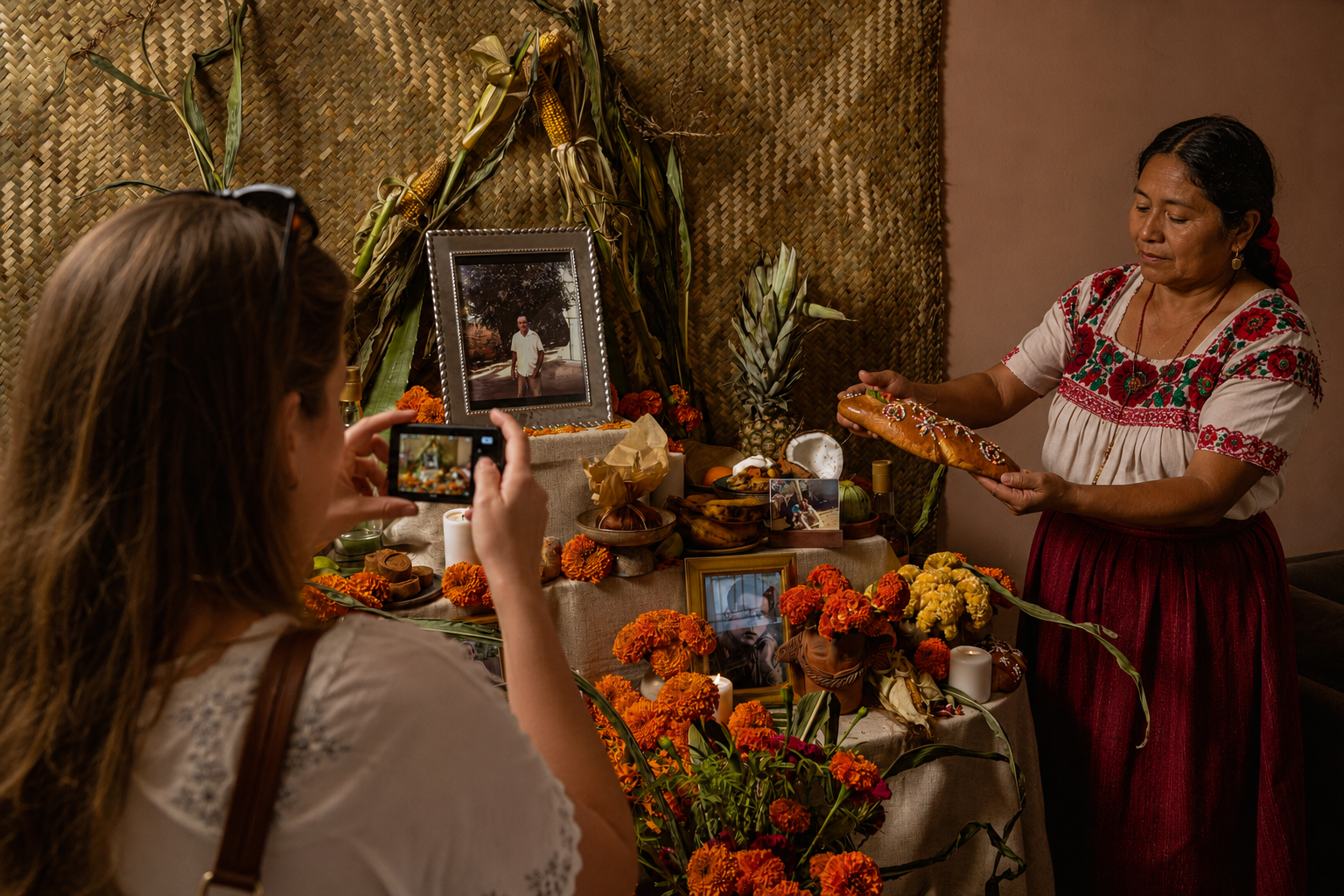
You are welcome to photograph Día de Muertos in Oaxaca. The city fills with public altars, comparsas, flowers, and candlelight that families and businesses are often happy to share. The kindest approach is simple: treat graves, ofrendas, and faces as belonging to living people first. Ask when you are close. Let candlelight do the work. If someone says no, thank them and look for another frame. Visitors who work this way tend to be invited in, not pushed away.
Why a Soft Touch Matters Here
Día de Muertos in Oaxaca is a homecoming. Families clean tombs, cook favorite foods, light candles, and sit through the night so the people they love can find their way back. There is music, mezcal, and a great deal of laughter. There can also be quiet grief sitting right beside the joy. A panteón in Xoxocotlán, Atzompa, Teotitlán del Valle, or a neighborhood cemetery is still a family space, even when the gates are open to guests.
Your camera can honor that. It helps when it behaves like a guest: curious, slow, and ready to put the lens down so a conversation can start. Wide scenes of marigold paths and distant candles are usually easy. Close portraits feel better after a nod. That small pause is not a barrier. It is how trust begins.
Public Streets and Shared Altars
A lot of what you see is meant to be looked at. In the Historic Center, shops and hotels build ofrendas so people will stop, sit, and take pictures. Comparsas move through the streets as performance and celebration. The public displays at places such as the Biblioteca are created for visitors as well as locals. The Municipality of Oaxaca de Juárez has stated that personal and family photography in public space is free and does not need a permit. Commercial productions with crews, models, and heavy lighting are a separate category and usually need municipal authorization.
Home altars and cemetery vigils sit on a more intimate scale. An ofrenda in a private house is a table set for someone who is missed. A decorated grave is a family’s gathering place for one night. Photographing the glow of the whole cemetery, the flowers along a path, or details that do not identify a person is generally fine. When a face, a name on a tomb, or a child comes into the frame, a short question keeps the moment generous on both sides.
Ask, Smile, Then Shoot
“¿Puedo tomar una foto, por favor?” is enough. Make eye contact. Keep the camera low until you hear the answer. Many families say yes, and some will pull you closer, offer pan de muerto, or tell you the name of the person they are waiting for. That welcome is part of the picture. Two or three frames, then a thank you, usually feels better than hovering with a long lens.
Helpful phrases:
• ¿Puedo tomar una foto, por favor? (PWEH-doh toh-MAHR oo-nah FOH-toh, por fah-VOR?)
• ¿Está bien si fotografío el altar? (ehs-TAH bee-EHN see foh-toh-grah-FEE-oh el ahl-TAR?)
• Muchas gracias. Qué hermoso recuerdo. (MOO-chahs GRAH-see-ahs. keh er-MOH-soh reh-KWER-doh.)
If you are within a couple of meters of someone, asking is the graceful move. Distant views of paths and candlelight rarely need a spoken yes. A long zoom on a single face is still a portrait, even from across the aisle. When in doubt, ask. People often appreciate the courtesy more than they mind the photograph.
Cemetery Night: Light, Children, and Small Gifts
Candlelight is the atmosphere of the vigil. Raising ISO, bracing the camera, or using a small tripod helps you keep that glow. Flash from a phone or a speedlight tends to flatten the color and startle people sitting in the dark. If you can work with the light that is already there, the pictures and the night both stay softer.
When children appear in a frame you hope to share online, it is kinder to check with a parent first. Walking around graves rather than over them, leaving candles where families placed them, and arriving sober all make you easier to welcome. A small offering helps too: cempasúchil, a candle, a piece of pan de muerto. Tending a quiet or forgotten grave with a flower is often received as a genuine gesture, and it gives your hands something to do besides hold a camera.
Dress as local families dress when you enter a village cemetery. Catrina makeup and full costume read beautifully in the zócalo and during comparsas. In many panteones they can feel out of place. You do not need a costume to belong for a few hours. Ordinary clothes and a calm pace usually fit the room better.
Muerteadas, Comparsas, and Larger Cameras
Street processions are theatrical and loud, and they photograph wonderfully. Bands, bells, masks, and movement are fair game as public celebration. When you want a tight portrait of a dancer, a quick ask still helps, especially if the person is carrying a heavy costume and working hard for the neighborhood rather than posing for visitors.
A few communities now set their own camera rules. In San Agustín Etla, Muerteada organizers have asked outside visitors in costume or face paint to pay a participation fee, and they have asked professional photographers and videographers for a similar quota plus prior accreditation. Those details change by year and by barrio. If you are arriving with a large lens or a video rig, check locally first. A phone or a small camera and an easy manner will often take you farther than heavy gear and a sense of rush.
After the Shutter: Sharing With Care
If a family posed for you, offering to send the photo by WhatsApp that same night is a lovely close to the exchange. When you post later, a light caption and no child’s full name keeps the moment human. If you later hope to use a portrait in a workshop, a book, or anything commercial, it is worth asking again. Consent for a keepsake is not automatically consent for a product.
A useful test before you publish: would this feel all right if it were your mother’s grave or your nephew asleep beside the candles, and a visitor you met for a few minutes put it online? If the answer is warm, share it. If it feels uneven, keep the file private. The night can still live in you.
A Friendly Field Checklist
• Spend the first few minutes in a cemetery or home looking before you shoot.
• Ask when faces, close altars, or children enter the frame.
• Prefer candlelight over flash.
• Learn two Spanish sentences and use them.
• Save full costume and Catrina makeup for the city streets if you are heading to a village vigil.
• Carry flowers or a candle so you arrive with something to give.
• Check local rules if you bring professional equipment to a Muerteada.
• Send pictures back to the people who trusted you.
• Leave room for the frames you choose not to take. Presence is part of the photograph too.
Photographers who move this way often receive more, not less: a seat by the candles, a story about a grandfather who loved mezcal, an invitation to return. Oaxaca does not ask you to hide the camera. It asks you to remember that the dead are being welcomed home, and you are standing in a doorway that families have opened with care. Knock softly, and most doors stay open.


