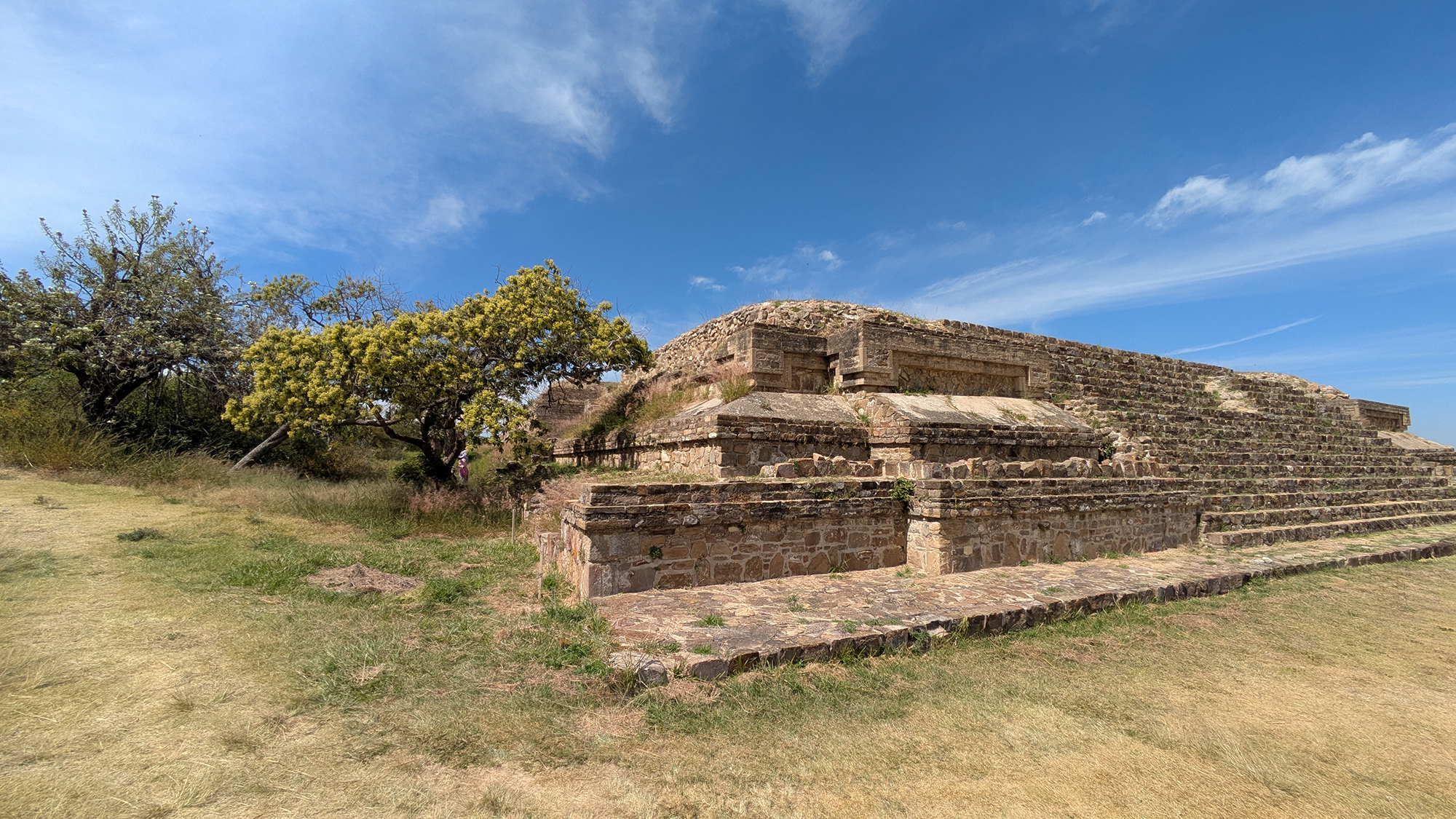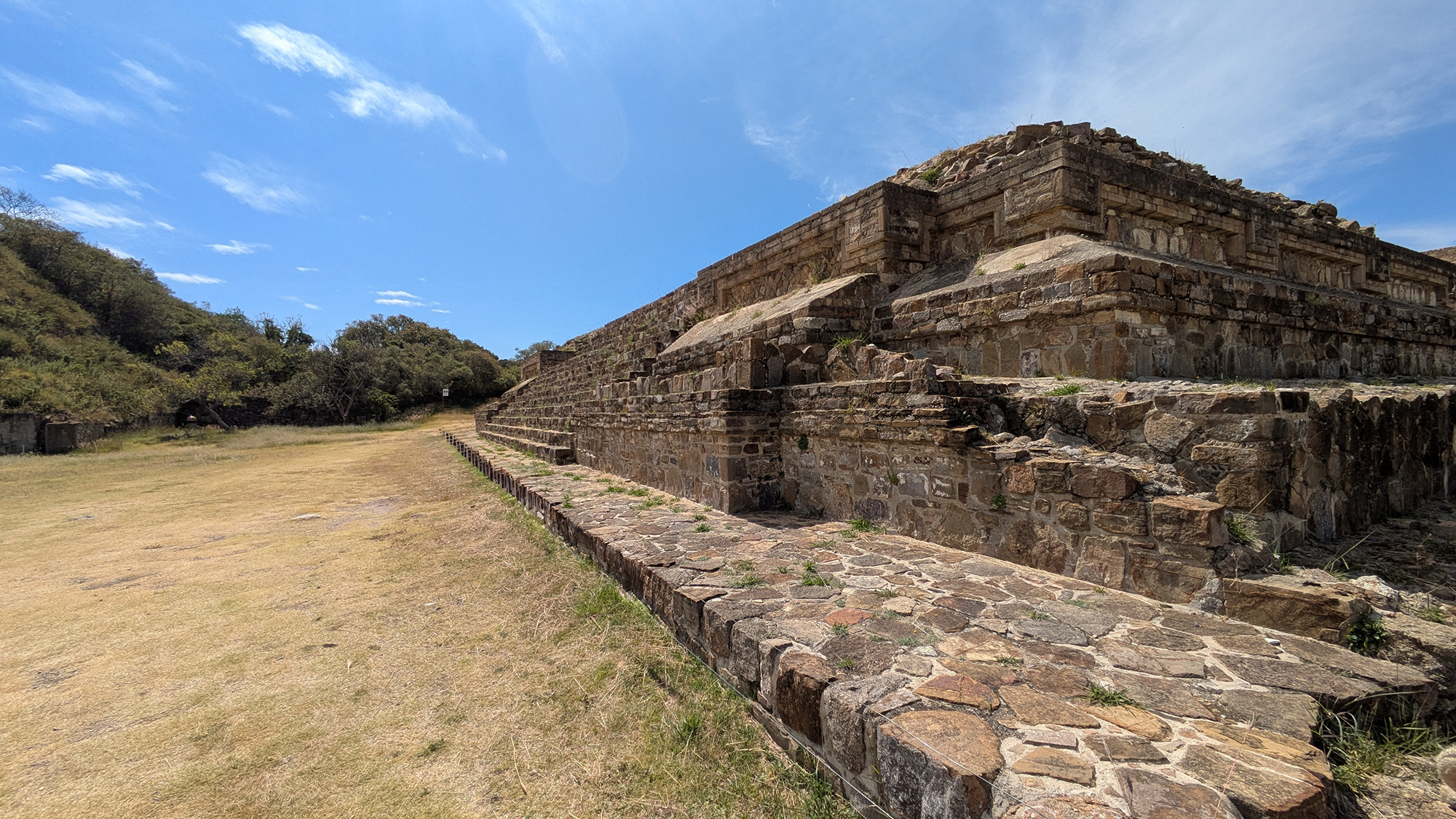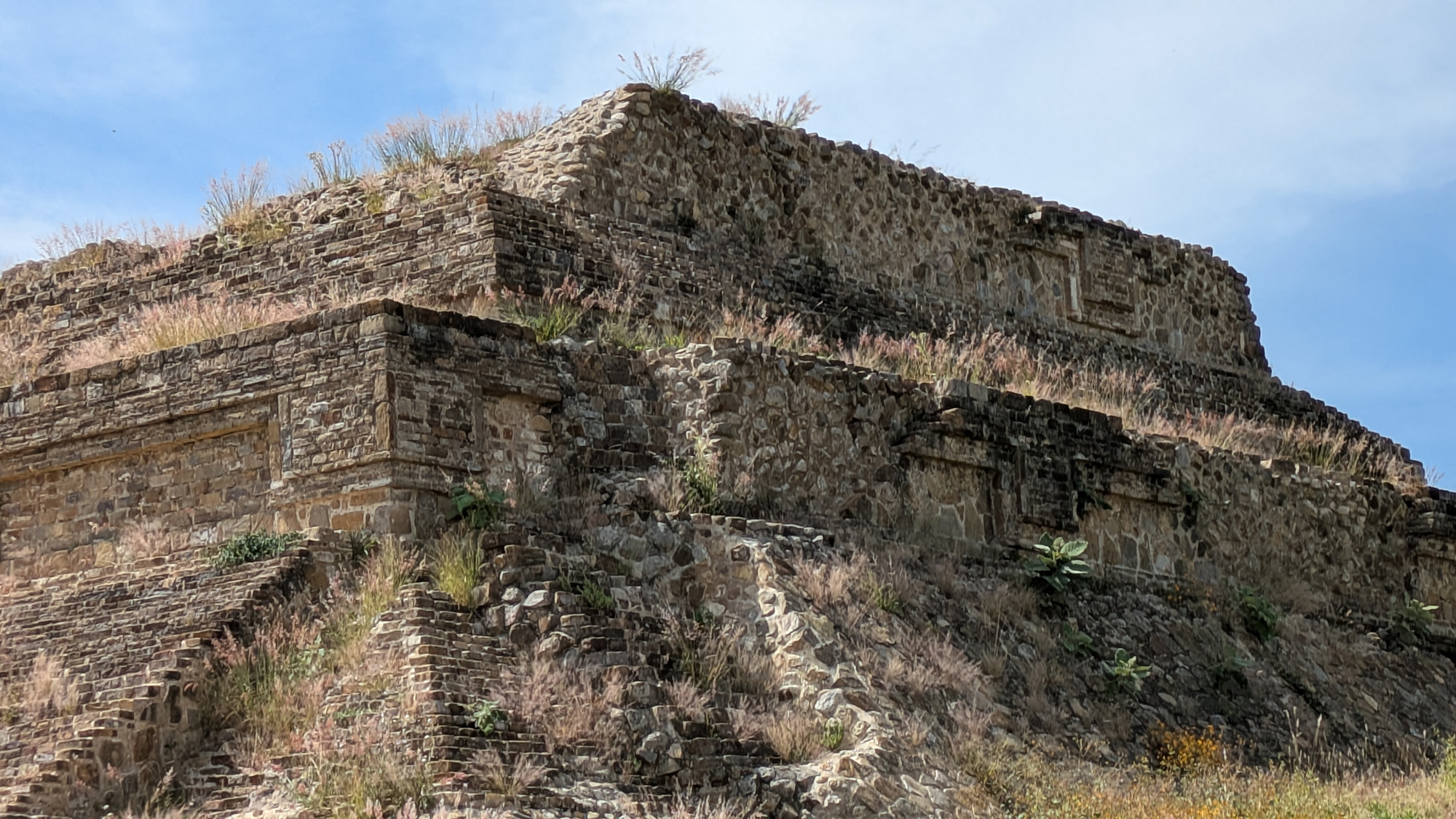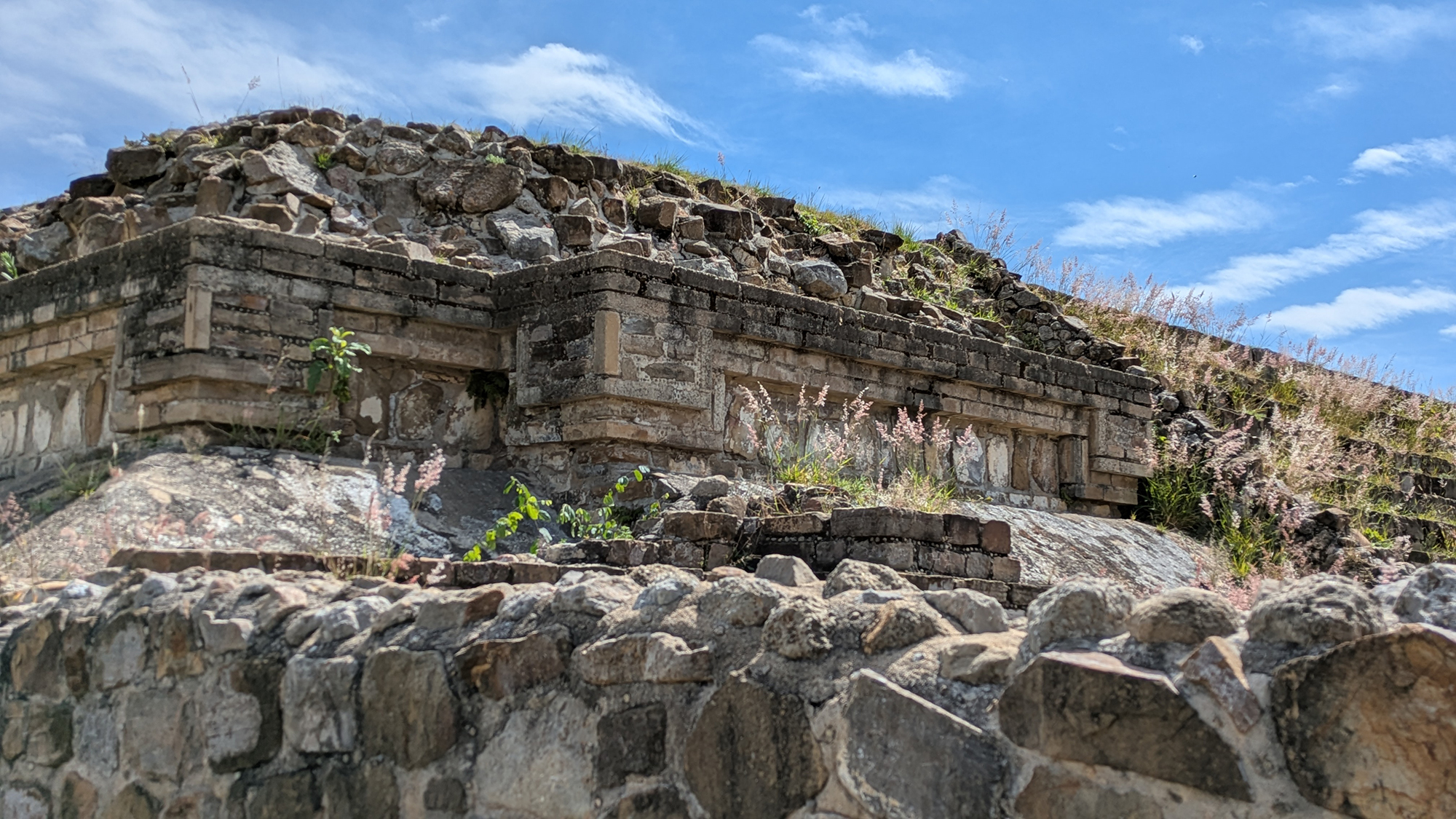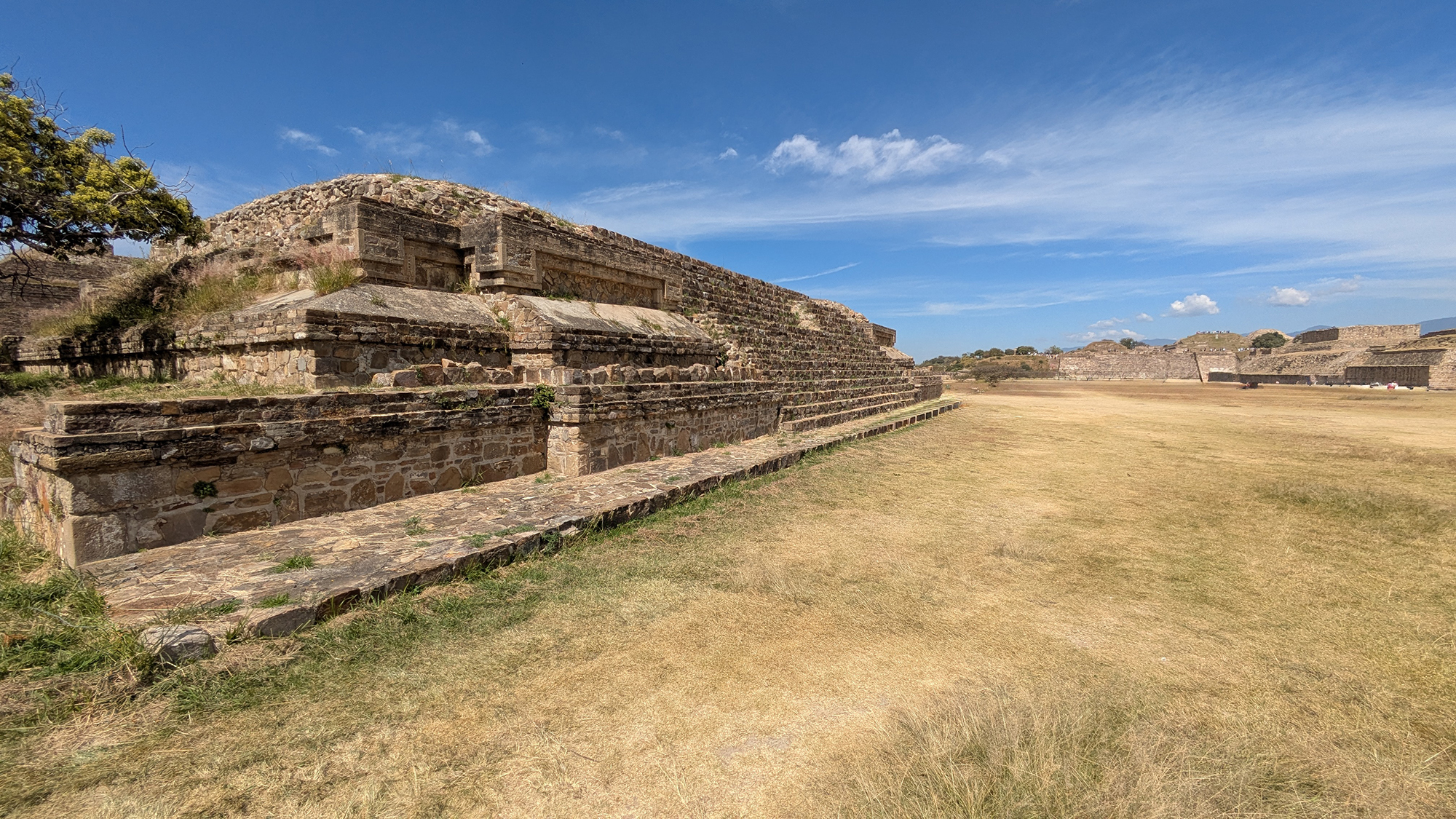


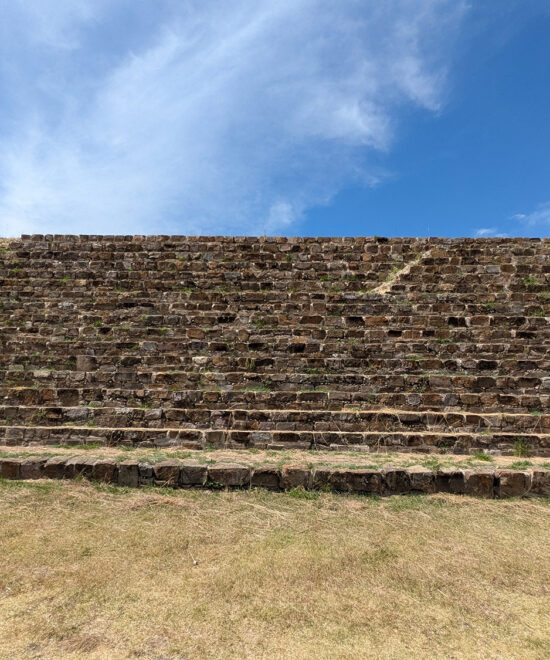
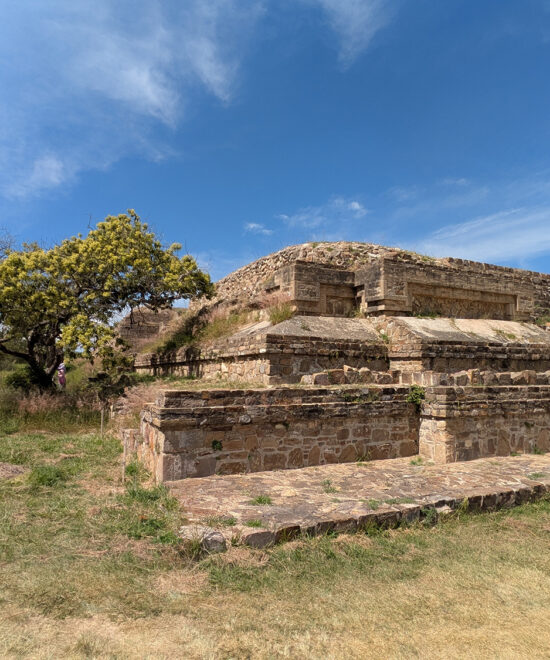
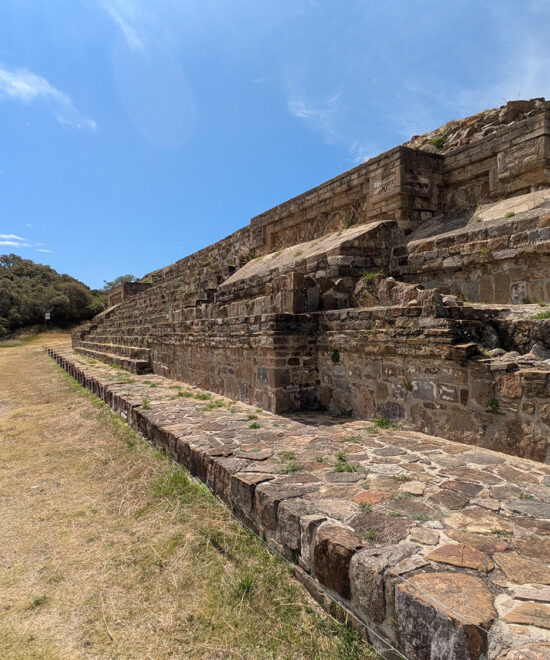
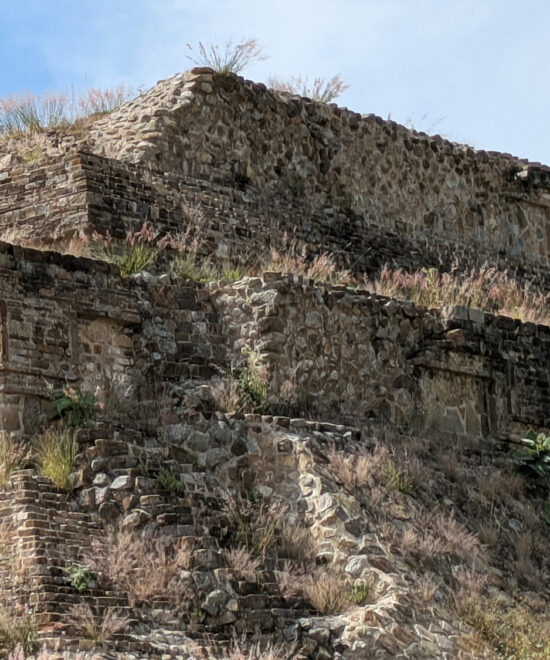
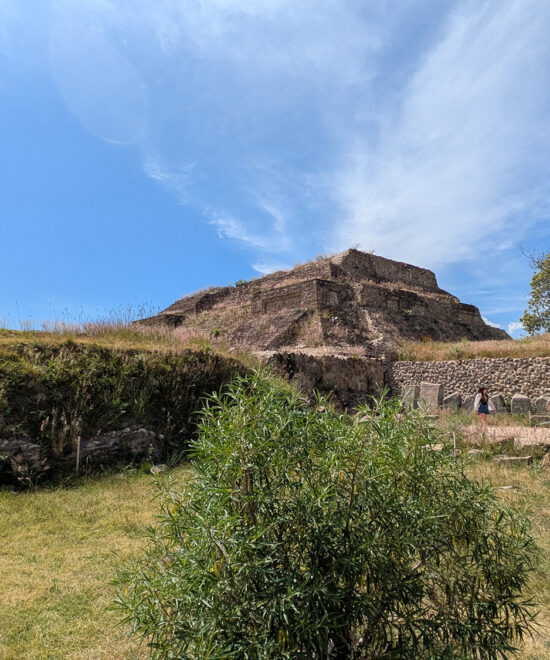
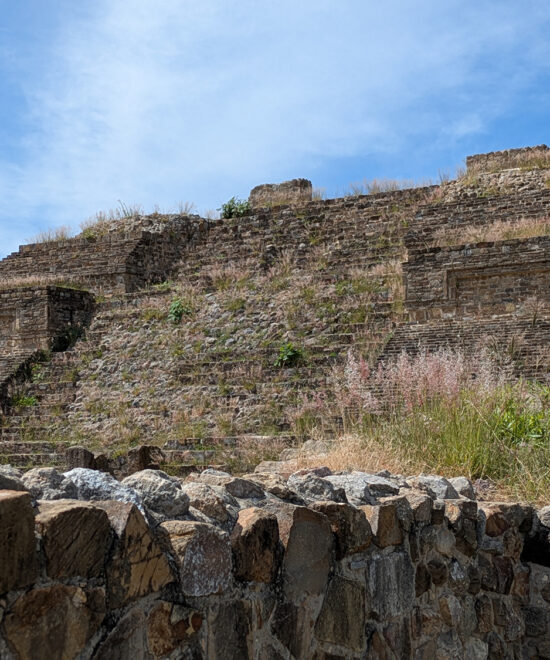
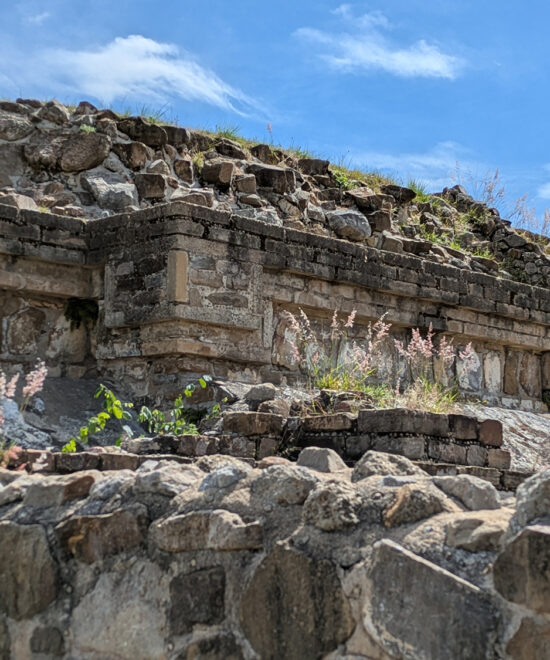
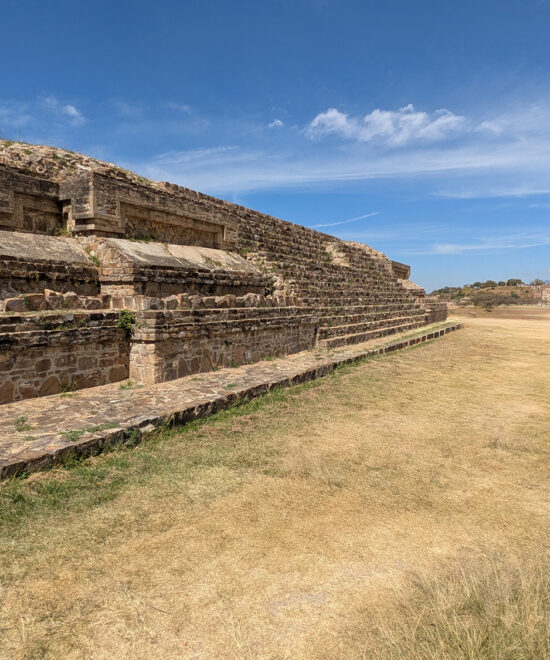
System M, formally designated as Sistema M, operates as a paramount ceremonial apparatus anchoring the western boundary of Monte Albán’s Main Plaza. Dominating the southwest corner of the monumental precinct, it is classified among the site's architecturally integrated "systems"—complexes engineered not as monolithic, isolated pyramids, but as rigorously controlled ritual units comprising elevated platforms, enclosed sunken patios, central altars, and culminating rear temples. Conceptually, System M must not be reduced to a mere mound bearing an alphabetic identifier; it is a highly calibrated ceremonial mechanism explicitly woven into the sociopolitical and urban logic of the Zapotec capital.15
The profound significance of this complex operates on a tripartite level. Spatially, it provides absolute definition to the southwest perimeter of the Main Plaza. Structurally, it functions as the architectural twin to System IV to the north, thereby imposing a massive, deliberate symmetry across the entire western esplanade. Sociologically, it physicalizes a critical paradigm shift in Monte Albán’s ritual life during its mature phases: a deliberate transition away from open, communal plazas toward heavily enclosed, strictly controlled, and visually exclusionary spaces reserved for elite ceremonial authority.56
Taxonomy and Historiography of the "System" Designation
The nomenclature of "System M" stems from the deep historiography of archaeological practice at Monte Albán. In nascent exploration phases, surveyors reflexively cataloged structures as disparate mounds or localized clusters, assigning them arbitrary letters or Roman numerals before their integrated urban functions could be deciphered. However, as methodical excavations proceeded under the direction of Dr. Alfonso Caso and his successors from 1931 onward, the stratigraphy revealed that these apparent "mounds" were, in fact, cohesive, multi-part ceremonial units driven by a unified spatial logic. While the antiquated alphabetic labels persisted, the interpretive paradigm was radically transformed.47
The term "system" is therefore an essential taxonomic correction. It enforces the archaeological reality that the complex consists of interdependent architectural vectors rather than a singular mass. System M must be read as a coherent ceremonial ensemble whose constituent parts were actively designed to throttle access, manipulate physical movement, blind specific sightlines, and centralize ritual focus. Referring to it merely as a "mound" flattens its sociological meaning; acknowledging it as a "system" honors its design, function, and relationship to the state.
Location and Spatial Layout
System M anchors the extreme southwest corner of Monte Albán’s Main Plaza, occupying a critical node within the western alignment of major ceremonial edifices that includes the Danzantes Building and System IV. The official INAH cartography precisely plots System M at this nexus, immediately adjacent to the southwestern stelae zone and the highly charged Danzantes gallery.2
The complex is rigorously organized via a linear temple-patio-temple syntax. The eastern component is Building O, which functions as the porous front structure facing the public expanse of the Main Plaza. Traversing this building leads down into a sunken, enclosed patio featuring a central shrine or altar. Bounding the western edge is Building M, a significantly more massive and elevated rear temple. Photographic documentation by scholars like Mary Ann Sullivan proves invaluable here, clearly delineating Building O from Building M while structurally confirming that Building M actively forms the southern retaining wall of the adjacent Danzantes patio.5
This layout is a physical manifestation of social hierarchy. It deliberately constructs a stark transition from exposed, public space into a highly restricted, cloistered ceremonial theater. A participant approaching from the Main Plaza could not simply wander into an open court; they were forced to breach a controlled architectural threshold (Building O) and descend into a secluded interior patio walled in by monumental architecture. This is how the Zapotec state materialized exclusivity in stone.
Architecture and Construction
Architecturally, System M employs the mature, formalized ceremonial vocabulary characteristic of Late Classic Monte Albán. The exposed remains display heavy stone foundations, substantial masonry terracing, evidence of thick stucco application, and the iconic double-scapular (tablero-talud variant) decorative moldings ubiquitous on the plaza's premier buildings. Comparative architectural studies emphasize this specific molding on Building O, noting its exact decorative parallelism with System IV to the north.56
The apex rear temple, Building M, was accessed via a monumental, east-facing central staircase that dominated the enclosed patio. This deliberate orientation granted the western temple absolute visual and ritual authority over the sunken space, while the front structure strictly regulated access from the general plaza. The resulting architecture transcends mere formal balance; it is an engineered spatial hierarchy demanding a sequence of public approach, controlled thresholding, interior enclosure, and finally, approach to the elevated sanctum.
As is standard across Monte Albán, these structures originally utilized stone substructures to support substantial adobe superstructures, all sealed in burnished lime stucco. Therefore, the surviving lithic skeleton represents only a fraction of the complex's original mass. In its pristine state, System M would have presented as a vastly more imposing, impermeable, and vibrantly finished environment than its current weathered footprint suggests.
Temple-Patio-Temple Logic and Ritual Restriction
While System M is frequently subsumed into the broader "Temple-Patio-Adoratorio" (TPA) discourse ubiquitous in Oaxaca, the most precise functional description for this specific unit is a temple-patio-temple arrangement anchored by a central altar. The undeniable archaeological reality is that the central patio was intentionally sunken and screened to obliterate direct sightlines from the wider Main Plaza, creating an interiorized environment of profound restriction.156
This spatial philosophy is critical because it indexes a massive evolution in Zapotec ceremonial culture. Formative Monte Albán relied heavily on expansive monumental spaces engineered to amass large publics. Conversely, the mature architectural programs of the Classic period aggressively privatized ritual environments. System M is the physical embodiment of this later logic. It proves that the ceremonies conducted here were inherently unequal; access to the sacred action within the complex was strictly curated based on social rank.
This does not imply that rituals were entirely secret or esoteric. It means that the architecture actively segregated the population—cleaving active participants from passive observers, insiders from outsiders, and the ruling elite from the common polity. Monte Albán did not merely stage state rituals; it staged the physical boundaries of who was permitted proximity to divine power.
Symmetry, Duality, and the Western Alignment
One of the most striking urbanistic features of System M is its precise architectural reciprocity with System IV. Situated at the opposing northern end of the western plaza boundary, System IV perfectly replicates the temple-patio-temple syntax, establishing a massive, deliberate symmetry across the western monumental core. Epigraphers and urban scholars universally recognize System M as the deliberate "twin" to System IV.56
This structural mirroring transcends mere aesthetic preference. In Mesoamerican urban planning, opposed or twinned structures frequently encode deep sociopolitical, lineage-based, or cosmological dualities. While it is academically irresponsible to claim complete knowledge of the specific institutional duality represented here, the sheer scale of the symmetry proves that the western edge of the plaza was engineered as a balanced, hyper-planned ceremonial zone, not a haphazard accretion of temples over time.
Crucially, System M’s southern positioning imbues it with a radically different contextual association than its twin. While System IV is inextricably linked to the narrative of Stele 18, System M shares a structural wall with the Danzantes Building, tethering it immediately to the oldest and most violently charged historical sector of the Zapotec capital.
Chronological Stratigraphy
System M is not the product of a single construction event. While the monumental footprint visible today is securely dated to the mature Classic phases of the city, this specific parcel of the western plaza has hosted continuous ceremonial activity since the site's genesis. The initial terraforming, leveling of the plateau, and demarcation of the western edge trace back to the formative phase (circa 500 BCE), whereas the massive Late Classic rebuilding campaigns provided the final stuccoed form.137
Therefore, System M must be comprehended stratigraphically. Entombed beneath the exposed masonry lie successive generations of earlier temples, earlier plaza pavements, and preceding ritual footprints. This cumulative vertical history is vital: the Main Plaza of Monte Albán was never a static blueprint. It was a living political organism, endlessly demolished and expanded to reflect the shifting needs of the Zapotec state.
Integration with Building L (The Danzantes Sector)
System M is physically inextricably linked to Building L, the famed Danzantes complex. Structural surveys confirm that the northern flank of Building M acts as the southern retaining wall for the patio associated with the Danzantes gallery, creating an unusually intimate architectural dialogue between the two zones.5
This adjacency is historically profound. Building L is arguably the most foundational monument at Monte Albán. Its gallery of carved orthostats—historically misidentified as "Dancers" (Danzantes)—are now universally recognized by epigraphers as graphic depictions of mutilated, sacrificed captives and subjugated rival leaders. Therefore, System M did not emerge in a neutral ceremonial vacuum. It was erected directly beside the state’s primary gallery of martial conquest, physical violence, and dynastic intimidation.89
Whether or not specific, older carved stones were cannibalized and reused within System M's foundations, the associative meaning is clear: System M operates within a sector of the city where the architecture of state terror and political memory had already been thickly layered for centuries.
Ritual and Socio-Political Function
While undisputedly a ceremonial node, it is overly simplistic to label System M strictly as a "temple." Within the Zapotec state, ceremonial architecture was functionally inseparable from civic administration, elite status reinforcement, and public ideology. A highly structured complex like System M likely served as the theater for bloodletting, lineage veneration, and exclusive priestly activities that legitimized state authority precisely through the performance of exclusivity.13
The restricted sightlines into the patio guarantee a hierarchy of participation. The populace amassed in the Main Plaza could perceive the monumental bulk of the complex, and perhaps catch glimpses of processionals ascending Building O, but they were structurally blinded from the core rites within. This segregation was the very engine of elite aura. In a highly practical sense, System M possessed immense administrative weight, not because temples functioned as bureaucratic offices, but because in antiquity, divine authority and political jurisdiction occupied the exact same physical space.
Astronomy and Orientation
Archaeoastronomical hypotheses at Monte Albán must be evaluated with rigorous skepticism. While the site undeniably features structural alignments linked to celestial mechanics, not every edifice requires an astronomical justification to possess profound archaeological value.
System M should be interpreted conservatively in this regard. Its primary value rests in its urban symmetry and spatial restriction. While it is highly probable that its layout harmonized with the broader Zapotec ritual calendar—given the agricultural imperative of seasonal tracking—the most definitive, empirically verifiable astronomical alignments at the site remain tethered to Building J and Stele 18.610
Certain interpretive models propose that the sunken patios within complexes like System M functioned as observational staging grounds for zenith passages or specific solar azimuths. While theoretically sound within the broader Mesoamerican cosmological framework, applying these theories specifically to System M requires significantly more robust, structure-specific data before they can be elevated from hypothesis to established fact.13
Epigraphy and Iconography
Unlike the densely inscribed Building J or the sprawling Danzantes gallery, System M is currently devoid of a famous or extensive epigraphic program. It is academically crucial to state this absence clearly, mitigating the tendency to inflate minor anomalies into sweeping theories. The interpretive gravity of System M derives from its spatial syntax and urban relationships, not from surviving hieroglyphs.
However, the lack of texts does not equate to a lack of messaging. The iconographic program was undoubtedly broadcast through vibrant stucco polychrome, the massive double-scapular moldings, and its stark adjacency to Building L. In Zapotec urbanism, the architecture itself was the text.
While some secondary sources postulate the existence of now-lost stelae or minor ritual glyphs associated with the complex, the current empirical evidence is insufficient to confirm a dedicated epigraphic corpus for System M. These theories must remain open avenues for future investigation rather than established facts.1314
Funerary and Lineage Ideology
The architecture of the Zapotec elite is inextricably bound to mortuary cults, ancestor veneration, and the physical preservation of lineage. Apex-status individuals were routinely interred directly beneath residential and ceremonial floors, ensuring that ancestral authority remained a visceral, active participant in contemporary politics.1112
While System M lacks a globally famous crypt akin to Tomb 7 or Tomb 104, the complex operates entirely within this mortuary logic. The screened patio, the central altar, and the elevated sanctuary perfectly match the architectural typologies utilized for dynastic ancestor rites. At Monte Albán, there was no philosophical boundary between the temple and the tomb.
Advanced interpretive models suggest that System M may have served as a highly specialized theater for elite funerary display or lineage-based bloodletting, possibly harboring undiscovered crypts beneath the patio floor. While entirely consistent with Zapotec behavior, claiming the existence of specific tombs beneath System M remains speculative until confirmed by targeted excavation.
Subterranean Features and Unresolved Anomalies
System M is central to ongoing debates regarding the unexcavated, hidden infrastructure of Monte Albán. Modern non-invasive technologies, such as Ground Penetrating Radar (GPR) and LiDAR, continually reveal that significant portions of the city's engineering—including buried facades, massive drainage conduits, and earlier ceremonial phases—remain completely obscured beneath the visible plaza.13
Some contemporary summaries utilize highly charged language, referring to "hidden tunnels" or "subterranean ritual labyrinths" within System M. From an institutional perspective, this terminology must be aggressively tempered. While it is highly likely that System M conceals buried drainage networks or the vaulted voids of earlier temples, utilizing the word "tunnel" implies a romanticized, Indiana Jones-esque function that lacks published empirical backing. Precision in language is paramount; the complex holds structural mysteries, but they must be grounded in stratigraphic reality, not speculation.
Excavation History and Scholarship
The contemporary understanding of System M is overwhelmingly reliant on the monumental, multi-decade Monte Albán project spearheaded by Dr. Alfonso Caso, heavily supported by Ignacio Bernal and Jorge R. Acosta. Their exhaustive clearing, trenching, and restoration efforts exposed the complex, established the definitive ceramic chronology, and first theorized the western plaza as a coordinated urban entity.47
Subsequent generations of scholars, notably Dr. Joyce Marcus and Dr. Kent V. Flannery, integrated these physical structures into a sweeping, macro-level analysis of Zapotec statecraft. Their syntheses remain indispensable, linking the evolution of standardized temple forms like System M directly to the increasing sociopolitical complexity of the Oaxaca Valley.1
Comparative Regional Context
The architectural syntax of System M gains immense clarity when subjected to regional comparison. Internally, its deliberate twinning with System IV provides the most direct comparative data. Externally, this specific patio-centered, restrictive elite model proliferates across secondary Zapotec centers throughout the valley.
This replication confirms that Monte Albán was actively exporting an architectural formula for power. System M is not merely a local building; it is a physical manifestation of a highly legible, standardized language of Zapotec authority that was deemed powerful enough to be reproduced regionally.
Ultimate Significance
System M remains one of the most potent examples of how the Zapotec state weaponized architecture to manage power. Its historical gravity does not rely on the presence of a golden hoard or a famous hieroglyph. Its power is derived purely from its spatial engineering: it is twinned, walled, elevated, and utterly exclusionary, locking down the southwestern axis of the Main Plaza.
System M proves that the rulers of Monte Albán dictated ritual behavior not just through spectacle, but through the aggressive enforcement of privacy, symmetry, and blocked movement. In the archaeological record, the buildings that scream the loudest are not always the most important; often, the structures designed to hide information tell us the most about how a society operated.
Scholarly References
- Marcus, Joyce, & Flannery, Kent V. (1996). Zapotec Civilization: How Urban Society Evolved in Mexico’s Oaxaca Valley. Thames & Hudson. Foundational synthesis on Monte Albán’s urbanism, temple forms, and state development.
- INAH. Monte Albán site map. Official map PDF. Identifies System M, neighboring buildings, and plaza layout.
- UNESCO World Heritage Centre. “Historic Centre of Oaxaca and Archaeological Site of Monte Albán.” Official World Heritage listing and statement of significance.
- Caso, Alfonso; Bernal, Ignacio; & Acosta, Jorge R. (1967). La Cerámica de Monte Albán. INAH. Basic excavation-era framework and chronology for the site.
- Sullivan, Mary Ann. “Monte Albán: System M and Danzantes Building.” Bluffton University. Useful photographic documentation and descriptive observations based on site study and cited guide literature.
- Sullivan, Mary Ann. “Monte Albán: System IV / Edifice K and Stele 18.” Bluffton University. Important for comparison with System M as its western twin.
- INAH. “Monte Albán.” Official institutional description of the site’s history, economy, writing, and broader urban context.
- INAH. “El enigma de los Danzantes de Monte Albán.” Institutional discussion of the Danzantes and their meanings.
- Urcid, Javier. (2001). Zapotec Hieroglyphic Writing. Dumbarton Oaks. Essential for Monte Albán’s epigraphic and visual programs.
- Aveni, Anthony F., & Linsley, Robert M. (1972). “Mound J, Monte Albán: Possible Astronomical Orientation.” American Antiquity. Included for wider archaeoastronomical context at Monte Albán.
- INAH. “Las tumbas de Monte Albán.” Official overview of Monte Albán’s funerary architecture and burial practices.
- INAH. “Museo de Sitio de Monte Albán.” Institutional summary of the site’s writing, religion, funerary customs, and historical interpretation.
- Interpretive synthesis provided for MAHC development on the architectural evolution, ritual restriction, archaeoastronomical possibilities, and possible buried features of System M. These points are included here as informed research directions that still require fuller corroboration in published site-specific documentation.
- Comparative and secondary discussions on Zapotec ceremonial architecture, elite enclosure, and possible administrative and subterranean functions in Monte Albán’s western plaza complexes. Used cautiously here as provisional context rather than firm proof.