


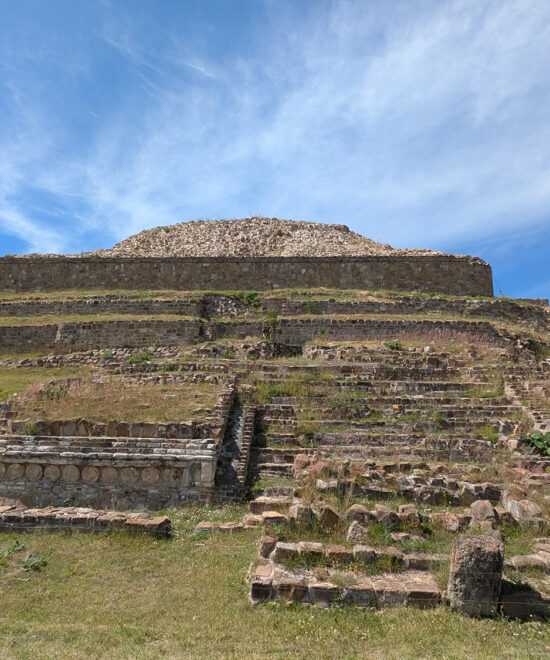
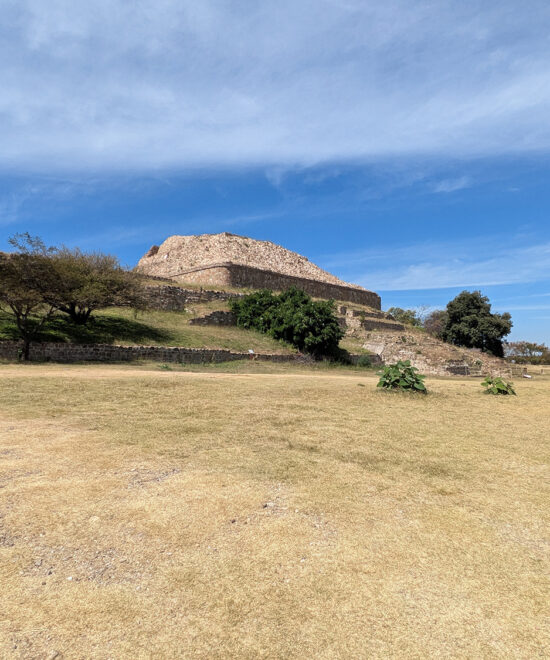


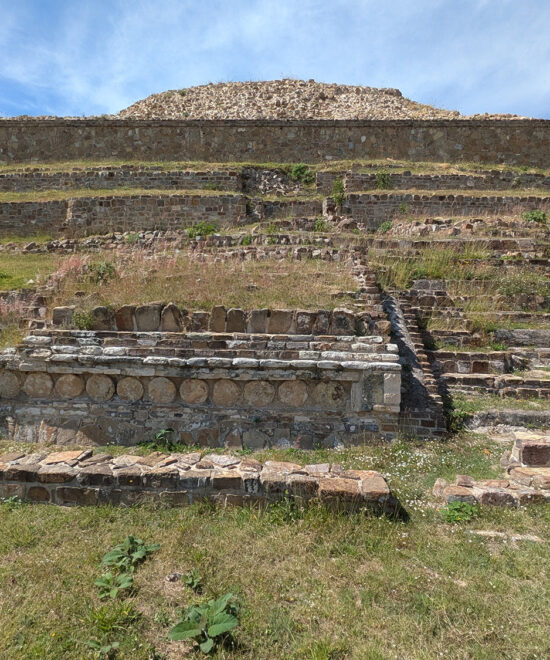
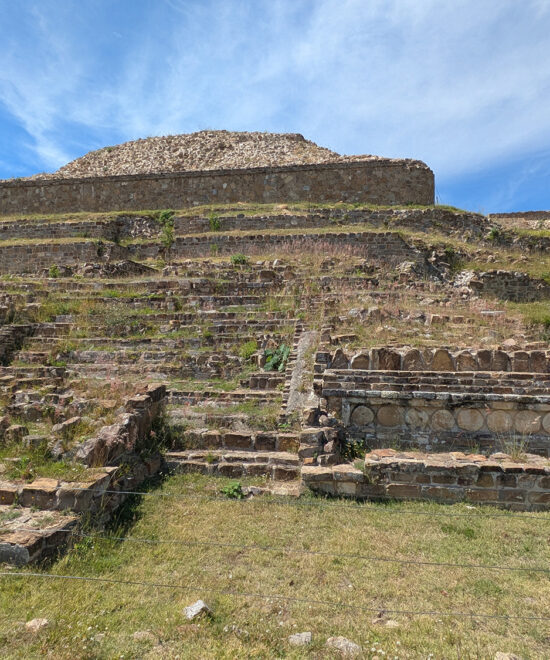
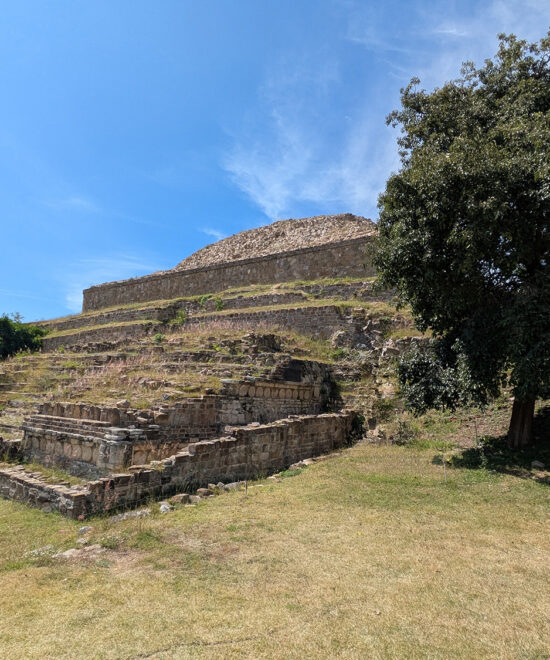
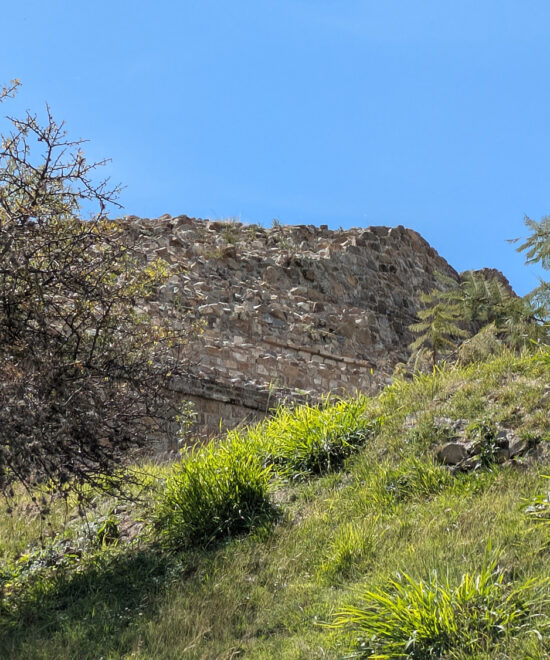

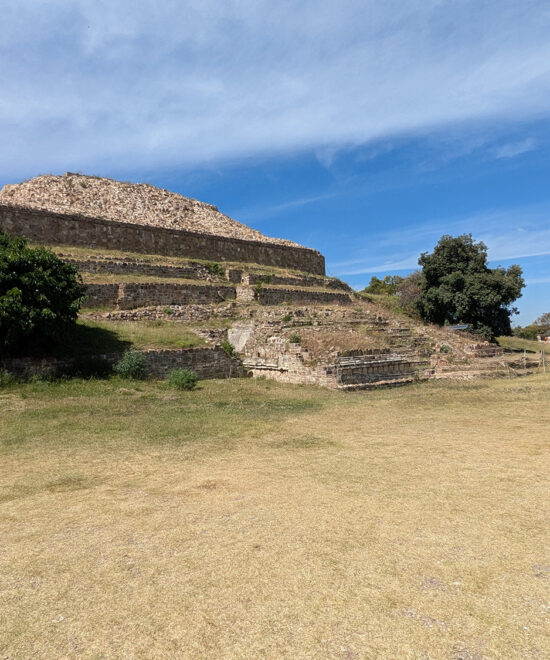
Building VG is the largest and most prominent structure of the Vértice Geodésico complex on Monte Albán's North Platform, a high-status ceremonial platform whose placement, enclosure, and solar alignments reveal the intimate relationship between architecture, elite ritual, and calendrical order in the Zapotec capital.
More than a scenic platform at the summit of the site, Building VG belongs to a restricted sacred precinct where architecture, dynastic imagery, and controlled astronomical observation converged within one of the most exclusive ritual environments documented at Monte Albán. Its significance extends across three interrelated domains: monumental spatial organization, archaeoastronomical alignment, and the progressive privatization of elite ceremony during the Classic period.¹⁷
Overview
Building VG, or Edificio VG, is the largest and most visually commanding structure in the Vértice Geodésico complex, the enclosed plaza situated on the highest architectural shelf of Monte Albán's North Platform. Dating principally to the mature Classic phases of the site (Monte Albán IIIB–IV, ca. AD 500–800), it constitutes one of the clearest examples of how the Zapotec elite engineered spaces that were simultaneously physically elevated and socially restricted. In marked contrast to the broad theatrical openness of the Main Plaza below, Building VG belongs to a far more circumscribed ceremonial environment, one designed expressly for limited access, controlled visibility, and high-status ritual performance.⁴⁷
The significance of Building VG resides in three overlapping functional and interpretive domains. First, it anchors the Vértice Geodésico complex architecturally, serving as the principal eastern structure in the quadrangular arrangement. Second, it participates in a set of solar alignments that have rendered the complex central to contemporary archaeoastronomical research at Monte Albán.¹ Third, it belongs to a summit zone whose restricted spatial logic suggests that, during the Classic period, the most sensitive ritual and dynastic acts at Monte Albán were progressively withdrawn from mass public view and concentrated within exclusive elite precincts.⁴
Taxonomy and Modern Designation
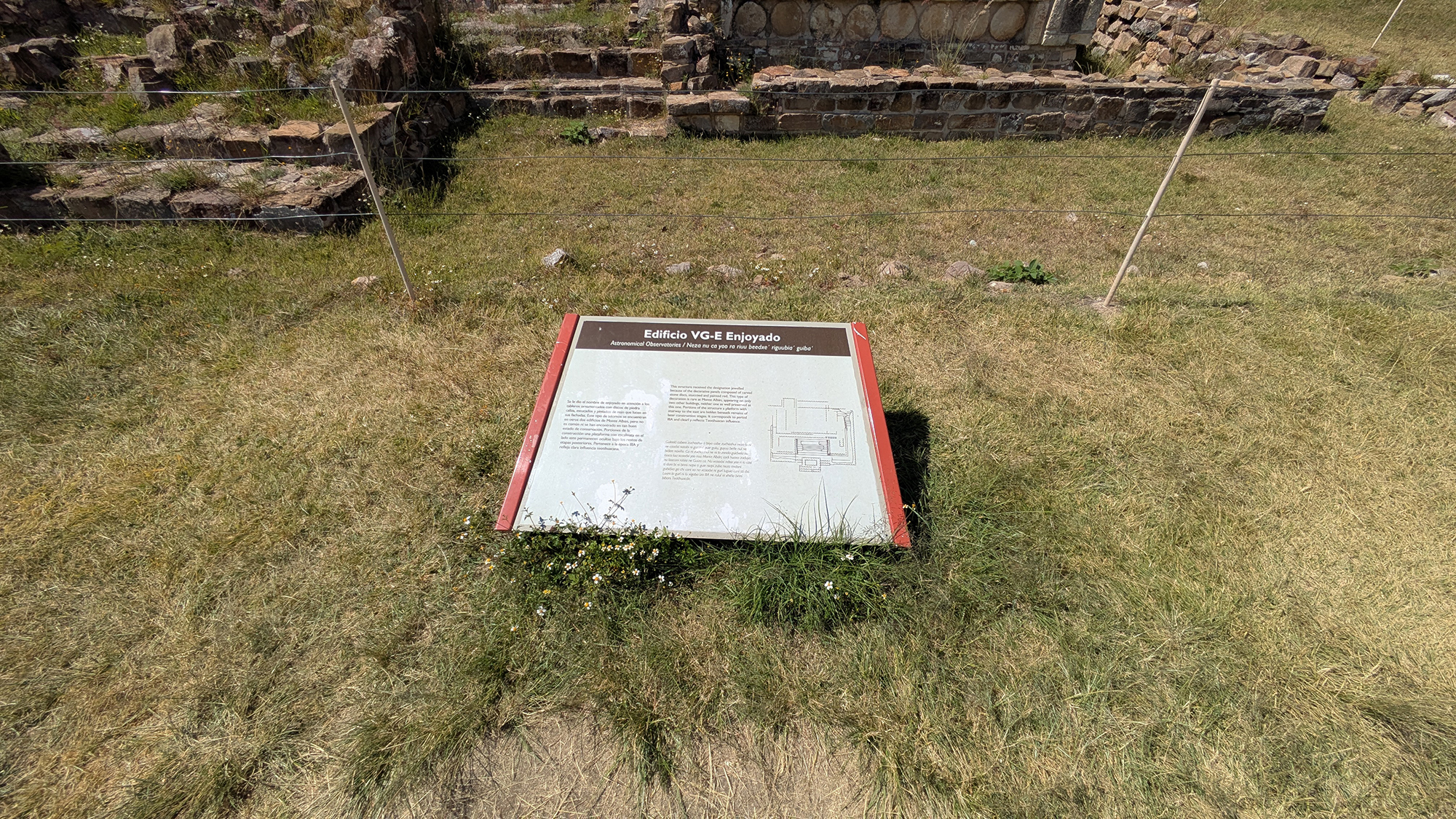
The designation "Building VG" is modern, not ancient. It derives from the Vértice Geodésico, the geodetic benchmark placed on the structure during modern surveying and cartographic operations. In scholarly and interpretive contexts, the building is typically discussed as a component of the Vértice Geodésico complex or Geodesic Vertex Group—terms that describe the wider enclosed precinct rather than a single isolated monument.
This distinction is methodologically important. Building VG should not be treated as an isolated platform on the summit. Its architectural function, ritual logic, and astronomical significance become substantially clearer when the structure is analyzed within the full quadrangular group in which it stands. The modern designation may be an archaeological convenience of nomenclature, but the underlying architectural reality—a coherent, formally enclosed precinct—is demonstrably ancient.⁷
Location and Spatial Organization
Building VG occupies the eastern side of the Vértice Geodésico complex on the North Platform, one of the highest and most exclusive architectural sectors of Monte Albán. The complex is defined by four principal structural boundaries: Building VG to the east, Building D to the north, Building E to the south, and the Temple of the Two Columns to the west. Together, these structures form a compact enclosed quadrangle—in effect, a concealed summit plaza removed from the great public stage of the Main Plaza below.⁷
This spatial arrangement is analytically crucial. The North Platform already occupies a privileged position within the monumental city, but the Vértice Geodésico complex introduces a second, more restrictive level of spatial segregation within that broader high-status zone. Its architecture implies not public congregation but selective participation: controlled ingress, limited sightlines, and an intentionally circumscribed audience. In practical terms, whatever ceremonial or administrative activities took place within this precinct were designed to be experienced by a numerically restricted elite, not by the general urban population.⁴
Architecture and Construction
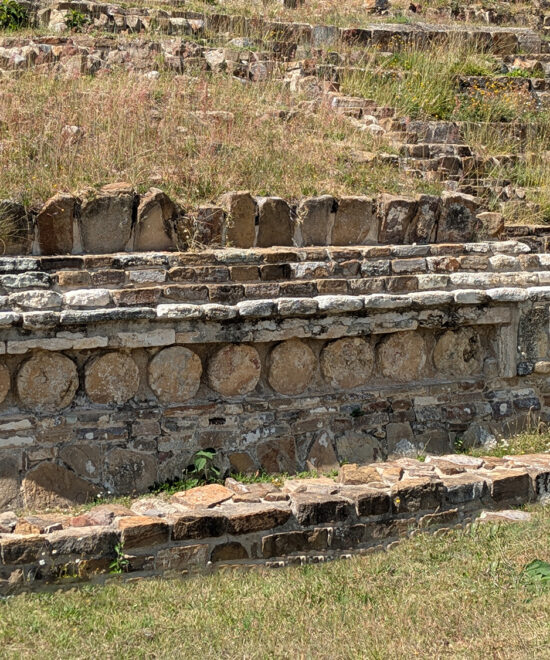
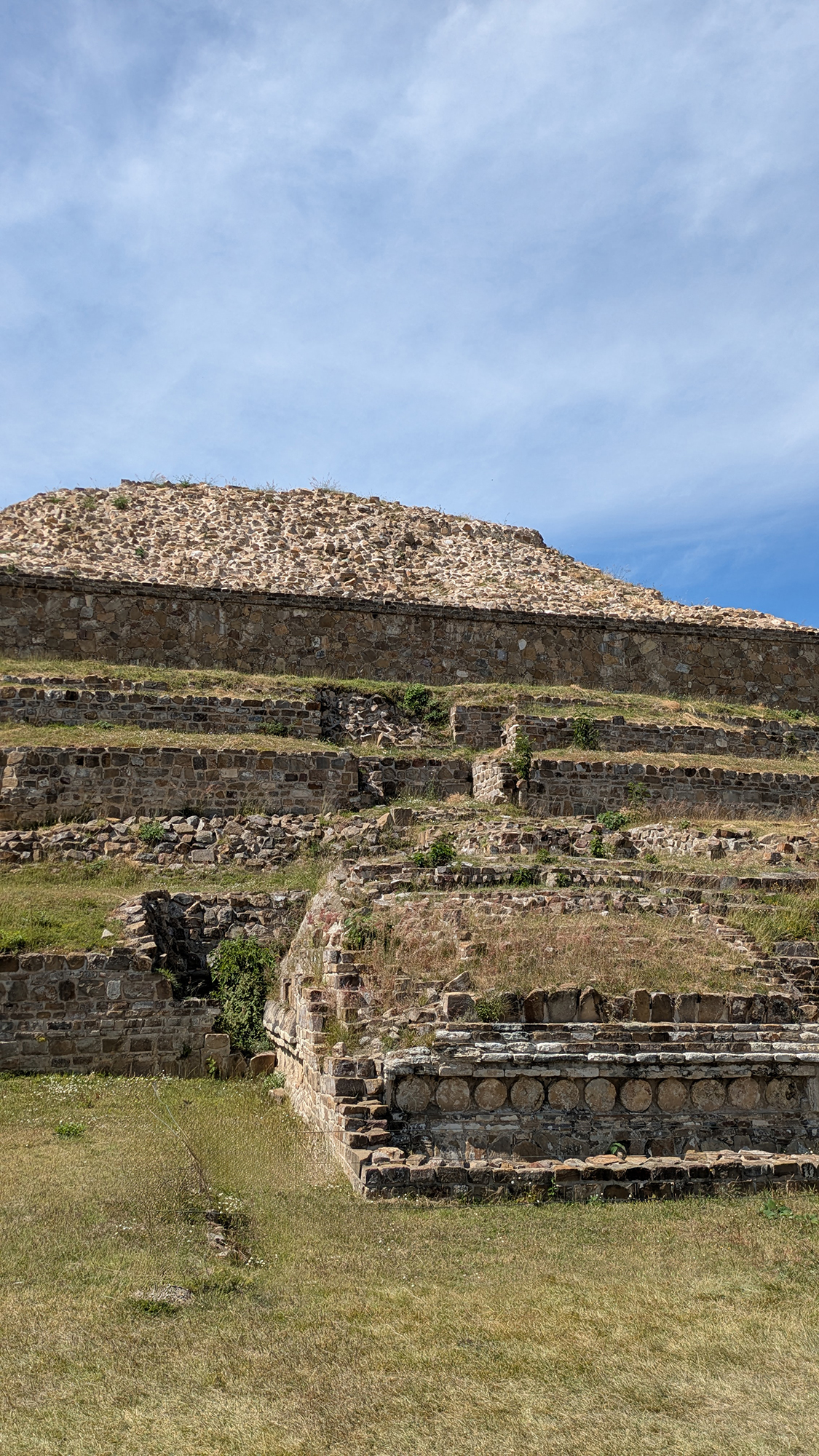
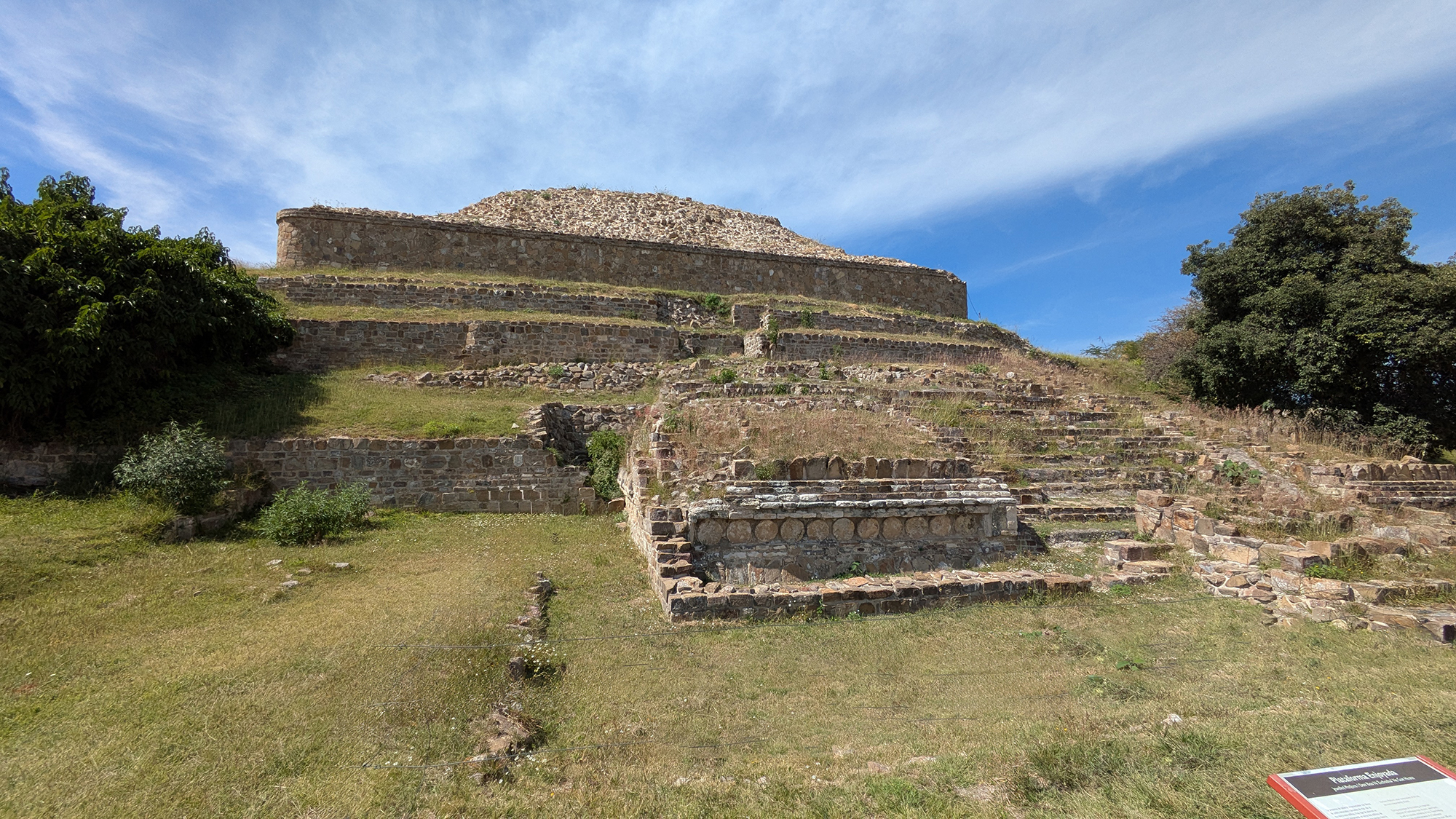
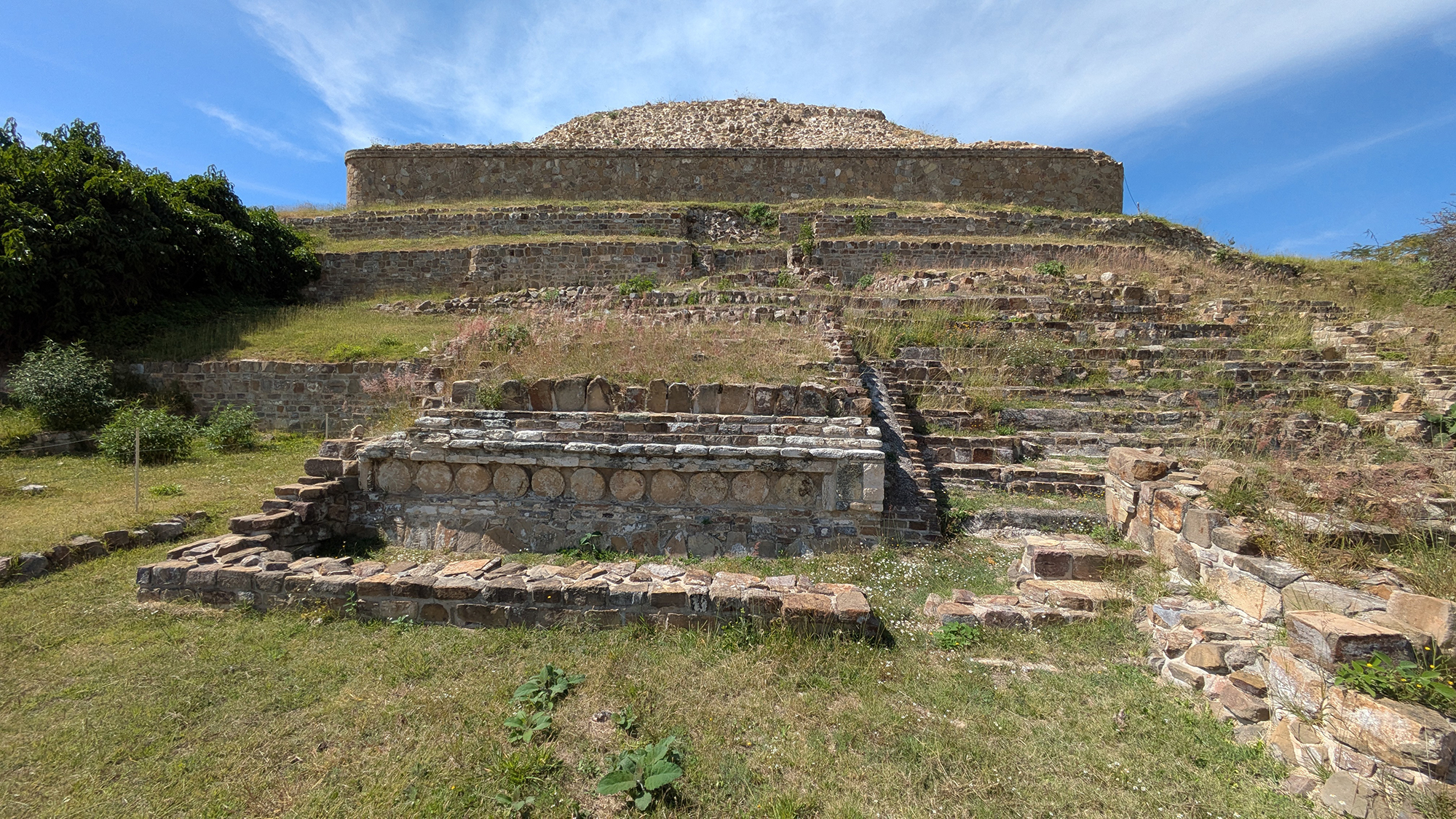
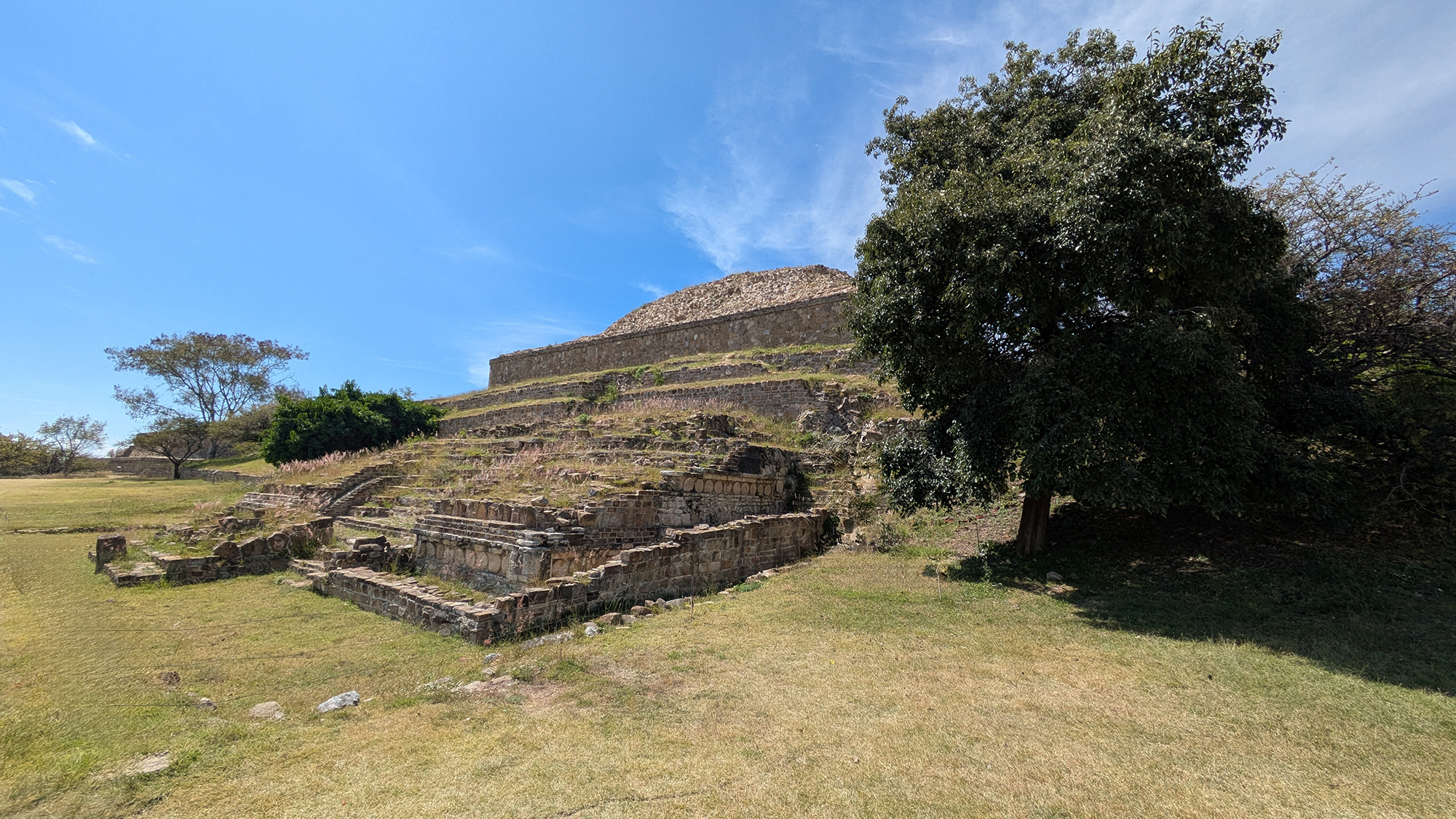
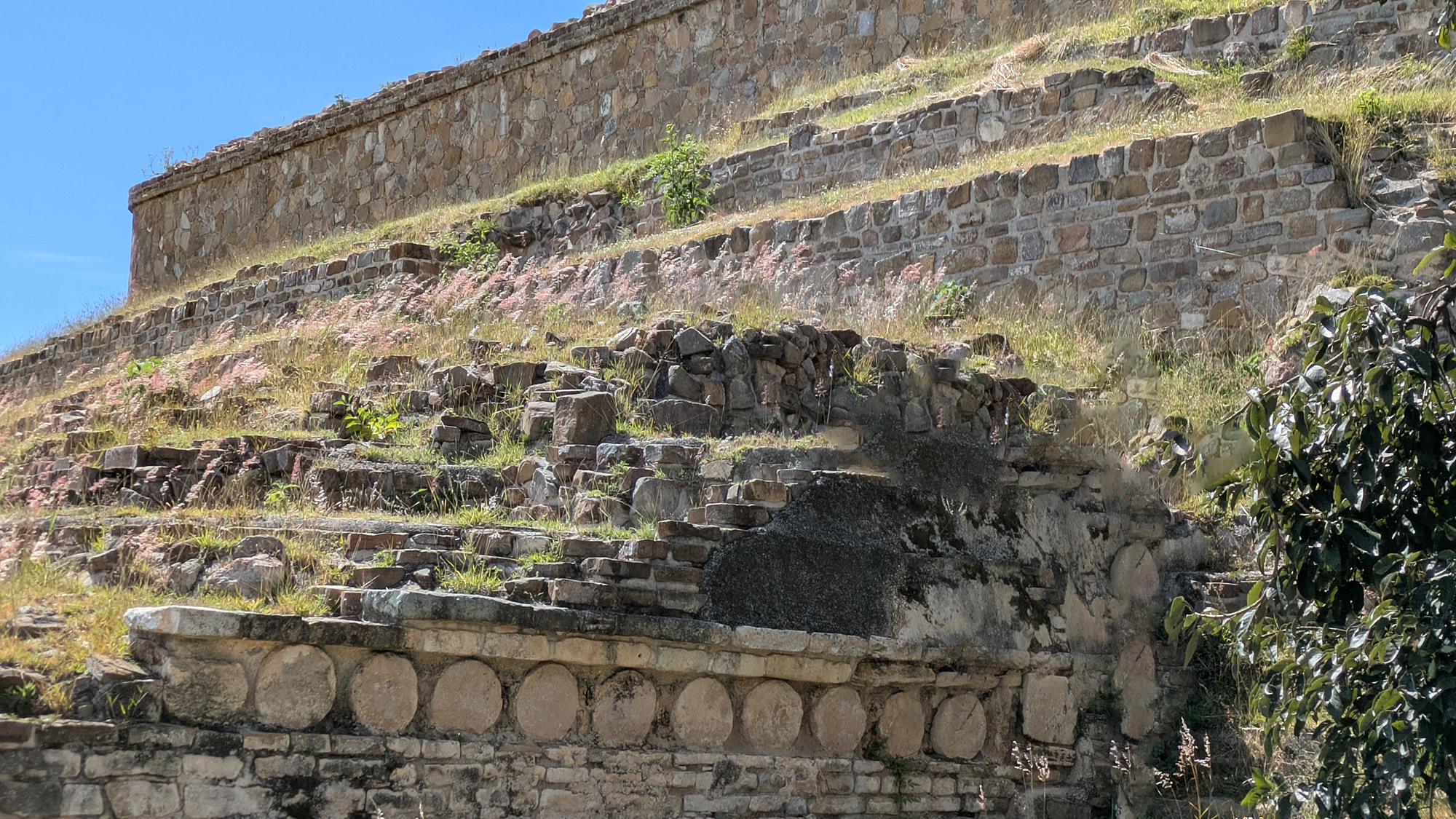
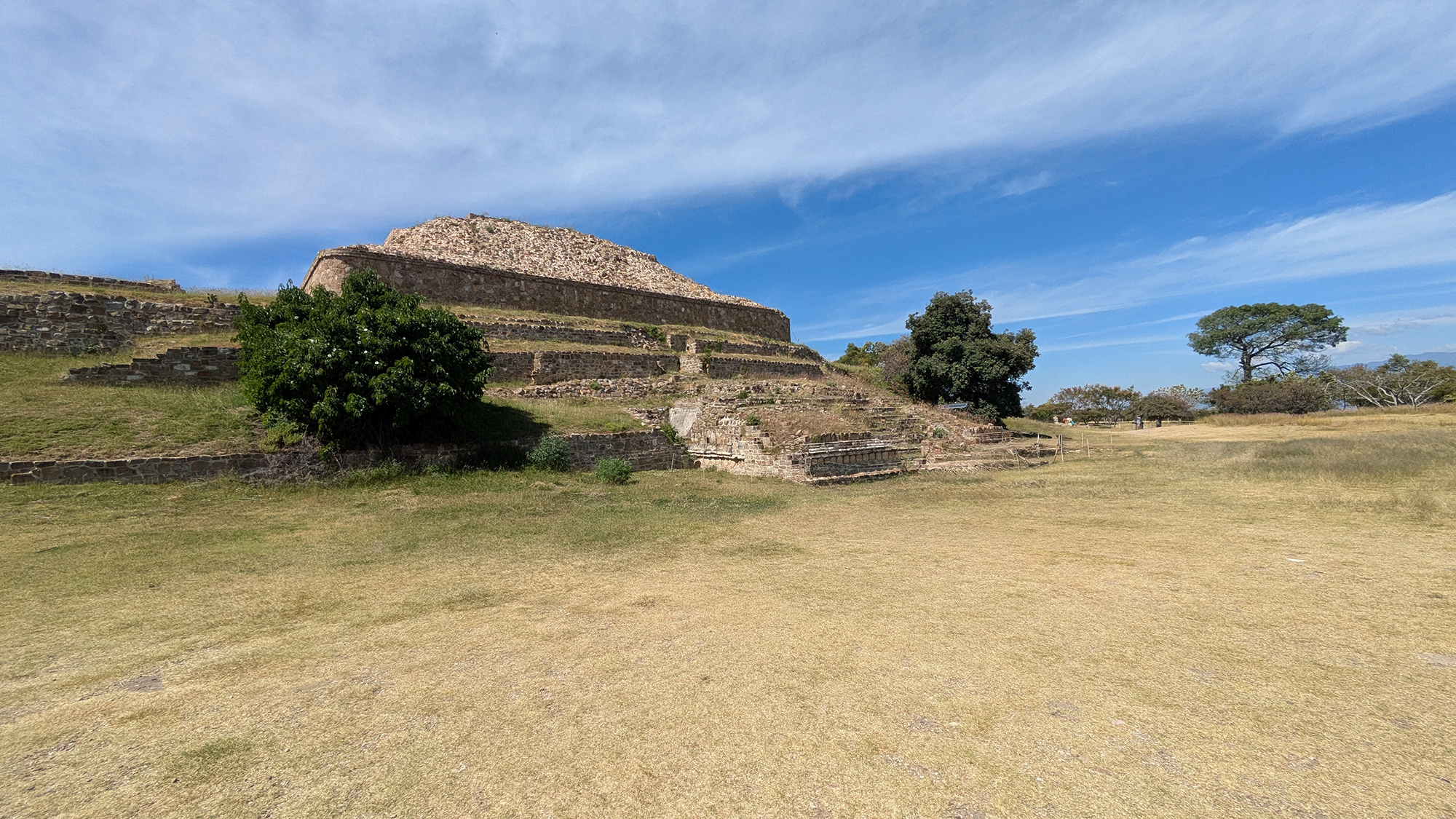
Building VG is a substantial rectangular platform constructed with stone foundations supporting adobe superstructures finished in stucco—materials and techniques consistent with the standard Zapotec elite building tradition of the Classic period. As the largest structure in the Vértice Geodésico complex, it dominates the east side of the enclosed plaza and establishes the principal architectural counterweight to the Temple of the Two Columns on the west. Its scale and axial placement confirm its role as the primary eastern component of the precinct.⁷
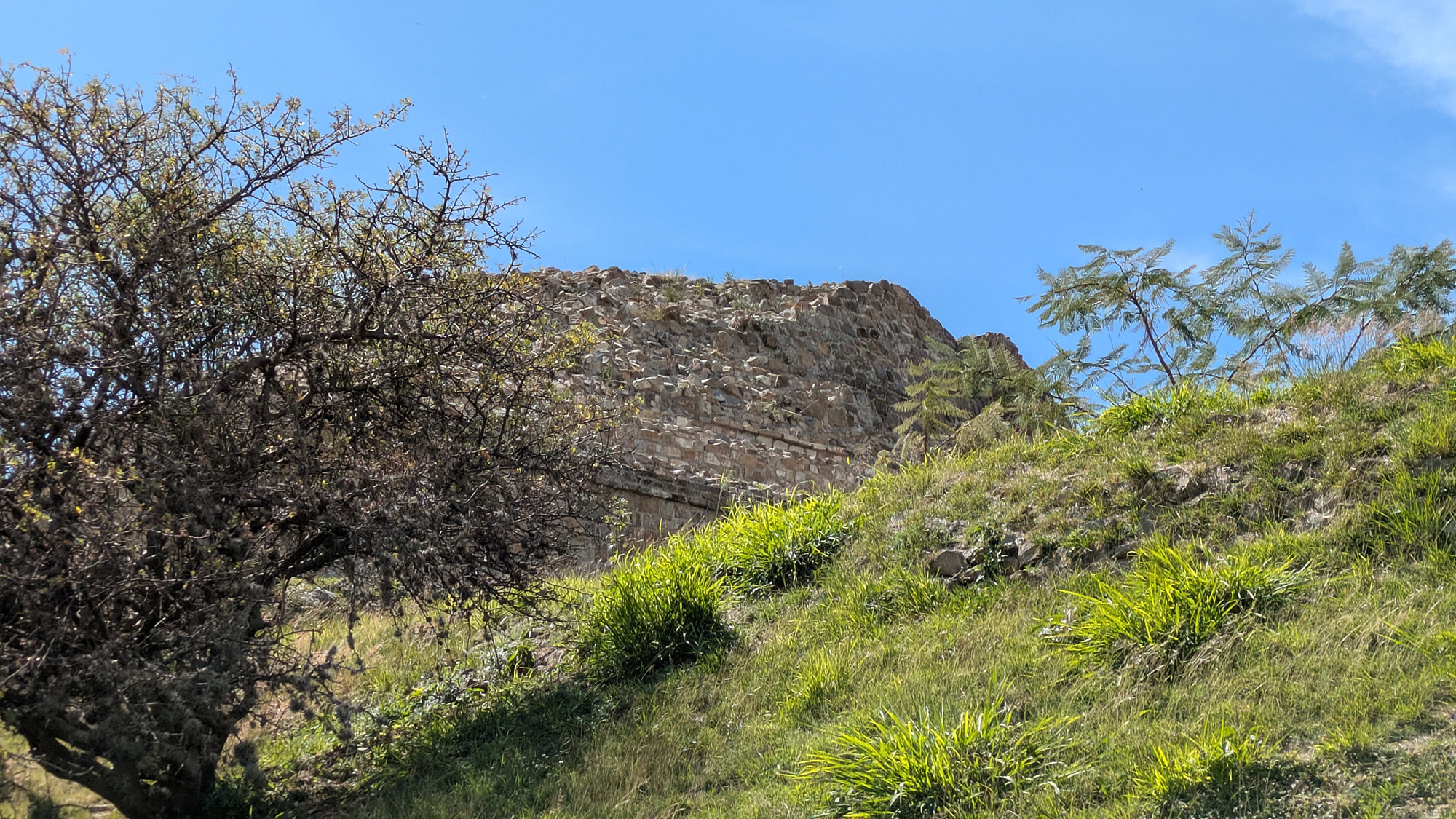
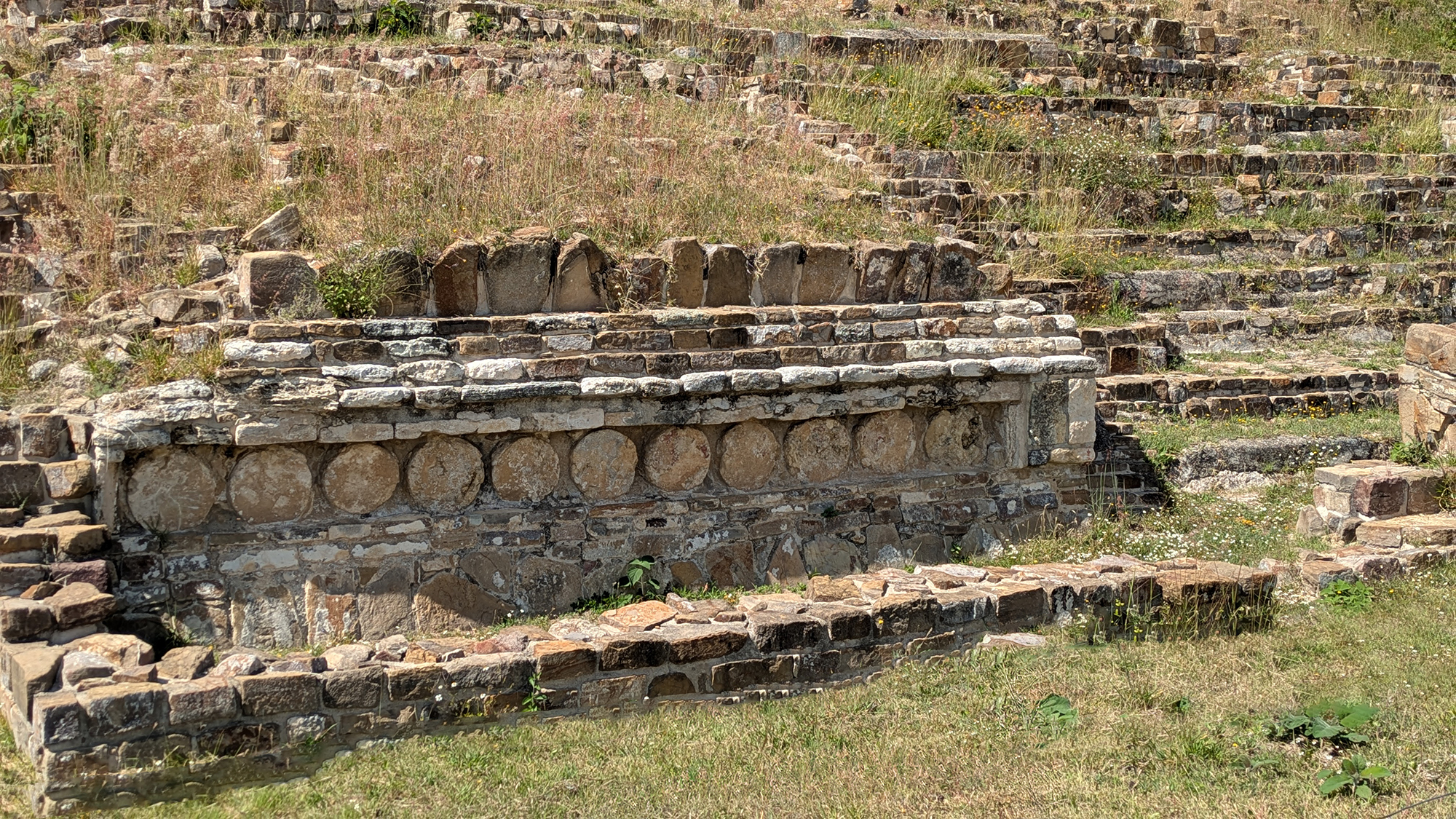
The visible remains indicate a summit building now largely reduced to its foundational courses, though the surviving architecture still communicates mass, formality, and controlled access. Broad stairways provide ascent, and the geometry of the platform is of particular significance because it is directly implicated in the solar alignments for which the complex has become known. Building VG was not merely a structure situated in an astronomically favorable location; its architectural orientation was itself integral to the alignment logic of the precinct.¹
The overall constructional character of the complex belongs to the mature Zapotec state idiom, wherein stone, adobe, stucco, and carefully regulated circulation patterns were deployed to reinforce both political authority and sacred order. If the exterior surfaces were painted—an entirely plausible proposition for a structure of this status and period—then the original visual impact would have been considerably more vivid than the stripped stone profile visible to the modern observer.⁴
The Enclosed Elite Precinct
One of the most analytically significant aspects of Building VG is not the structure in isolation, but the character of the space it helps to constitute. The Vértice Geodésico complex functions as an enclosed elite plaza at the summit of the North Platform. Unlike the Main Plaza—which could accommodate large-scale gatherings and public ceremonial display—this upper precinct imposed severe restrictions on both physical access and visual exposure.⁴
This spatial configuration supports a broader interpretation advanced by scholars of Monte Albán's political evolution: that during the Classic period, certain categories of ritual practice and forms of political authority became progressively concentrated in private or semi-private elite environments, withdrawn from the theatrical public arenas that characterized earlier phases of the city's development. Building VG belongs precisely to this world. It represents architecture designed as much for exclusion as for devotion. The individuals who occupied this space were not members of the general populace; they constituted the ruling and ritual class of the Zapotec state.⁴⁷
Archaeoastronomy and Sunset Alignments
Building VG has emerged as one of the most significant structures in the archaeoastronomical analysis of Monte Albán. Recent research conducted under the auspices of INAH, including the 2025 archaeoastronomy workshop held at the site, has demonstrated that the Vértice Geodésico complex contains solar alignments of notable precision. According to the official INAH bulletin, one of the key alignments occurs when the axis of symmetry of Building VG corresponds to the position of the setting sun on the evenings of September 1 and April 11, observed across the enclosed patio toward the Temple of the Two Columns.¹
These dates are not incidental. They belong to what researchers describe as a broader Mesoamerican pattern of calendrically significant intervals, frequently discussed in relation to the 73-day family of solar positions. Within this interpretive framework, the architectural alignment was not merely observational but temporal: it served to order time through the medium of sacred architecture. Building VG therefore functioned not simply as a platform from which to observe a sunset, but as a component of a built calendrical system embedded within the engineered landscape of the North Platform.¹
This constitutes one of the strongest arguments for reassessing the scholarly attention accorded to Building VG. It represents one of the architectural loci at Monte Albán where the Zapotec state may have rendered temporal order materially visible—where calendrical knowledge was inscribed not in codices or carved glyphs alone, but in the very orientation and spatial relationships of monumental architecture.
Relationship to the Temple of the Two Columns
Directly opposite Building VG, on the western side of the same enclosed complex, stands the Temple of the Two Columns. The architectural and functional relationship between these two structures constitutes one of the defining features of the precinct. The solar alignment documented in recent INAH interpretation depends specifically on an observation axis running from the stair zone of Building VG toward the Temple of the Two Columns, where the setting sun is framed between architectural elements on the calendrically significant dates.¹
This pairing carries iconographic significance as well. The Temple of the Two Columns preserves some of the richest visual and symbolic material in the complex, including imagery associated with the deity known as the God of the Wide Beak. The interpretive consequence is clear: the significance of Building VG cannot be analytically separated from the broader ceremonial logic of the precinct. Building VG is not the sole meaningful structure in the complex, but it is the platform whose orientation and axial position make the spatial and solar drama of the group architecturally operative.¹⁵
Epigraphy, Iconography, and Dynastic Significance
Building VG itself is not the best-known epigraphic monument at Monte Albán, but the wider Vértice Geodésico complex is rich in symbolic and inscriptional material. Carved monuments and sculptural elements associated particularly with Building E and the Temple of the Two Columns indicate that this summit precinct served not only astronomical but also dynastic and ideological functions.⁵
Of particular importance is Stela VGE-2, associated with the south side of Building E within the same complex. Scholarly interpretations of this monument identify it as a genealogical and succession-related composition depicting elite figures, including women of named status. While specific details of its iconographic reading remain subject to ongoing scholarly discussion, the broader conclusion is well supported: the Vértice Geodésico complex participated actively in the visual documentation of lineage, political authority, and legitimized dynastic succession.⁵
In this context, Building VG belongs to a sacred-administrative summit environment where astronomical observation, dynastic imagery, and restricted ritual practice likely reinforced one another in a mutually constitutive relationship. Architecture did not stand apart from ideology within this precinct. It was the principal medium through which ideology was spatially enacted.
Archaeological Research and Modern Interpretation
Building VG owes much of its contemporary scholarly visibility to two converging research traditions. The first is the longstanding program of excavation and architectural interpretation at Monte Albán, from the foundational campaigns of Alfonso Caso onward, which established the North Platform as a zone of elite and ceremonial complexity within the urban center.⁴
The second is the more recent and rapidly developing field of archaeoastronomy at the site, particularly the 2025 INAH workshop and associated interpretive studies that brought renewed analytical focus to the September 1 and April 11 sunset alignments of the Vértice Geodésico complex.¹
Building VG should also be situated within the context of broader geophysical investigation at Monte Albán, which has revealed subsurface structures and extended construction histories in other sectors of the site. Even when such studies do not address Building VG specifically, they reinforce a critical methodological point: what survives visibly at Monte Albán often represents only the terminal constructional phase of substantially deeper architectural biographies.⁶
Site Context and Viewing Notes
Building VG commands some of the finest panoramic vistas at Monte Albán, particularly southward across the Main Plaza toward the South Platform. However, the structure should not be reduced to the status of a scenic overlook. Its architectural, ritual, and astronomical value substantially exceeds its topographic advantage, considerable though that advantage may be.³
Visitors reaching the Vértice Geodésico complex are encouraged to observe the enclosed spatial character of the summit plaza and to note the westward axial relationship between Building VG and the Temple of the Two Columns. The solar alignment is most frequently discussed in relation to the September 1 and April 11 dates, although the fragile upper remains of the complex merit careful treatment and physical respect from all visitors. The modern geodetic marker on the summit introduces an additional layer to the building's material biography: a contemporary surveying instrument resting atop an ancient one.¹
Significance
Building VG is one of the clearest loci at Monte Albán where elite spatial organization, sacred architecture, and calendrical timekeeping converge. It is not the most widely recognized structure at the site, but it is among the most analytically revealing. Its position on the highest sector of the North Platform, its role within a concealed quadrangular precinct, and its solar alignment with the Temple of the Two Columns render it an indispensable monument for understanding how the Zapotec state employed architecture to regulate both social access and temporal order.¹⁴
This is why Building VG warrants sustained scholarly and public attention. It is at once a summit sanctuary, a calendrical instrument, and a political stage encoded in architectural form. If Monte Albán was a city in which authority was built into stone, Building VG is one of the places where that authority extended its reach beyond the horizon.⁷
Scholarly References & Primary Sources
- INAH. "En Monte Albán el tiempo se ordenó mediante un modelo articulado por la arquitectura sagrada." Official bulletin, 2025.
- UNESCO World Heritage Centre. "Historic Centre of Oaxaca and Archaeological Site of Monte Albán."
- INAH. "Monte Albán." Official site description and broader North Platform context.
- Marcus, Joyce, and Kent V. Flannery. (1996). Zapotec Civilization: How Urban Society Evolved in Mexico's Oaxaca Valley. Thames & Hudson.
- Urcid, Javier. (2001). Zapotec Hieroglyphic Writing. Dumbarton Oaks. See also subsequent works on Zapotec iconography and epigraphy at Monte Albán.
- Levine, Marc N., et al. (2021). "Monte Alban's Hidden Past." Latin American Antiquity.
- MAHC research brief on Building VG, including the Vértice Geodésico designation, elite-plaza interpretation, archaeoastronomical framing, and dynastic context.





Social and Administrative Function
The broader significance of the Vértice Geodésico complex lies in what it reveals about the social and institutional transformation of Monte Albán during the Classic period. By relocating some of the most sensitive astronomical and dynastic ritual activities to the summit of the North Platform, the Zapotec state appears to have transferred important sacred acts into spaces of progressively increasing exclusivity. This was not the architecture of communal participation; it was the architecture of professionalized hierarchy and specialized religious authority.⁴
Building VG therefore accords well with the interpretation of the North Platform as a zone of concentrated elite power. In this analytical framework, the Vértice Geodésico complex was not merely a ceremonial patio group but also an integral component of the administrative and ideological apparatus of the state. Those who controlled calendrical knowledge, ritual timing, and dynastic memory controlled more than ceremony alone; they exercised authority over the temporal and cosmological order upon which the legitimacy of the city itself depended.⁴¹