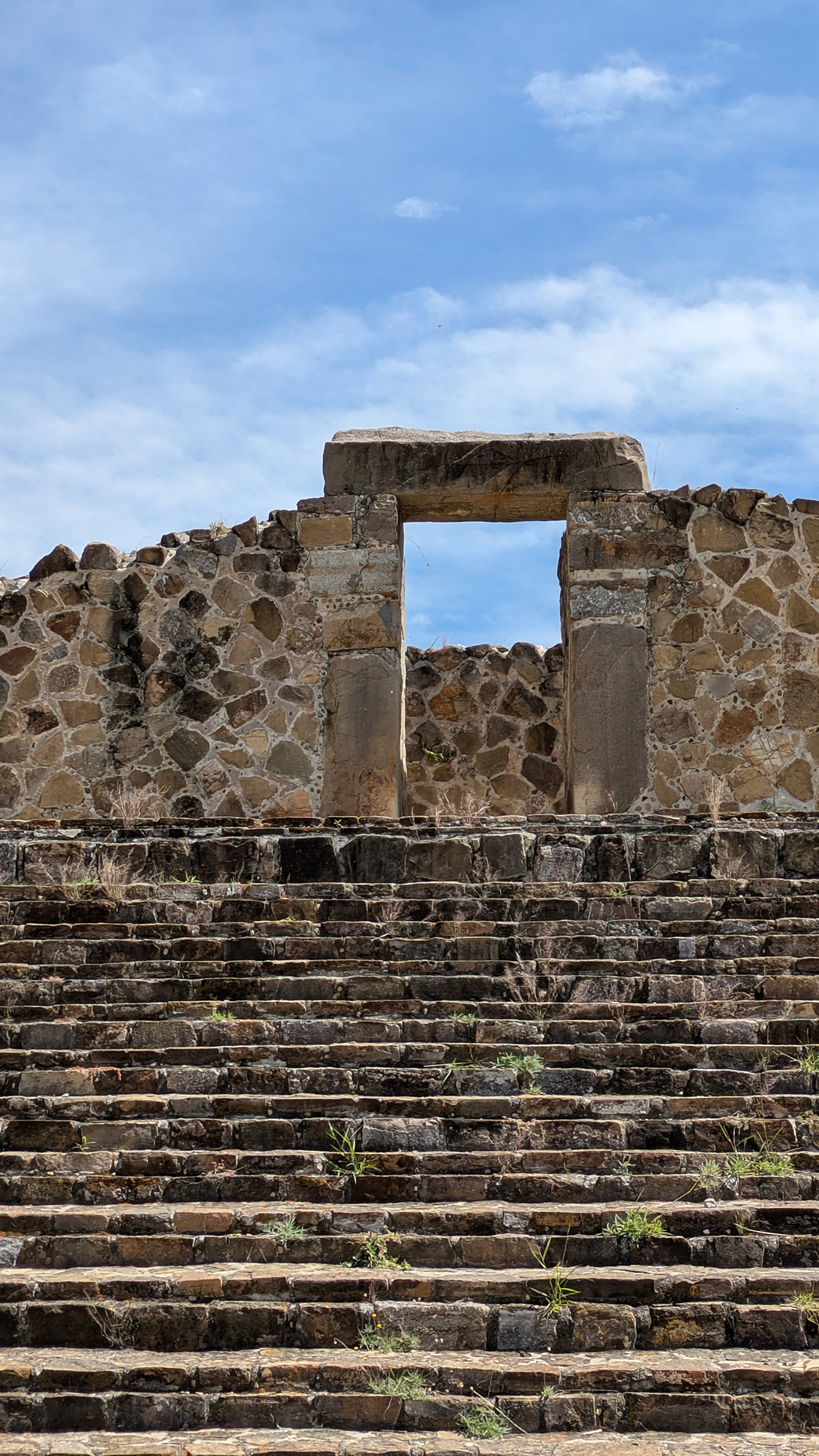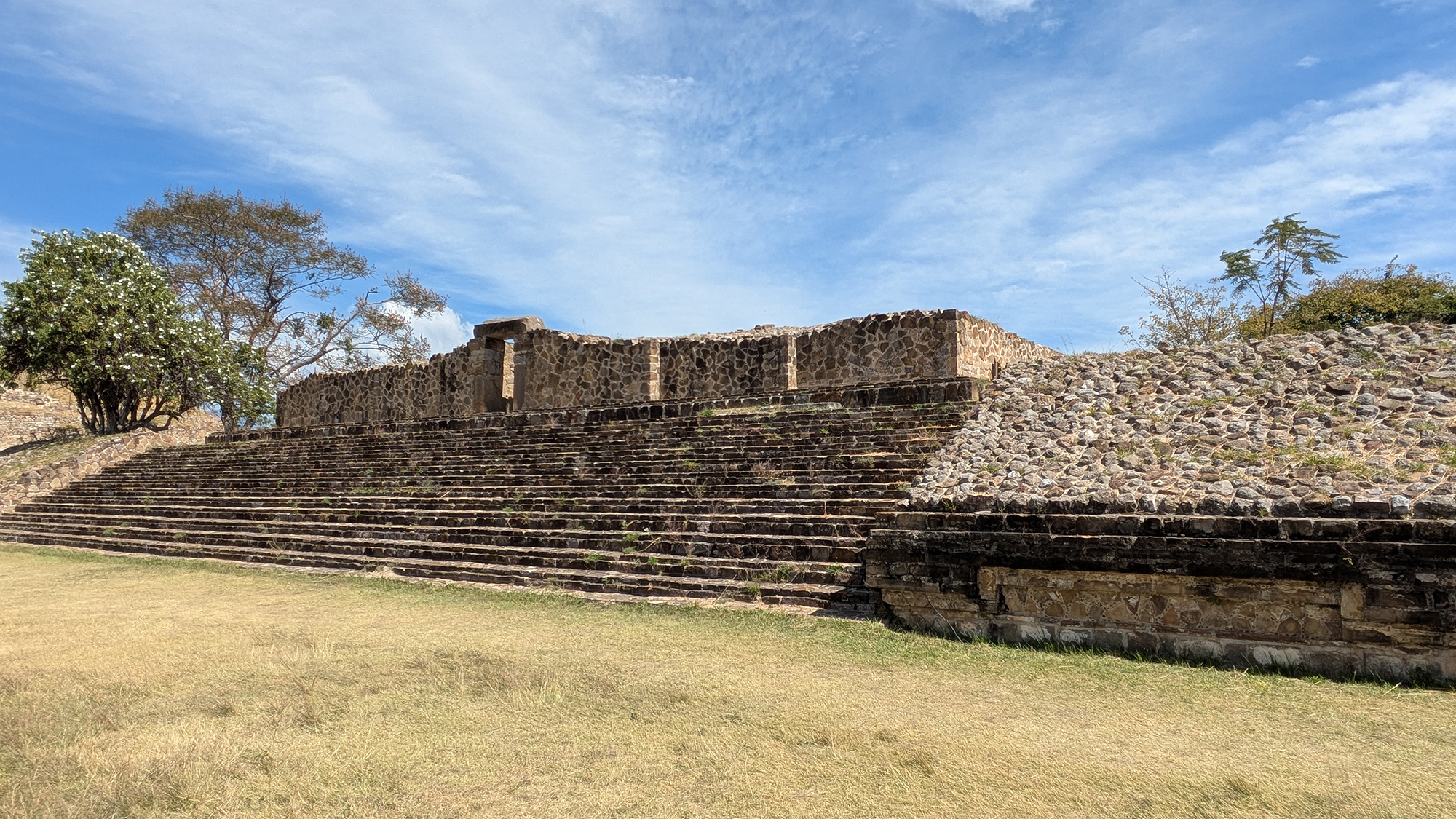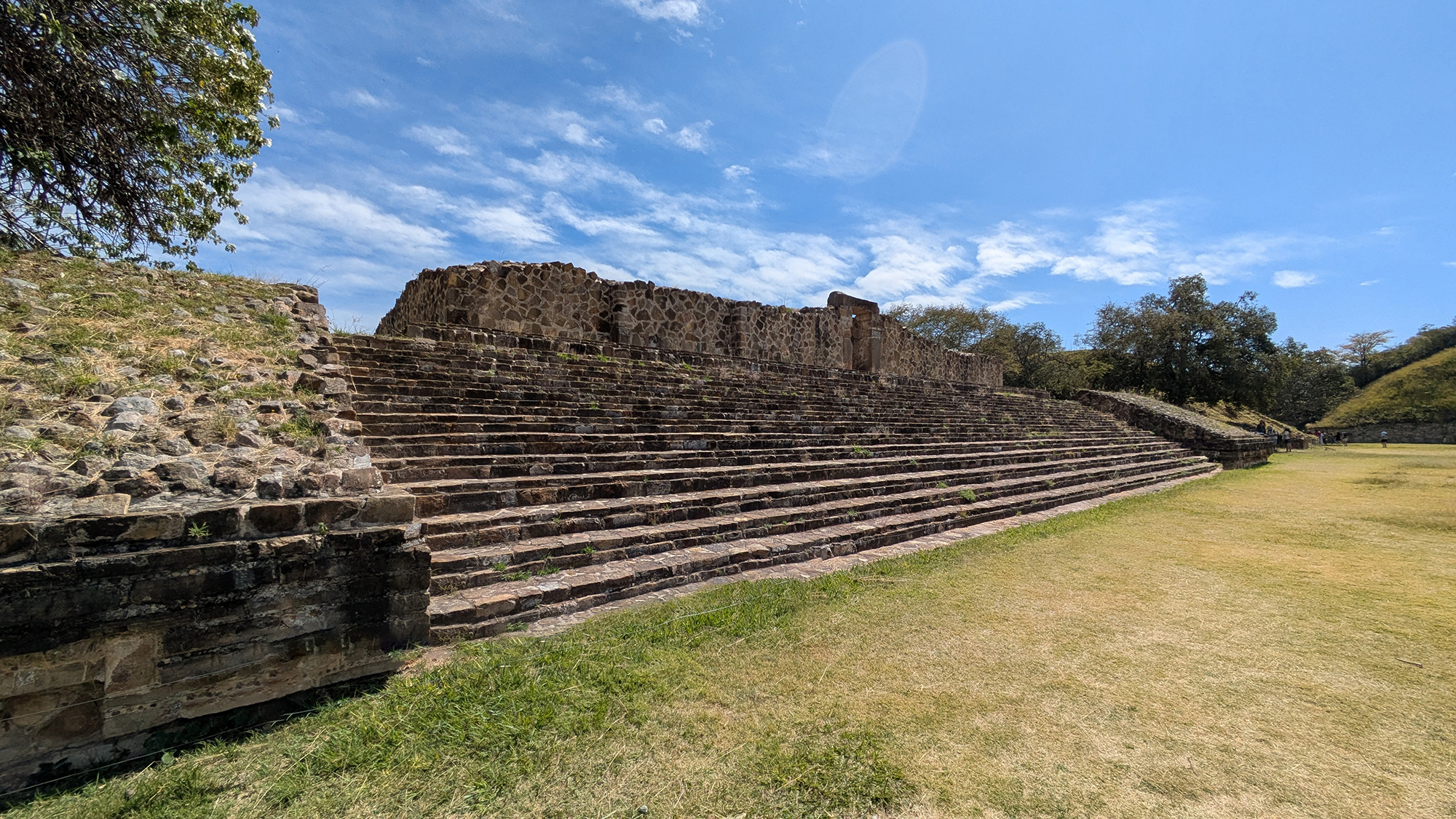




The Palace, designated archaeologically as El Palacio or Building S, represents one of the most critical elite architectural complexes surviving at Monte Albán. Situated along the formidable eastern boundary of the Main Plaza, it belongs primarily to the city’s Classic florescence (Periods IIIA and IIIB-IV). It epitomizes an inward-looking typology of Zapotec high-status architecture—built not for mass public display, but engineered expressly for controlled access, privacy, and the consolidation of authority. Far from functioning as a simple domestic compound, The Palace is widely interpreted as a hybridized structure that seamlessly merged elite residential living, restricted ceremonial activity, and civic governance within a single, tightly controlled architectural envelope.25
The profound significance of The Palace derives not from sheer monumental volume, but from the deliberate sociology of its design. While its broad western staircase interfaces directly with the Main Plaza, the actual ingress route bends through a calculated "blind entrance," structurally preventing direct visibility into the interior patio. Within this perimeter, rooms cluster around a central open court containing a quadrangular altar, while a subterranean tunnel hints at esoteric, controlled movement beneath the surface. Collectively, these spatial features make The Palace one of the most legible models at Monte Albán for studying the architecture of exclusivity and elite segregation from the public sphere.6
Spatial Morphology and Urban Setting
The Palace forms an integral component of the Eastern Group, the continuous monumental alignment that defines the eastern terminus of Monte Albán’s Main Plaza. It is situated immediately south of Building P (renowned for its zenith-aligned features) and north of Building Q. Within the broader urban choreography of the site, it actively participates in the architectural rhythm that includes the Ballcourt and surrounding administrative buildings, effectively counterbalancing the massive ceremonial systems dominating the western esplanade.58
The core structure occupies a nearly perfect square platform measuring approximately 30 by 30 meters, with its residential nucleus entirely enclosed behind substantial masonry walls. Its urban placement is highly strategic: viewed from the plaza, the edifice projects the authority of a monumental state component; yet, upon ascension, the architecture immediately begins to restrict sightlines and physically choke public access. This dual phenomenological condition—hyper-visible externally but heavily screened internally—is central to decoding the building’s sociopolitical meaning.2
Architectural Layout and Internal Organization
The Palace serves as an archetypal surviving example of the quihuitao tradition—the royal or noble Zapotec palace form. In Zapotec archaeology, this term designates a built environment engineered specifically for ranked social access, rigorous internal control, and the physical manifestation of elite lineage and power.69
Its most celebrated architectural feature is the blind entrance. Individuals approaching from the west via the monumental staircase face a doorway that deliberately does not align with the internal courtyard. Instead, the masonry forces a broken, dog-leg path of entry, serving as a visual baffle that entirely prevents external observers from viewing the patio. Official INAH documentation explicitly highlights this feature, recognizing it as one of the most definitive architectural assertions of elite privacy in ancient Oaxaca.5
The interior is organized around a private central courtyard. Current site descriptions document 13 distinct rooms distributed around this patio, utilizing thick masonry divisions. Benches attached to the interior walls strongly align with comparable Zapotec elite residences, where they functioned as seating or sleeping platforms. The spatial syntax confirms the compound was strictly intended to accommodate a small, apex-status demographic rather than broad communal habitation.58
Occupying the center of the patio is a quadrangular altar. Historiographically, early excavators hypothesized the presence of a primary royal tomb directly beneath this patio center, but subsequent INAH investigations have reconsidered this. The preservation of the altar, combined with evidence of adaptation over earlier structural phases, strongly corroborates that The Palace maintained highly specialized ceremonial duties alongside its residential function.5
Constructed primarily of local stone, the complex was originally finished with thick stucco. While surviving surface decoration is highly fragmentary today, the remaining masonry layout—room footprints, patio geometry, and the careful orchestration of the threshold—provides immense data on Classic period elite spatial planning.7
Subterranean Passage and Restricted Circulation
One of the most enigmatic features of Building S is the access point to a subterranean tunnel located within the complex. INAH formally classifies this tunnel as not having been fully or exhaustively explored, which remains the most scientifically prudent classification. The passage appears oriented to connect The Palace to adjacent architectural sectors—likely eastward—though its complete subterranean route and explicit function remain unresolved in public archaeological records.5
Regardless of its exact terminus, the tunnel holds immense interpretive value. When analyzed alongside the blind entrance and the heavily screened patio, it amplifies the structure's ethos of absolute access control. Whether it facilitated practical, hidden movement for rulers, served as a conduit for esoteric ritual staging, or both, the passage confirms that The Palace governed an environment where visibility, movement, and presence were heavily politicized.23
Political Function and Ceremonial Exclusivity
The Palace must be interpreted as an administrative nexus where elite domesticity, sovereign authority, and restricted ritual physically intersected. While older literature simplifies it as a "royal residence," the spatial data suggests a far more complex civic organ. By monopolizing prime real estate on the Main Plaza while aggressively screening its interior, the building provided a secure theater where the ruling stratum could dwell, execute statecraft, receive high-ranking emissaries, and maintain absolute ceremonial distance from the populace below.23
This dynamic makes Building S an invaluable locus for studying Zapotec statecraft. While structures like the South Platform projected ideology publicly, The Palace reveals how power operated once it withdrew behind closed doors. Privacy was not merely a domestic luxury; it was a fundamental technology of governance, materialized in stone to protect and reify elite status.6
Archaeological Historiography and Stratigraphy
The Palace was thoroughly documented during the monumental twentieth-century Monte Albán expeditions directed by Dr. Alfonso Caso, supported heavily by Ignacio Bernal and Jorge R. Acosta. Rigorous ceramic chronologies and stratigraphic analyses securely tethered the visible architecture to the Classic occupation phases, specifically the IIIA and IIIB-IV horizons cited in contemporary INAH records.15
Contemporary archaeological theory has increasingly contextualized The Palace not as an isolated dwelling, but as a node within an interconnected political landscape. Modern conservation protocols have focused on stabilizing exposed masonry and managing visitor circulation, ensuring that the foundational legibility of the compound is preserved, even as it serves as a stark reminder of the once-vibrant stuccoed environment that existed here centuries ago.410
Phenomenological Visiting Notes
For researchers and visitors, The Palace is a highly instructive stop when traversing the eastern boundary of the Main Plaza. Ascending the main western staircase allows observers to directly experience the spatial disruption of the blind entrance before viewing the internal patio, altar, and room foundations. It provides unparalleled physical insight into how elite households carved out protected, sovereign spaces within the dense ceremonial core of the city.5
While the tunnel entrance is visible, internal access is strictly restricted to preserve structural integrity. However, the top platform affords commanding sightlines across the plaza toward the South Platform, vividly illustrating how strategically The Palace was positioned to monitor the civic and ritual heart of Monte Albán.
Scholarly References
- Caso, Alfonso, Ignacio Bernal, and Jorge R. Acosta. La Cerámica de Monte Albán. Instituto Nacional de Antropología e Historia. Cited here for the Monte Albán ceramic sequence used to frame the building’s Classic period chronology.
- Marcus, Joyce, and Kent V. Flannery. Zapotec Civilization: How Urban Society Evolved in Mexico’s Oaxaca Valley. Thames and Hudson, 1996. Used here for the broader interpretation of elite architecture, governance, and Zapotec state organization.
- The Metropolitan Museum of Art. "Monte Albán: Sacred Architecture." Used for general architectural context within the civic and ceremonial core of Monte Albán.
- UNESCO World Heritage Centre. "Historic Centre of Oaxaca and Archaeological Site of Monte Albán." Official World Heritage listing and conservation context.
- Instituto Nacional de Antropología e Historia. "Monte Albán." Official site description. This is the key public source for the blind entrance, central courtyard, quadrangular altar, and tunnel.
- Spencer, Charles S., and Elsa M. Redmond. "A Late Monte Albán I Phase (300-100 B.C.) Palace in the Valley of Oaxaca." Latin American Antiquity. Cited comparatively for the palace tradition and the term quihuitao.
- Evans, Susan Toby, and Joanne Pillsbury, eds. Palaces of the Ancient New World. Dumbarton Oaks, 2004. Includes comparative discussion of palace compounds and an illustration reference for Building S at Monte Albán.
- Oaxaca Travel. "Monte Albán." Public tourism description noting the 13 rooms arranged around a central patio.
- Marcus, Joyce. Zapotec Monuments and Political History. Dumbarton Oaks, 2020. Used for wider political and elite context in Zapotec statecraft.
- Society for American Archaeology. Management of Archaeological Resources in Mexico. Used for broader conservation context affecting major archaeological sites such as Monte Albán.