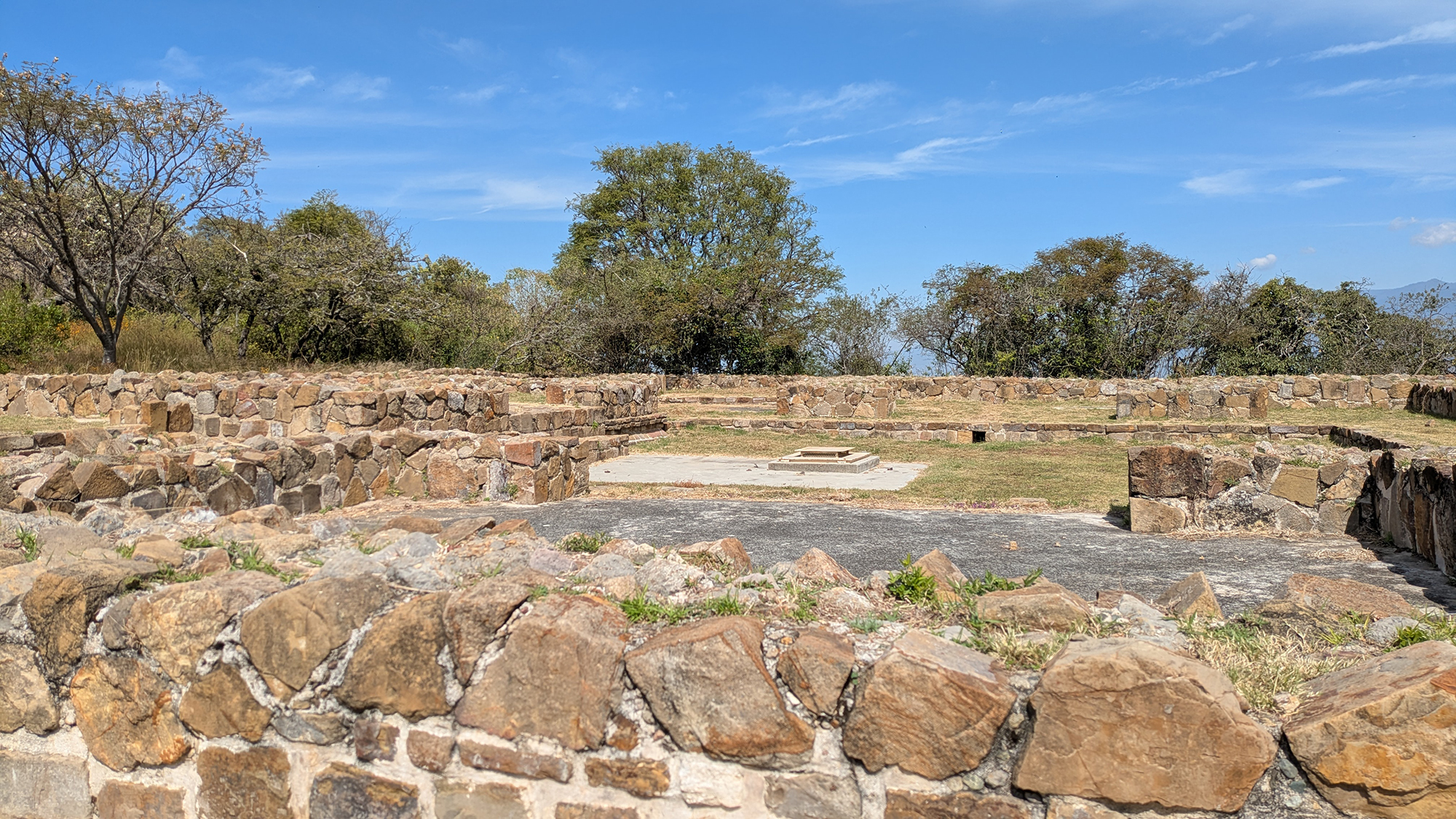
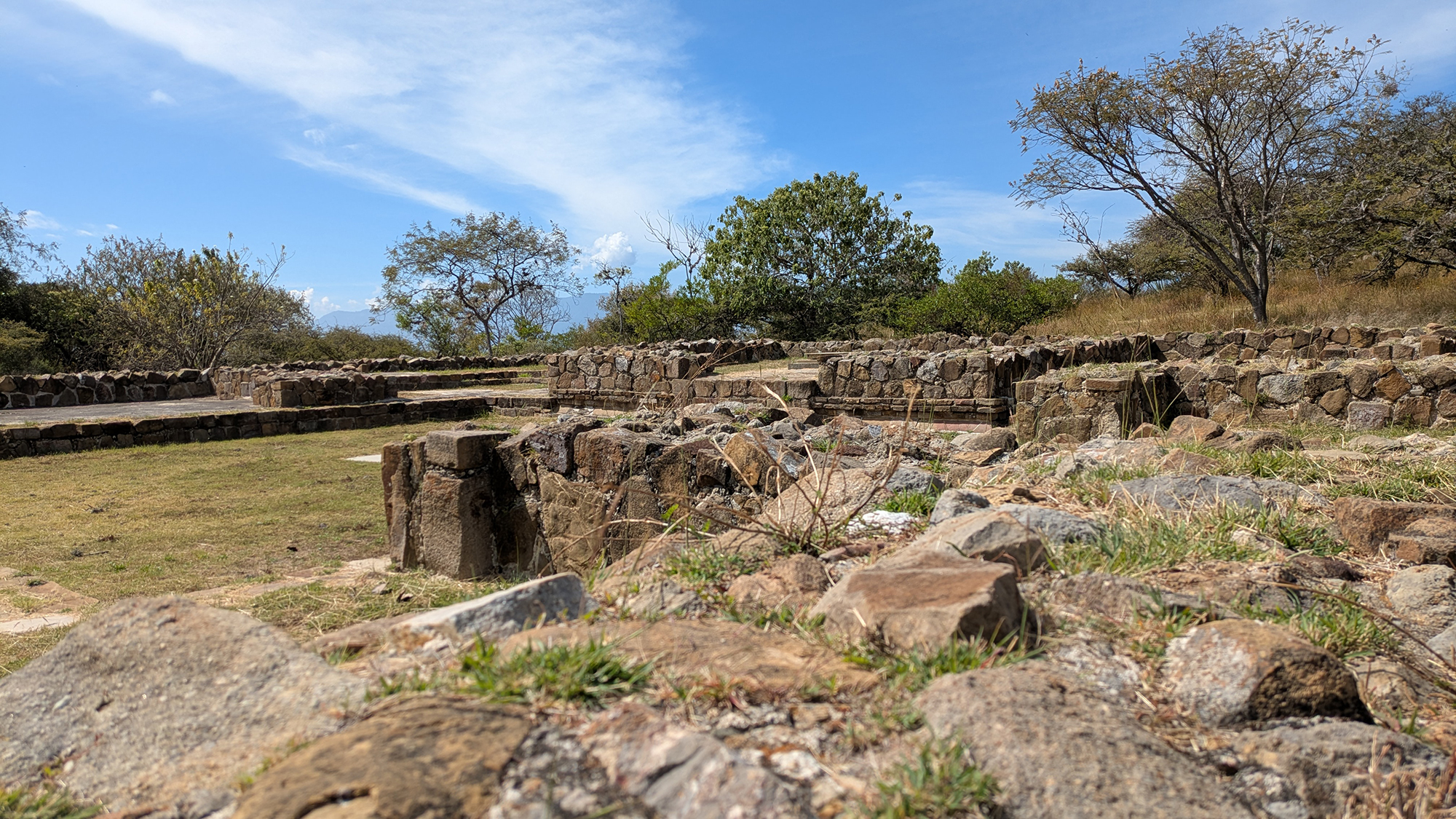
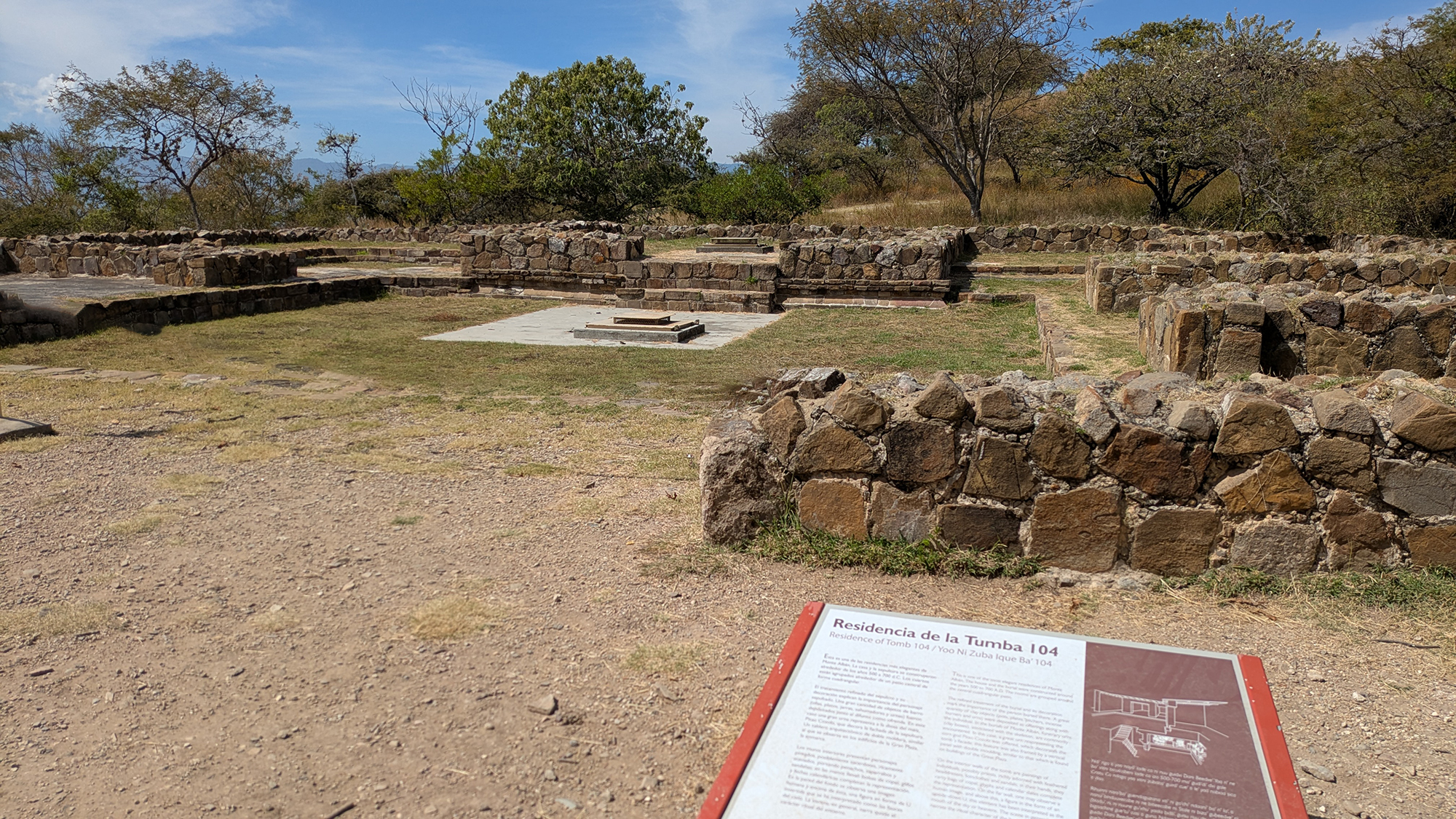
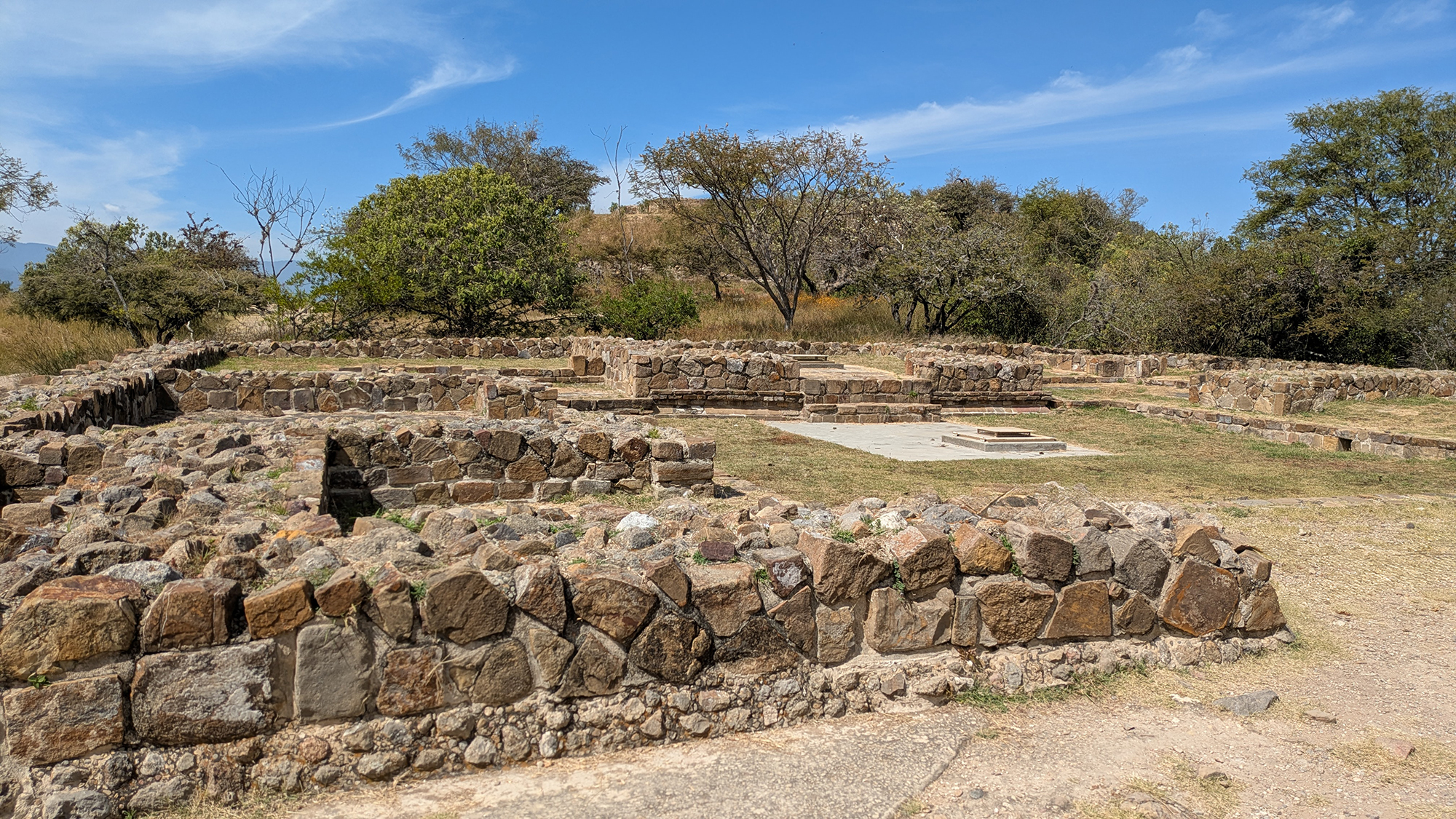
Tomb 104 (Tumba 104) is one of the most celebrated funerary monuments of Monte Albán and stands as one of the finest surviving examples of Zapotec painted mortuary art. Located beneath the patio of a sprawling elite residential complex northeast of the Main Plaza, it forms a critical component of the North Platform sector, illustrating the broader architectural ecosystem where noble houses, the ancestor cult, and sacred memory were inextricably woven together. Its extraordinary significance stems not only from its discovery in a fully intact state, but from the unparalleled way it preserves architecture, mural painting, deity imagery, and burial practice as a single, integrated programmatic vision.
Unlike many monumental tombs that were plundered or disturbed in antiquity, Tomb 104 remained sealed until the twentieth century. This pristine context provides an unusually clear window into Zapotec elite funerary ideology, demonstrating how ancestors were commemorated directly beneath residential compounds and honored through painted processions, sacred glyphs, and a carefully staged architectural façade.1
Spatial Morphology and Residential Context
Tomb 104 lies beneath the western patio of a major residential structure in the northeastern portion of the North Platform sector. Official INAH documentation identifies the housing complex as featuring access points aligned squarely toward the cardinal directions, alongside a sophisticated system of rooms with their own patios, identifying it as part of an elite necropolis operating between AD 500 and 800. This localized setting is crucial: Tomb 104 was not an isolated burial in an open cemetery. It was deeply embedded within a noble residential compound, reinforcing the core Zapotec spatial practice of placing the dead beneath the immediate spaces of the living.3
The tomb itself follows a cruciform (cross-shaped) plan, representing one of the most preferred architectural layouts for high-ranking funerary structures in Monte Albán. It is composed of a vestibule (antechamber) and a principal burial chamber. The entrance is oriented strictly toward the west and was originally sealed by a massive stone slab. This west-facing access and interior organization are consistent with broader Zapotec design typologies, yet Tomb 104 stands out due to the high sophistication with which this plan integrates painting, functional niches, and exterior façade symbolism.
Architectural Stratigraphy and Facade Engineering
Tomb 104 was excavated directly into the bedrock of the hill, a hallmark of labor-intensive, high-status Zapotec funerary engineering. The chamber walls were carved, carefully regularized, and subsequently coated with a fine stucco surface that served as the ground for the exquisite painted murals. The exterior façade is particularly distinguished, displaying the classic doble escapulario (double-scapular) decorative motif—one of the most recognizable and ubiquitous signatures of Zapotec monumental architecture—and incorporates a central niche directly above the doorway.
This elaborate exterior treatment makes it clear that the tomb was intended to be far more than a hidden, sealed chamber. It possessed a public, or semi-public, face within the active residence above. The tomb functioned dually: physically hidden below the patio floor, yet ritually marked above by a sculptural and architectural program that continuously signaled the sacred importance and ongoing presence of the ancestor buried within.
The Pitao Cozobi Urn and Facade Iconography
One of the most striking components of Tomb 104 is the masterful ceramic urn deliberately placed in the central niche of the façade. Institutional records identify this complex urn as representing Pitao Cozobi, the Zapotec deity of maize and agricultural abundance. Intricately, its headdress incorporates the distinct image of Pitao Cocijo, the powerful god of rain and lightning. The theological symbolism is unmistakable: life-giving maize and sustaining rain are fused into a single sacred entity, bringing the concepts of agricultural fertility directly into the mortuary programming of the tomb.5
This proves that Tomb 104 was not conceived merely as a silent, static repository for human remains. The façade participated actively in the religious and social life of the household. The urn served as an interactive mediating image, visible to family members who entered or approached the residential patio, likely functioning as an anchor for the continued ritual veneration of the ancestor. Placing the maize god at the threshold of the tomb powerfully reinforces the Zapotec cosmological view that burial, lineage continuity, agricultural fertility, and divine protection were completely inseparable.
Polychrome Murals and Processional Narrative
Tomb 104 is universally renowned for its extraordinary interior murals, which are among the finest and best-preserved in all of ancient Oaxaca. The paintings wrap the principal walls of the burial chamber, presenting a highly structured, processional arrangement of figures moving purposefully toward the rear of the tomb. The color palette, extensively documented by INAH and UNAM, includes rich hematite reds, blue-greens, vivid ochres, bone blacks, and limestone whites.6
On the south wall, an older male figure painted in red is depicted carrying a specialized bag, widely interpreted as containing copal incense or perhaps maize grains. Mirroring him on the north wall is a younger male figure engaged in similar ritual motion, also holding a copal bag. On the focal back wall, a massive, imposing face emerges from what epigraphers have interpreted as the stylized jaws of the sky or an earth monster.
These are not merely decorative embellishments; they belong to a carefully orchestrated visual narrative tied intrinsically to lineage justification and sacred memory. The result is a chamber that functions as an architectural codex: a space whose walls preserve not only religious imagery but the very identity, ancestry, and sociopolitical memory of the elite family.
Epigraphy, Symbolism, and Lineage Memory
The iconography of Tomb 104 synthesizes ancestral portraiture, divine cosmology, and precise calendrical writing. Accompanying the processional figures are highly specific calendrical glyphs and name signs. Most notably, the prominent glyph "5 Turquoise" appears on the rear wall, alongside other identifying date or name combinations on the lateral walls. Above one interior niche, a painted offering box supports a bird carrying a single grain of maize in its beak. On the north wall, accompanying signs include symbols historically associated with heart sacrifice and named elite identities.8
Together, these elements suggest a highly ordered mortuary world. The deceased were not forgotten individuals surrendered to the earth; they were transformed into revered members of a ritually sustained lineage. By visually linking maize, rain, copal incense, blood sacrifice, the sky, and specific ancestral names, Tomb 104 provides unparalleled insight into how Zapotec elites materialized the continuity between their living household and the divine forces sustaining the cosmos.
Mortuary Assemblage and Human Remains
Constructed for a primary, high-status individual, the tomb yielded a substantial and luxurious inventory of elite ceramic offerings upon its opening. The material recovered emphasizes beautifully crafted polychrome plates, bowls, miniature vessels, elaborate incense burners, and highly specialized ceramic forms associated directly with ritual administration and high rank. These were not generic household utensils; they formed a bespoke funerary assemblage expressly intended to accompany and physically sustain the deceased in the afterlife.
Osteological descriptions note that the individual was interred in a flexed position, with the skull found slightly separated from the post-cranial skeleton. Whether this displacement was the result of natural post-depositional settling, or indicative of secondary ritual activity (a known practice in Mesoamerica), it adds significant complexity to the burial narrative. What remains absolute is the exceptional care and immense resource expenditure dedicated to furnishing the tomb, unequivocally reflecting the apex status of the interred lord.
The 1937 Excavation and Archaeological Historiography
Tomb 104 was spectacularly discovered intact in 1937 during the pivotal sixth season of the Monte Albán Project, directed by Dr. Alfonso Caso. Contemporary reporting and archival records demonstrate that the unearthing immediately garnered national and international attention. The find was instantly recognized as a paradigm-shifting discovery due to its unlooted state, the brilliance of its murals, and the material wealth of its exterior decoration, cementing its place as the most important discovery at the site since Tomb 7.1
The excavation carried immense cultural and political weight in post-revolutionary Mexico, prompting direct attention and visits from President Lázaro Cárdenas. Since then, Caso’s meticulous original documentation has served as the baseline for generations of scholars reconstructing Zapotec lineage ideology, while the tomb itself has become a foundational reference point for the study of pre-Hispanic muralism, pigment composition, and iconographic coherence.7
Conservation Protocols and Institutional Replicas
Due to the extreme fragility and sensitivity of the original stucco and pigments, Tomb 104 is permanently closed to public access. This vital conservation protocol protects the murals from micro-climatic fluctuations, severe humidity changes, and destructive salt blooms. Decades of specialized interventions have focused on stabilizing the tomb's internal environment to halt further deterioration.
To facilitate continued public education and scholarly study without endangering the site, a painstaking, full-scale replica was constructed and is permanently housed at the National Museum of Anthropology (MNA) in Mexico City. This precise reconstruction includes the Pitao Cozobi façade urn and flawlessly reproduces the mural program under specialized lighting. This replica is an essential, highly successful extension of the site's overall conservation strategy, allowing the public to experience the tomb's spatial and visual impact safely.4
Scholarly References
- Marcus, Joyce, & Flannery, Kent V. (1996). Zapotec Civilization: How Urban Society Evolved in Mexico’s Oaxaca Valley. Thames & Hudson.
- UNESCO World Heritage Centre. "Historic Centre of Oaxaca and Archaeological Site of Monte Albán."
- INAH. "Monte Albán." Official description of the Residence of Tomb 104.
- Museo Nacional de Antropología. "Tumba 104 de Monte Albán." Replica and mural interpretation.
- Mediateca INAH. "Tumba 104 tablero y urna sobre la entrada — Dios del Maíz (Pitao Cozobi)."
- Repositorio INAH. "Pintura de la Tumba 104, Monte Albán."
- El Universal. "Monte Albán: Así fue el maravilloso hallazgo de la tumba 104, en 1937." Contemporary reporting on the discovery.
- Urcid, Javier. Works on Zapotec writing and iconography at Monte Albán.