



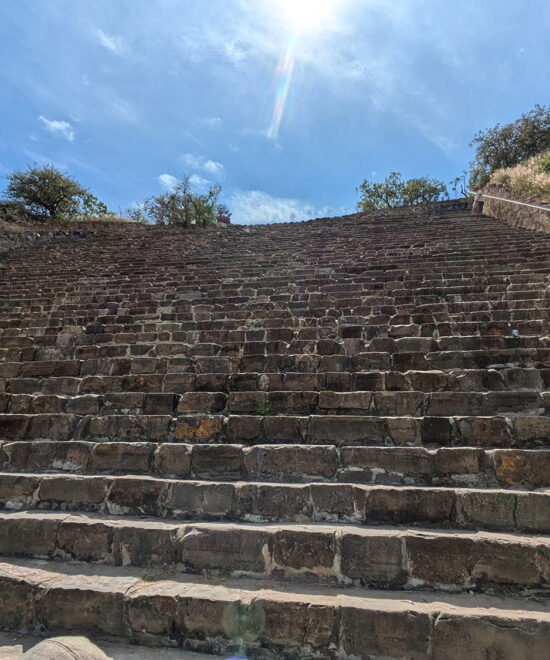
The South Platform (Plataforma Sur) constitutes the most imposing architectural mass within the monumental core of Monte Albán. Defining the southern limit of the Great Plaza, this massive two-tiered pyramidal structure stands at a diagnostic height of 40 meters (131 feet), serving as the city’s primary vertical anchor. More than a feat of masonry, the structure is a complex repository of Zapotec history, integrating nearly a millennium of structural modifications, ritual performance, and advanced engineering intended to withstand the high seismicity of the Oaxaca Valley.12
Engineering a Sacred Topography
The construction of the South Platform required a massive program of cutting and filling to transform the rugged summit of Cerro del Jaguar into a flat, ceremonial esplanade. Zapotec engineers mobilized thousands of tons of local sandstone and greenstone (volcanic tuff) to level the mountain ridge, effectively turning geography into a direct manifestation of state power.1 Positioned at 1,940 meters ASL, the platform was designed to be visible across the three branches of the Oaxaca Valley, signaling a unified regional hegemony known in scholarly literature as a "disembedded capital."1
Chronological Evolution and Construction Phases
The platform’s history is divided into five diagnostic phases, revealing a trajectory from localized lineage mounds to a centralized state monument.1
- Phase I (500–100 BCE): Initial development of smaller temple mounds. Recent GPR surveys (PGMA) identified an 18x18m structure razed during the transition to Phase II, indicating a pivotal sociopolitical transformation.12
- Phase II (100 BCE – 200 CE): Consolidation of the urban core and initial iteration of the unified platform base.
- Phase III (200–800 CE): The Classic apogee. The structure reached its full 40-meter height, adorned with double-scapulary (tablero) moldings and vibrant murals.1
- Phases IV & V (800–1521 CE): Defensive reorganization and later Mixtec reuse as a site of pilgrimage and offerings.
Geospatial Placement
Architecture and Masonry Techniques
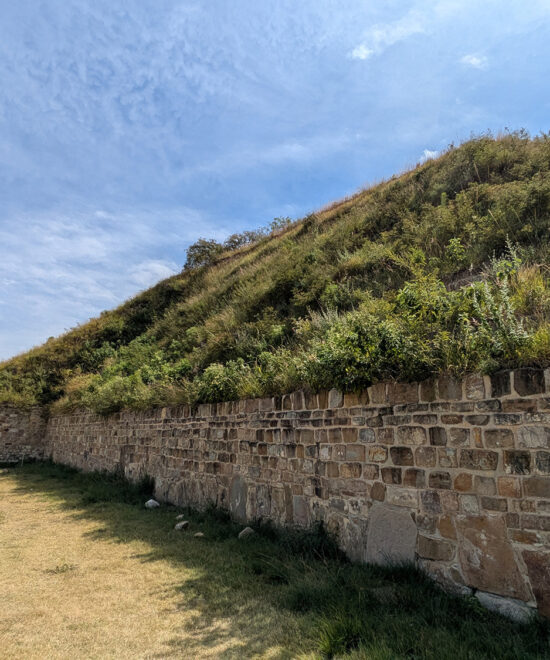
The South Platform is a "two-body" construction, characterized by massive internal rubble fill supported by a dressed stone shell. Key architectural diagnostic features include:
- Main Staircase: A monumental 40-meter-wide staircase designed for high-visibility elite processions.
- Alfardas: Sloping borders that provide structural solidity and a visual frame for the ascent.
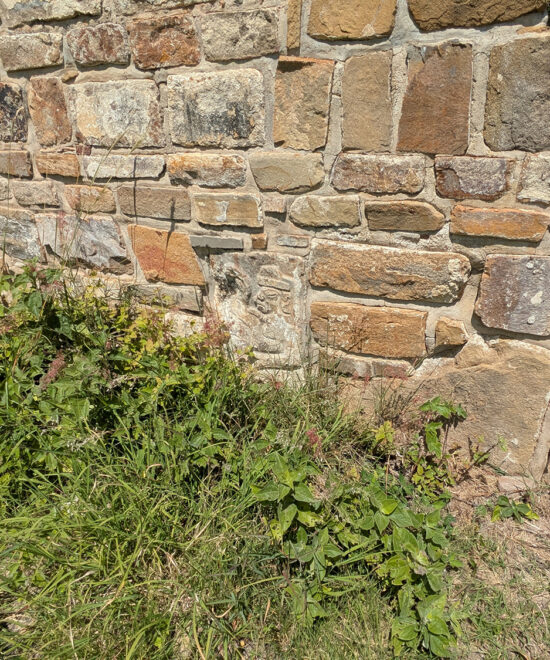
- Scapulary Panels: Zapotec-style tableros that create a rhythmic play of light and shadow, originally finished in white lime plaster.8
Epigraphy and the Public Record
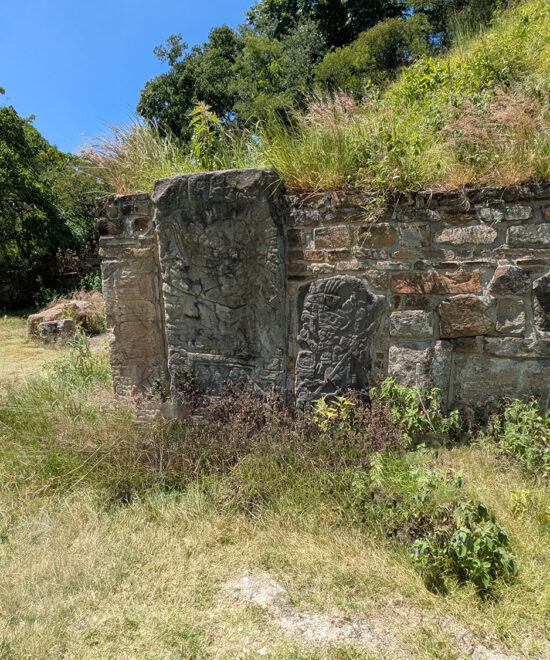
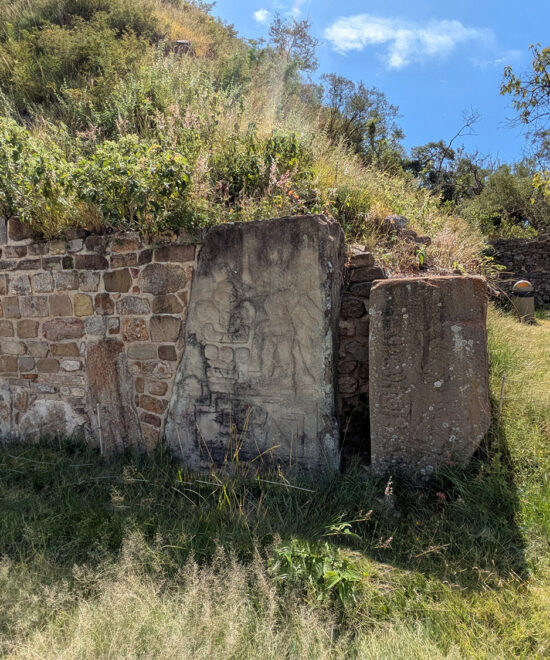
The lower façade of the South Platform serves as a stone archive. Embedded stelae document dynastic events and military conquests in the Zapotec writing tradition.4
- Stelae 12 & 13: Located in the platform's vicinity, these contain the earliest examples of Zapotec hieroglyphic and calendrical notation (Phase I).4
- The 12 Jaguar Slabs: Commissioned by Ruler 12 Jaguar in the 3rd century CE, these record diplomatic encounters with visiting elites from Teotihuacan.16
- Conquest Slabs: Images of bound prisoners and toponymic (hill) glyphs signifying Zapotec regional domination.4
Summit Structures and Archaeoastronomy
The summit of the South Platform was a restricted zone of ritual hierarchy. It houses Building III, the principal temple platform, and the Southeast Mound (M-SE).2 The latter features a vertical shaft identified as a zenith passage instrument, used to track the sun when it casts no lateral shadow—a critical event for the ritual 260-day calendar and agricultural scheduling.2
Resilience: Seismic Adaptation and Conservation
Oaxaca’s high seismicity influenced Zapotec engineering, resulting in the use of thick walls and flexible lime-based masonry.5
| Historical Event | Magnitude | PGA (cm/s²) | Observed Impact |
|---|---|---|---|
| Jan 15, 1931 | 7.8 Mw | ~480 | Monumental rubble collapses. |
| Sept 30, 1999 | 7.5 Mw | 137 | Significant structural fractures. |
| Sept 8, 2017 | 8.2 Mw | 129 | Damage to 11 site monuments. |
Modern restoration under Dr. Nelly Robles García has prioritized traditional lime mixtures over rigid 1930s-era cement, allowing the structure to flex during tremors.5
Institutional Visiting Protocol
Access to the South Platform is subject to INAH regulations. Visitors who ascend the 40-meter staircase are afforded the definitive panoramic perspective of the Great Plaza’s axial planning, providing visual context for Building J, System M, and the North Platform. Photography of the embedded corner stelae is best conducted in morning light to highlight the shallow relief carvings.3
Scholarly References & Primary Sources
- Marcus, J., & Flannery, K. V. (1996). Zapotec Civilization. Thames & Hudson.
- Wikipedia. "Monte Albán: Plataforma Sur."
- INAH. "ZonArq Monte Albán."
- Marcus, Joyce. (1992). Mesoamerican Writing Systems. Princeton University Press.
- SciELO México. "Ground Motion at Monte Albán during damaging earthquakes."
- Masonry Magazine. "Marvelous Masonry: Monte Albán."
- Batres, Leopoldo. (1902). Exploraciones de Monte Albán.
- Paddock, John. (1966). Ancient Oaxaca. Stanford University Press.
- Levine, Marc N. (2021). "Monte Albán’s Hidden Past: Buried Buildings." Latin American Antiquity.
- Metropolitan Museum of Art. "Monte Albán: Stone Sculpture."