


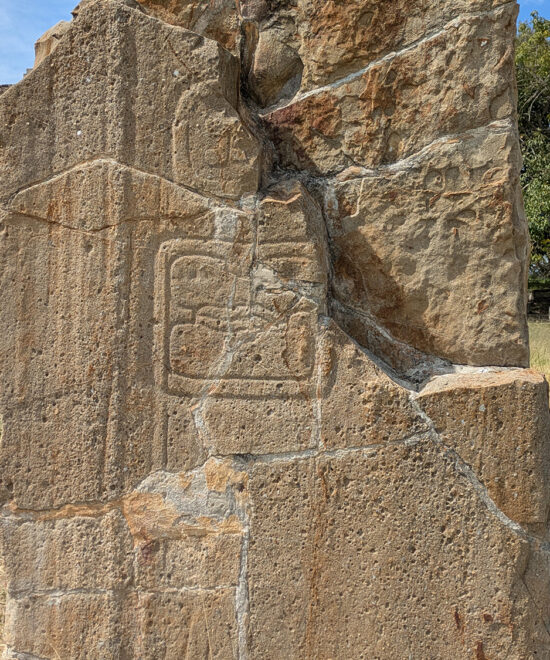
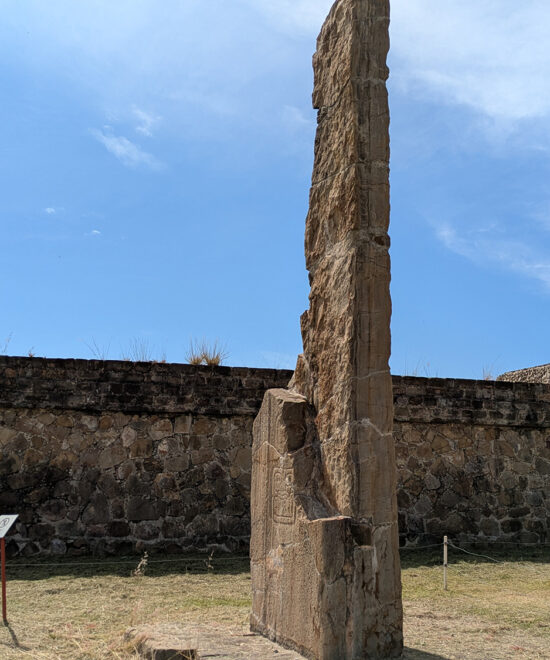
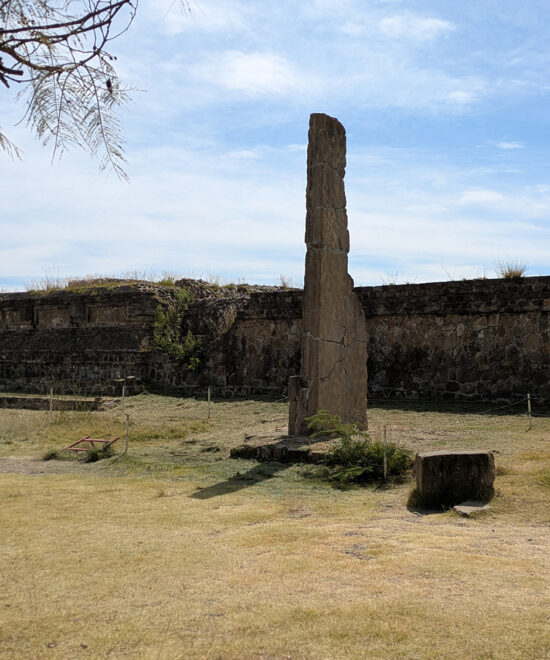
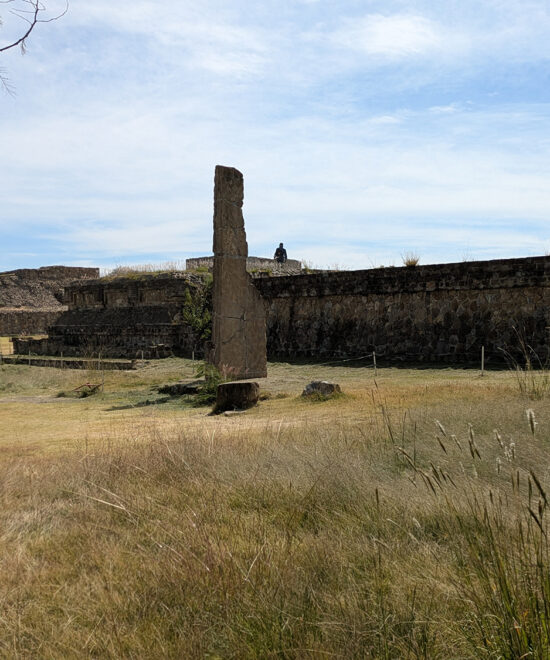
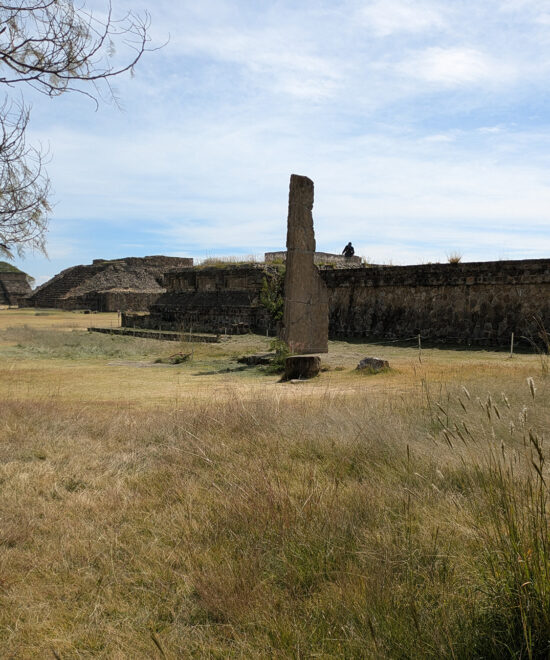
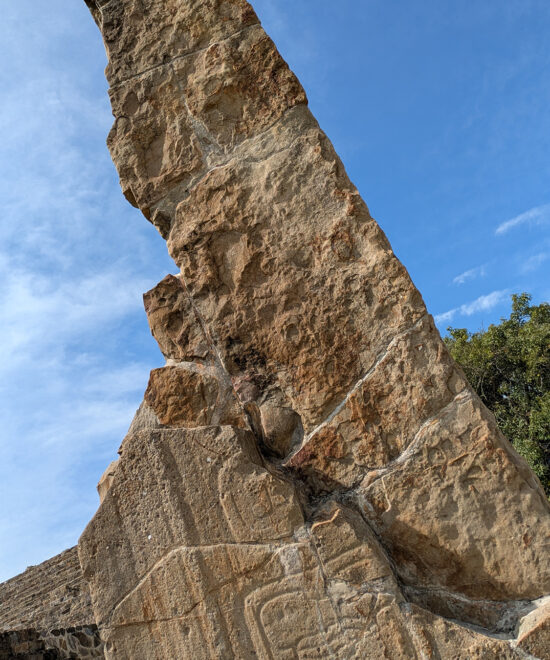
Stela 18 (Estela 18) stands as a lithic artifact of unparalleled historical, scientific, and architectural significance within the Zapotec capital. Erected during the Monte Albán II phase (c. 100 BCE – 300 CE), it is the oldest and tallest carved stone monument at the site. Functioning as a triad of civic instruments—a precision-engineered gnomon, a commemorative text, and a potent tool of state propaganda—Stela 18 mediated the threshold between the public concourse of the Main Plaza and the elite sanctum of the System IV temple complex.1
Geographical Topography and the Urban Genesis
Monte Albán, rising 400 meters from the valley floor to an elevation of 1,940 meters ASL, was established at the strategic nexus where the valley's three primary branches converge: Etla, Tlacolula, and Zimatlán. The city's design was consciously adapted to withstand extreme seismic activity through low, broad buildings and robust freestanding monoliths like Stela 18. Its location at the absolute northwest corner of the ceremonial core delineates the boundary of the sacred Main Plaza.2Material Composition and Dimensional Analysis
The monolith is composed of local sedimentary sandstone, selected for its malleability to allow for intricate pecking and incising. The dimensional data from authoritative sources highlight its unique scale:| Authority | Height | Methodology Context |
|---|---|---|
| Sullivan / Bluffton Univ. | 5.8 m (19 ft) | Total quarried length, accounting for buried stabilizing section. |
| INAH Registry | 5.20 m | Visible height above the current modern plaza floor. |
| García Moll / Marcus | 5.07 m | Precise metric survey: 5.07m (H) x 1.64m (W) x 0.60m (T). |
Geospatial Placement
The Monolithic Gnomon: Archaeoastronomical Mechanics
Stela 18 functioned as a precision shadow-caster. According to Anthony Aveni, its orientation was meticulously calculated to track the sun's trajectory.- Midday Verification: At solar noon, the shadow indicates true astronomical north with unyielding accuracy, providing daily calibration for ritual processions.
- Zenith Passages: At the latitude of 17.04° N, the sun passes directly overhead in early May and August. The resulting disappearance of the stela’s lateral shadow verified the onset of the rainy season and the vital planting of maize.5
The Hieroglyphic Program: Coefficients and Determinatives
The inscriptions on Stela 18 are organized vertically across opposite faces, organized as follows:| Face | Content | Interpretation |
|---|---|---|
| Face A | Coefficients 5 and 2 | Calendrical names of Zapotec lords (e.g., "Lord 5" and "Lord 2") or historical/ritual dates. |
| Face B | Non-numerical glyphs | Likely toponyms (place names) or royal titles associated with the dates. |
| Eastern Face | "Water Sign" determinative | A semantic modifier linking astronomical observation to the prediction of rain and agricultural fertility. |
Comparative Monumentality
To fully grasp the "Lord 5" and "Lord 2" coefficients, they must be compared to better-preserved texts such as Stela 15 (Lord 5 Reed) and the conquest slabs of Building J. By tying these royal names to the stone that tracks the sun, the Zapotec state naturalized its sovereign power—rendering the ruler's authority as inevitable and divine as the solar zenith itself.16Historiography and Conservation
Scientific understanding is indebted to Alfonso Caso, who discovered and re-erected Stela 18 during his 1937–1939 campaigns. Formalized as Monuments 249 and 250 in the García Moll survey, the monolith now faces significant conservation challenges. Its sandstone composition is vulnerable to acid rain and wind erosion, emphasizing the urgency of non-invasive 3D photogrammetry to preserve the fading "water sign" and calendrical notations.3Scholarly References & Primary Sources
- Marcus, Joyce. (1992). Mesoamerican Writing Systems: Propaganda, Myth, and History. Princeton Univ. Press.
- Diaz, Vincent. (2026). Stela 18: An Exhaustive Analysis. MAPSA Internal Monograph.
- INAH. "Monte Albán - Lugares INAH."
- García Moll, Roberto, et al. (1986). Catalogo de monumentos escultóricos de Monte Albán.
- Aveni, Anthony F. (2001). Skywatchers. University of Texas Press.
- Urcid, Javier. (2001). Zapotec Hieroglyphic Writing. Dumbarton Oaks.