


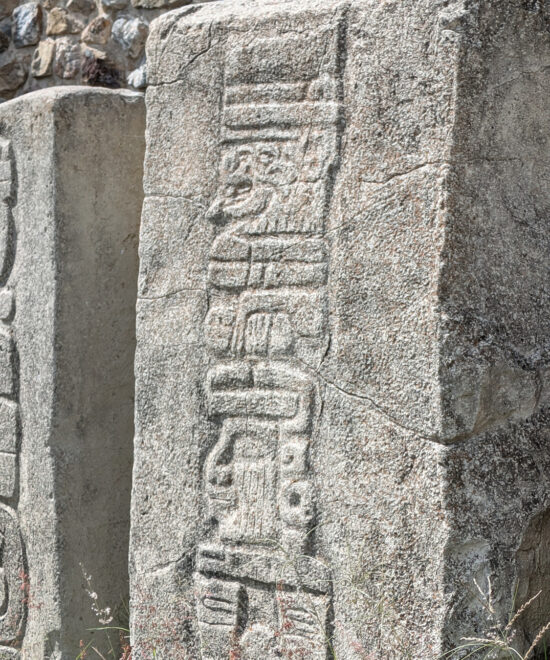
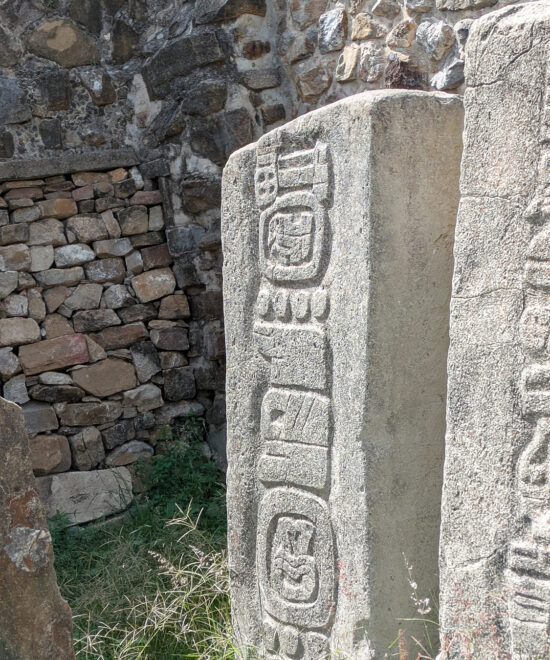
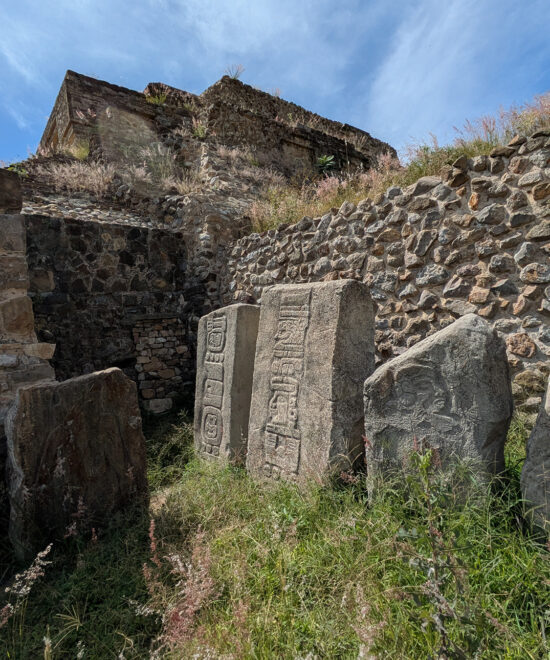
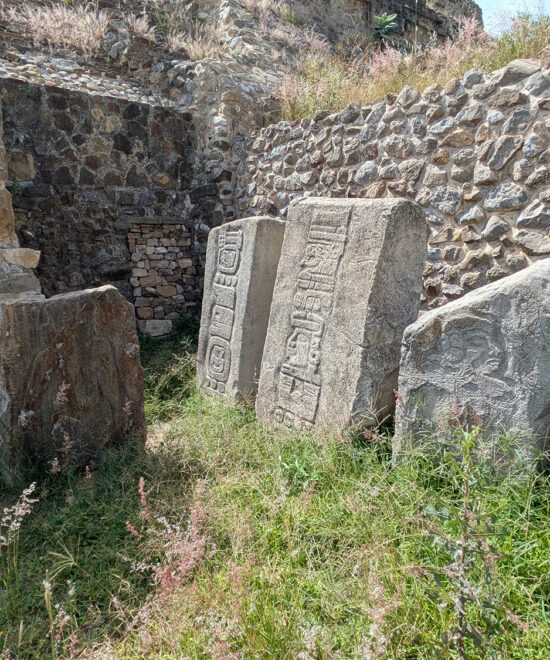
Stelae 12 and 13 constitute two of the most critical epigraphic monuments originating from the foundational epoch of Monte Albán. Dating strictly to the city's initial consolidation (Phase I), they preserve the most definitive early evidence of Zapotec hieroglyphic writing deployed within a public, political matrix.13 These monoliths transcend abstract or purely decorative glyphic application; they exist as deliberate instruments of statecraft designed to record historical action, identify sovereign individuals, and broadcast emerging dynastic power to a captive civic audience.1
Their unparalleled institutional importance rests on a confluence of archaeological and linguistic factors. First, they firmly belong to the Monte Albán I horizon, anchoring them to the era when the new capital was actively forging its regional hegemony.1 Second, they codify diagnostic syntactical traits exclusive to Zapotec writing—most notably the placement of numerical coefficients directly following day names and the employment of linguistic rebuses functioning solely within the Zapotec tongue.1 Finally, they are widely interpreted as commemorating the formalized enthronement of a paramount ruler, establishing them as among the earliest known monuments in Mesoamerica to synthesize script, calendrics, and regime legitimacy into a cohesive public decree.1
Taxonomy and Historiography
While historically disseminated in literature simply as "Stelae 12 and 13," contemporary epigraphic cataloging—championed extensively by Dr. Javier Urcid—designates these artifacts formally as Monolith D-139 and Monolith D-140.56 This terminological evolution is not arbitrary; it represents a paradigm shift toward a highly systematized corpus wherein these stones are analyzed not as isolated artistic curiosities, but as integrated components of a vast carved landscape engineered during early state formation.1
The modern trajectory of their study was inaugurated by Dr. Alfonso Caso, whose pioneering field documentation of Zapotec stelae established the baseline for subsequent decipherment. Dr. Joyce Marcus systematically advanced this foundation, revolutionizing the interpretation of these monuments by deciphering their political utility.1 In her comprehensive studies detailing the genesis of Mesoamerican script, Marcus identified Stelae 12 and 13 as incontrovertible proof that the glyphic system presented was distinctly Zapotec, operating to record specific sovereign actions.1
Location and Original Context
Stelae 12 and 13 were initially recovered in direct stratigraphic association with the Building L structural zone, situated near the southern terminus of the infamous Danzantes (Prisoner Gallery) sector.16 This original spatial provenience is of paramount importance. It deliberately embedded the monuments within one of the most ideologically concentrated matrices of early Monte Albán, a sector where undulating carved depictions of mutilated, sacrificed adversaries violently projected a narrative of martial domination and state terror.1
Within this highly militarized visual context, Stelae 12 and 13 operated as historical and legal anchors. While the surrounding orthostats displayed the visceral consequences of resisting the state, the stelae explicitly identified the central rulership responsible for that violence, confirming dynastic legitimacy through calendrical order.1 Collectively, they forged a unified political thesis: enemies are subjugated, rulers are divinely installed, and the nascent state forever inscribes its sovereignty in stone.1
Currently, the original monoliths are conserved ex situ within the Monte Albán Site Museum. INAH curators house them in Area Two, explicitly presenting them as the earliest iterations of Zapotec script, ensuring their preservation away from the severe meteorological degradation of the plaza.34
Material Form and Visual Design
The monuments themselves are imposing, vertically carved lithic slabs standing approximately two meters (6.6 feet) in elevation.6 This vertical formatting is not incidental; it necessitates public legibility and mass display. These were not subterranean funerary slabs interred within crypts, nor were they structural fill. They belonged to a highly visible, outward-facing monumental program dominating the open ceremonial plazas of Phase I Monte Albán.1
The glyphic inscriptions are meticulously arranged in a vertical syntax. Contemporary structural readings underscore the strict, paired organization of the text.1 This highly disciplined design confirms that writing at Monte Albán was a formalized visual and structural system engineered specifically for monumental application, functioning simultaneously as readable text and as an intimidating public object.1
Epigraphy and the Zapotec Writing System
Stelae 12 and 13 are foundational to the epigraphic history of the Americas because they display linguistic architecture that inextricably proves the system is Zapotec.1 Joyce Marcus has continually highlighted two uniquely diagnostic markers. The first is the syntactical placement of numerical coefficients directly after the day names—a structural feature inherent to Zapotec syntax but structurally opposite to Maya epigraphy. The second is the brilliant deployment of a linguistic rebus substituting the concept of "first-born son" with the image of a "human thumb"—a phonetic pun that translates exclusively within the Zapotec language family.1
These precise linguistic identifiers elevate the artifacts beyond generalized "early glyphs." They confirm the inscriptions are deeply tied to a localized, highly developed spoken language.1 Furthermore, the texts exhibit the integration of sophisticated calendrical notation utilized in a public historical register, demonstrating that writing at Monte Albán had rapidly evolved into a bureaucratic tool capable of tracking named entities, temporal data, and official state acts.1
The Accession Narrative of 8 Water
The preeminent interpretation of the stelae's narrative, pioneered by Dr. Joyce Marcus, concludes that the text explicitly details the accession of an early sovereign. Her structural reading translates the paired monuments as: “In the year 4 Lightning, a man named 8 Water, a first-born son, was seated in office.”1 While epigraphic micro-debates occasionally reinterpret specific secondary signs, the academic consensus remains absolute: these monuments are an official record of a royal enthronement.1
This transforms Stelae 12 and 13 from generic ritual carvings into definitive state texts. They immortalize a named historical individual, anchor him to an exact calendrical date, aggressively emphasize his noble lineage (first-born son), and elevate his rulership into a formalized, recorded event.1 The specific phrase “seated in office” perfectly aligns with the broader Mesoamerican political metaphor where sovereignty is physically assumed via the throne or mat.1
Calendrics, Format, and Writing Practice
These monoliths provide incontrovertible proof that writing, rigorous timekeeping, and political historiography were seamlessly intertwined at the dawn of the city. The integration of the Year Bearer sign, specific day signs, and structured personal naming conventions reveals that the 260-day ritual calendar (piye) was already being leveraged for public political discourse.1
Scholars heavily emphasize the formal organization of the columns. The inscriptions display a mature, structured layout featuring strict vertical flow and paired glyphic blocks.1 This confirms that Zapotec scribes had already standardized their writing system for integration into monumental stone carving.1 Despite the relatively shallow relief technique, the intellectual and bureaucratic program driving the carving was exceptionally advanced.
Scholarly References
- Marcus, Joyce. “Origins of Hieroglyphic Writing.” Archaeological Research in Oaxaca, University of Michigan.
- UNESCO World Heritage Centre. “Historic Centre of Oaxaca and Archaeological Site of Monte Albán.”
- INAH. “Museo de Sitio de Monte Albán.” Area Two identifies Stelae 12 and 13 as examples of the earliest known Zapotec writing.
- INAH. “Area Two, Monte Albán Site Museum.”
- Urcid, Javier. Modern catalog designations for the monuments as D-139 and D-140.
- UDLAP archive. “Monte Albán, monoliths D-139 and D-140.”