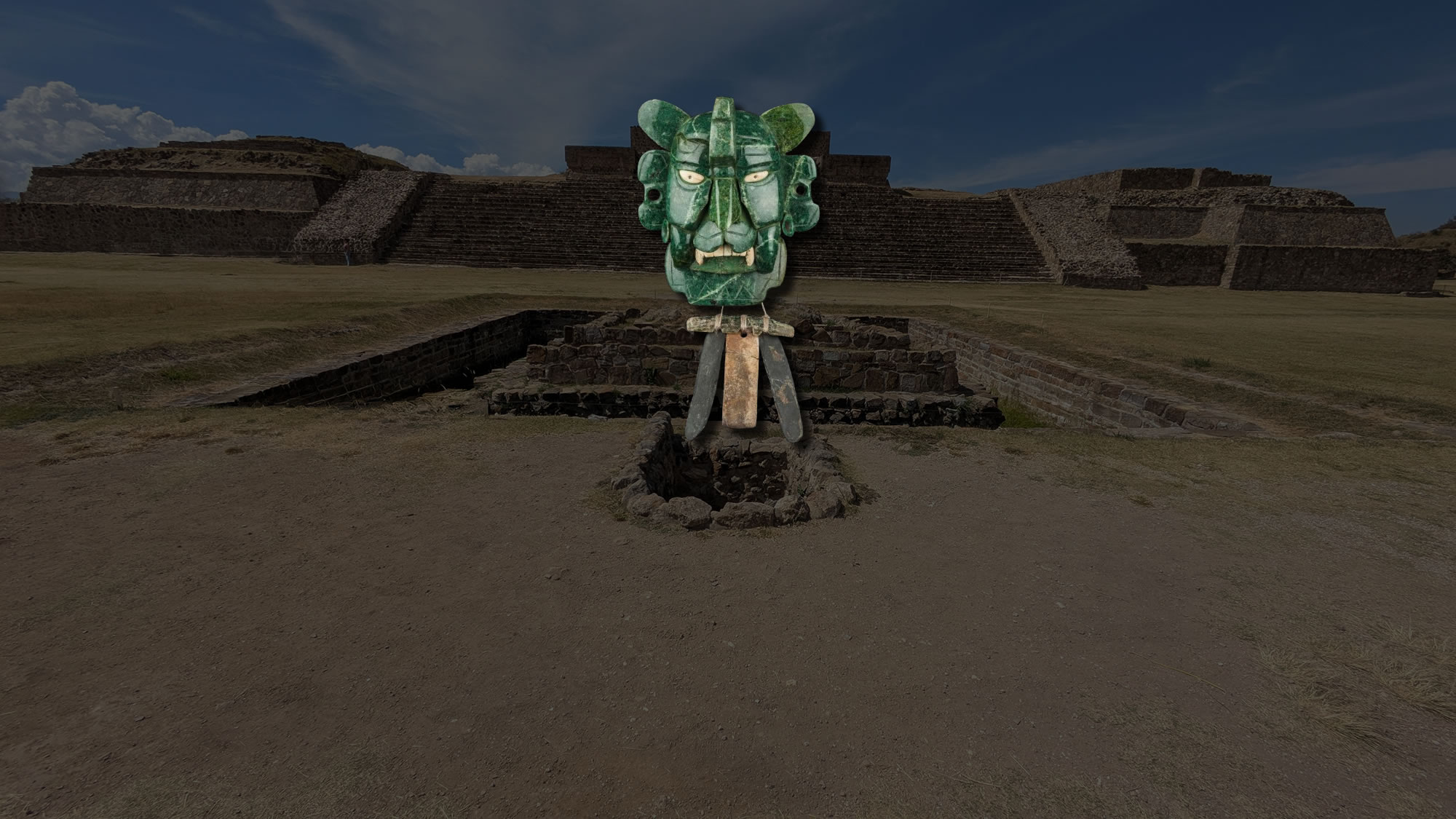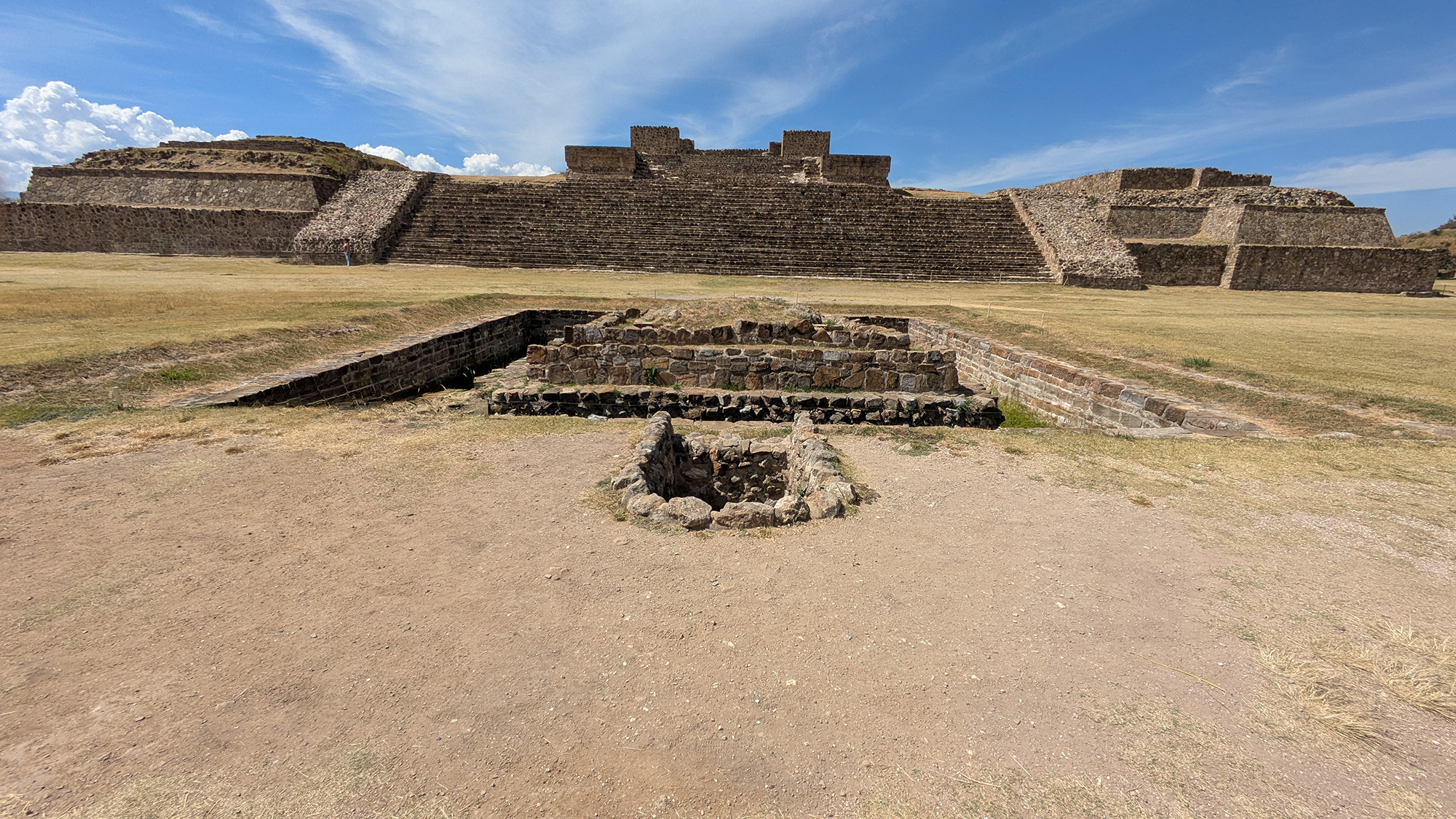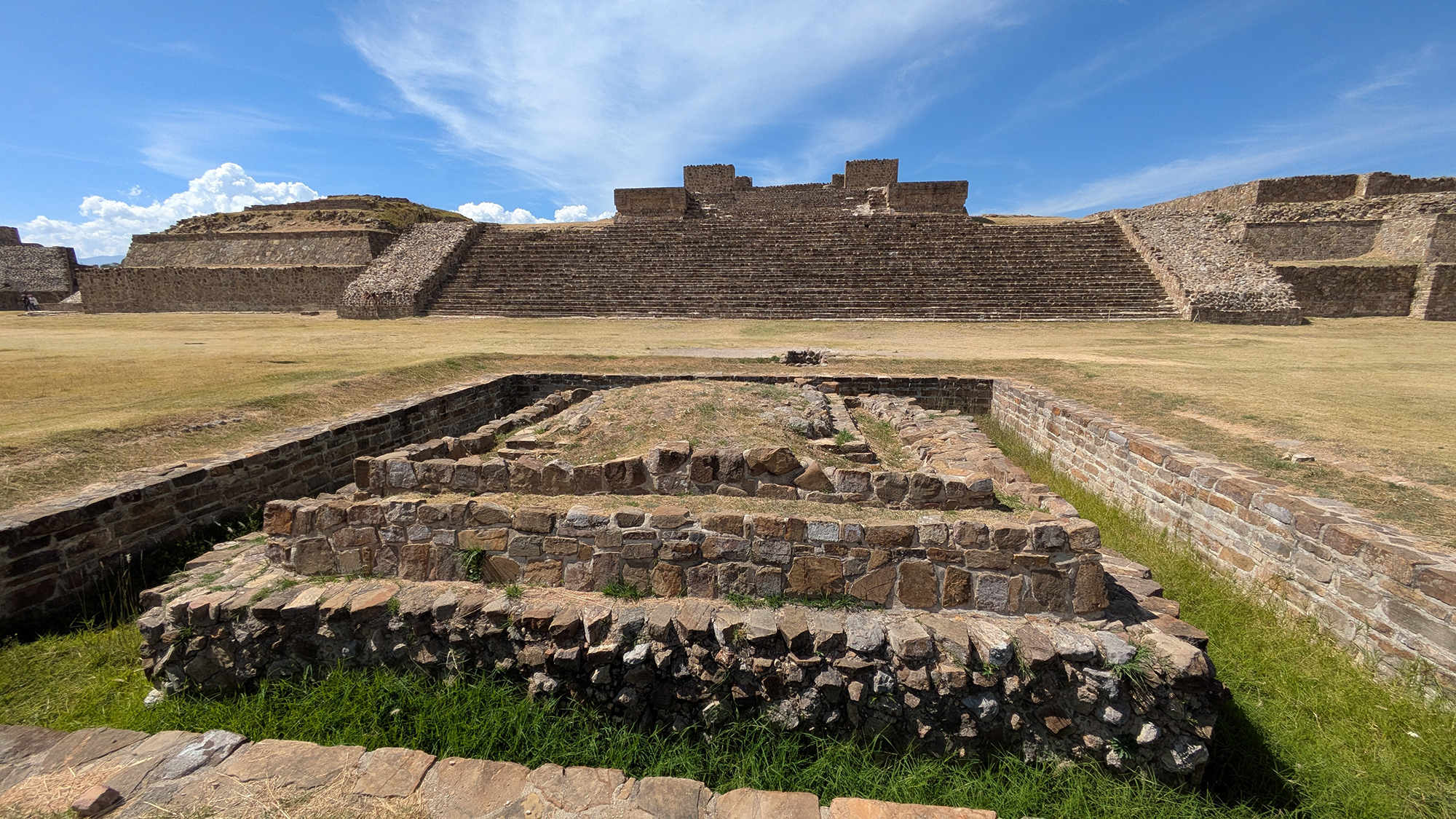


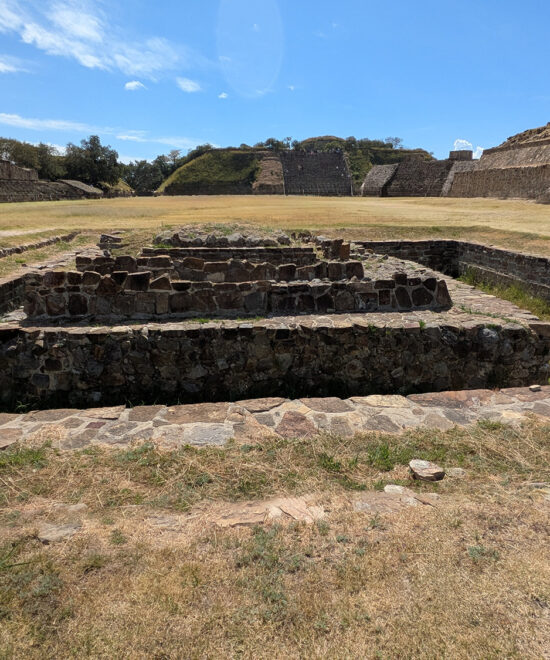

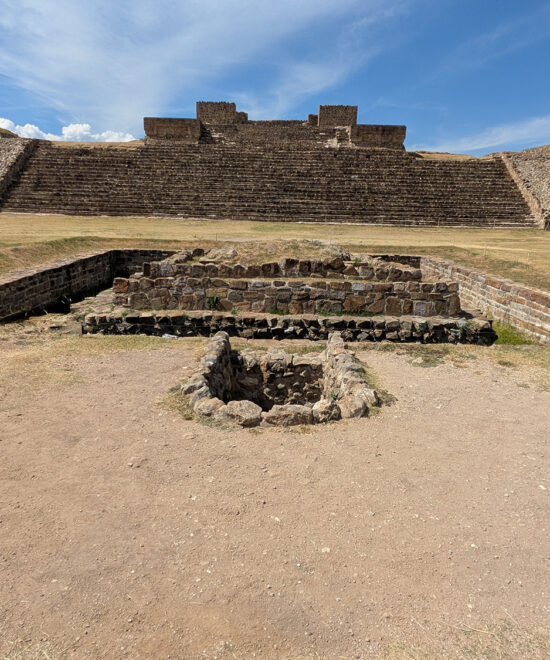


The Adoratorio, also recognized academically as the Central Adoratory, stands as one of the most critical ritual installations within the monumental heart of Monte Albán. Located strategically between Building P to the east and the central G-H-I architectural group to the west, it occupied a precise nodal point within the Great Plaza, organizing ceremonial movement, visual sightlines, and sacred action across the urban core. While it may appear visually modest when juxtaposed against the towering surrounding platforms, the Adoratorio was not a piece of secondary architecture; it was a primary locus where Zapotec ritual authority and political power were explicitly concentrated.1
Its extraordinary significance is derived from the convergence of multiple civic and religious functions. It operated as a central altar-shrine, served as the focal point for critical beginning-of-rains ceremonies, anchored a complex subterranean network of hydraulic tunnels, and housed one of the most famous ritual deposits ever recovered at Monte Albán: the jade bat pectoral. Consequently, the Adoratorio functioned as an active instrument of statecraft rather than a passive architectural marker.3
Terminological Clarification
A persistent difficulty in the historiography of the Adoratorio is the inconsistent terminology utilized across modern archaeological summaries. Various sources frequently conflate the Central Adoratory in the Great Plaza with the entirely separate Patio Hundido (Sunken Patio) located within the North Platform complex, using overlapping nomenclature such as "sunken altar" or "sunken patio" interchangeably.5
For absolute institutional clarity, this dossier focuses exclusively on the central altar-shrine situated between Building P and the G-H-I complex. This distinction is vital because elements frequently misattributed to the Adoratorio in popular literature—such as the massive 50-meter square sunken layout and Stela 10—belong unequivocally to the North Platform. The Adoratorio discussed here is defined strictly by its spatial relationship to Building H, its integration with rainy-season rites, and its direct association with the jade bat pectoral deposit.
Spatial Morphology and Layout
The Adoratorio commands one of the most strategic geographic positions within the Great Plaza. Official INAH documentation places it precisely in relation to Building P to the east and the alignment of Buildings G, H, and I to the west. This placement is foundational: it signifies that the shrine stood at the exact architectural junction tying together the eastern structural range and the central spine, linking two profoundly charged ceremonial sectors.1
This spatial function extended beyond mere geometry. The Adoratorio acted as the epicenter of a vast ceremonial theater designed to accommodate massive public gatherings. Rituals performed upon this central altar were executed in full visual dialogue with the monumental architecture surrounding it. Simultaneously, the integration of connected subterranean drains reveals that the structure also governed a hidden, esoteric level of movement and engineering invisible from the plaza surface.
Architectural Evolution and Construction Phases
Stratigraphic analysis indicates that the central Adoratory underwent at least two major construction phases mirroring the urban evolution of Monte Albán. The formative earlier phase was explicitly associated with two engineered tunnels (or drains) on its east and west flanks, creating subterranean linkages to the higher elevations of Building II (east) and Building H (west). The subsequent, later phase corresponds to the cistern-like morphology observable today, featuring a defined central altar upon which rich offerings were continuously deposited.1
This diachronic sequence proves that the Adoratorio was a dynamic, rather than static, monument. It was repeatedly heavily modified, seamlessly marrying elite ritual requirements with complex hydraulic engineering. It transcended the definition of a simple plaza shrine to become vital civic infrastructure managing water, ritual movement, and sacred state display.
Rain Ceremonies and Hydraulic Significance
According to institutional INAH records, the Adoratorio served as a paramount sacred space for Zapotec elites during the celebration marking the beginning of the annual rainy season. This critical functional attribution requires far greater emphasis than it traditionally receives in broad site summaries. The shrine is explicitly documented as having functioned as a rainwater reservoir, demonstrating that practical hydraulic management and sacred ritual were entirely intertwined.2
This establishes the Adoratorio as a primary locus where Zapotec engineering and cosmology converged. In ancient Oaxaca, rain was not merely a meteorological event; it was the sole guarantor of agricultural survival, economic stability, and, ultimately, political legitimacy. A central shrine governing the arrival of rains was a theater where cosmology and statecraft overlapped entirely. Rituals enacted here were direct interventions into the seasonal order upon which the entire valley depended.
Subterranean Tunnels and Esoteric Circulation
Perhaps the most structurally remarkable feature of the Adoratorio is its integration into a subterranean network. INAH corroborates the presence of two tunnels connected to the structure's earliest phase, linking it below-ground to Building II and Building H. These passages unequivocally prove that the Adoratorio was an active node within a buried infrastructural system rather than an isolated surface altar.1
These features demand interpretation through both hydraulic and ritual lenses. The practical drainage capability of the Great Plaza is well-supported. Concurrently, the existence of these hidden passages would have facilitated controlled, esoteric movement for priests and elites within the ceremonial center, adding a highly performative dimension to state rituals. Water management and ritual choreography were executed as a unified discipline.
The Jade Bat Pectoral and Multiple Burial Context
The Adoratorio is immortalized by its direct association with one of the most spectacular ritual deposits discovered at Monte Albán: a complex multiple burial containing the renowned jade bat pectoral (often colloquially termed the "bat mask"). Dr. Jorge Acosta’s published excavation records detail how, between 1945 and 1946, the clearing of a subterranean tunnel between Mound II and Building P guided investigators deep into the subsoil of the central plaza, terminating near the foundational base of the Adoratorio of Mound H.3
There, embedded along the front of a buried retaining wall, archaeologists breached a slab floor containing the skeletal remains of a multiple burial, including the primary elite individual adorned with the jade pectoral. This context is archaeologically vital: it confirms the pectoral is not a detached, contextless artifact, but a purposefully deposited offering tied to the Adoratorio's ceremonial sphere. The artifact itself—a human face superimposed by the visage of a bat—powerfully invokes the nocturnal, blood-linked, underworld symbolism fundamentally associated with bats in classic Mesoamerican cosmology.
Offerings, Water Symbolism, and Sacred Efficacy
Analyses of the material assemblage recovered from this specific ritual context highlight a dense concentration of ceramic offerings, featuring vessels and specialized containers whose iconography is heavily predicated on water and agricultural fertility. While popular narratives occasionally reduce the complex to a simplistic "water shrine," the rigorous archaeological interpretation confirms that the Adoratorio anchored a ceremonial environment entirely dedicated to rain, elite deposition, fertility, and cosmic renewal.5
This aligns seamlessly with INAH's identification of the structure as the focal point for rainy-season rites. The Adoratorio transcended mere ritual deposition; it was the precise geographic location where the Zapotec state negotiated survival with the divine, ensuring the seasonal renewal of the environment and the sacred management of life-giving water.
Scholarly References
- INAH. "Monte Albán." Official site description of the central Adoratory and its function in rainy-season celebrations.
- INAH. "Monte Albán." Spanish version of the official site description.
- Acosta, Jorge R. "El pectoral de jade de Monte Albán." Arqueología Mexicana. Primary excavation record of the bat mask deposit.
- UNESCO World Heritage Centre. "Historic Centre of Oaxaca and Archaeological Site of Monte Albán."
- Marcus, Joyce, and Kent V. Flannery. (1996). Zapotec Civilization: How Urban Society Evolved in Mexico’s Oaxaca Valley. Thames & Hudson.
- Monte Albán Heritage Center. Building H and Building P architectural context within the Main Plaza.