


Geographical and Topographic Framework
The municipality of San Pablo Huitzo is strategically positioned at the northern end of the Etla Valley, which forms the northern arm of the “upside-down Y” configuration of the Central Valleys of Oaxaca. This specific branch of the valley was historically the gateway between the semi-arid northern highlands and the fertile agricultural core of the Zapotec heartland. The location of Tomb 10 on the Cerro de la Cantera is not merely a matter of convenience but reflects a deep-seated Zapotec tradition of integrating elite architecture into the sacred topography of the landscape. The site is characterized by its access to high-quality gray and pink quarry stone (cantera), a material that was as vital to ancient builders as it is to modern masonry. The topographic elevation provides a commanding view of the surrounding valley floor, extending up to forty kilometers on clear days, which allowed the ancient inhabitants to monitor trade routes and military movements—a function reflected in the Zapotec name for the area, Huijazoo, meaning “Atalaya de Guerra” or “War Fortress”.| Locational Attribute | Statistical and Geographic Detail |
|---|---|
| Site Name | Cerro de la Cantera (Huijazoo Complex) |
| Geographic Coordinates | 17° 16′ 37″ N, 96° 53′ 12″ W |
| Elevation | 1,700 meters above sea level |
| Distance to State Capital | 31–35 km Northwest of Oaxaca City |
| Geological Substrate | Limestone and Gray/Pink Cantera deposits |
| Climate Classification | Templado subhúmedo (Temperate sub-humid) |
| Historical Jurisdiction | Lordship of Huijazoo (Atalaya de Guerra) |
Historical and Political Context: The Shadow of Monte Albán
To appreciate the gravity of the Tomb 10 discovery, it must be situated within the broader narrative of Zapotec urbanization. Monte Albán, founded around 500 BCE, served as the primary socio-political and economic hub for over a millennium. During the Early and Late Classic periods (200–800 CE), Monte Albán exerted varying degrees of control over the valley’s sub-regions. The Etla Valley, where Huitzo is located, was a critical zone for resource management and defense. Analysis suggests that while sites like Huijazoo were regional powers with their own internal hierarchies and elite lineages, they remained culturally and politically tethered to the capital. Experts like Nelly M. Robles have noted that during the Classic period, virtually every site in the valley paid tribute to or was administratively dependent on Monte Albán. However, the architectural grandeur of Tomb 10 indicates that local lords at the frontier held significant autonomy and resources, perhaps acting as semi-independent “buffer” states against Mixtec encroachment from the north. The lordship of Huijazoo attained its maximum splendor between 650 and 700 CE. This era coincided with the gradual fragmentation of Monte Albán’s central authority, a period during which regional elites began to assert their prestige through the construction of monumental funerary complexes. Tomb 10, alongside the previously discovered Tomb 5, suggests that Huitzo functioned as a high-status “acropolis,” a term used by INAH specialists to describe the concentration of elite residential and ritual structures in the area. [6] [7] [8]Archaeological Discovery and Rescue Operations
The genesis of the current research began in late 2025, following a confidential report of potential illicit excavations on Cerro de la Cantera. This triggered a swift intervention by the National Institute of Anthropology and History (INAH), under the direction of the Ministry of Culture. The rescue project was led by archaeologists Jorge Bautista Hernández and Gabriela Galicia Moreno, who identified a shaft that had remained sealed for approximately 1,400 years. The integrity of the seal is the primary factor behind the tomb’s “extraordinary” state of preservation. While many tombs in the Oaxaca region were disturbed in antiquity for secondary ritual purposes or looted in the modern era, Tomb 10 provided a pristine laboratory for the study of Zapotec ritual life. The announcement of the discovery by President Claudia Sheinbaum Pardo and Culture Secretary Claudia Curiel de Icaza on January 23, 2026, underscored the tomb’s role as a symbol of “ancient greatness” and a victory for heritage preservation efforts. [9] [10] [11]Architectural Specifications and Construction Techniques
Tomb 10 is an architectural marvel of the Late Classic Zapotec style. It is defined as a “stepped-vault” (bóveda escalonada) chamber, a complex engineering feat that utilized large limestone slabs and finely cut gray cantera stone to support the weight of the hillside above. This style is characteristic of elite Zapotec funerary architecture found at major sites like Monte Albán and Mitla, but its execution in Huitzo is particularly refined.| Structural Element | Technical Specifications |
|---|---|
| Total Length | 5.55 meters |
| Width | Variable between 1.66 and 2.79 meters |
| Height | Variable between 1.68 and 2.60 meters |
| Access Mechanism | Vertical shaft leading to a sunken patio/antechamber |
| Materials | Limestone slabs, gray cantera, lime stucco |
| Vaulting | Stepped vault (bóveda escalonada) |
| Finish | Polished white lime stucco with polychrome murals |
Iconographic Mastery: The Sculpture of the Owl
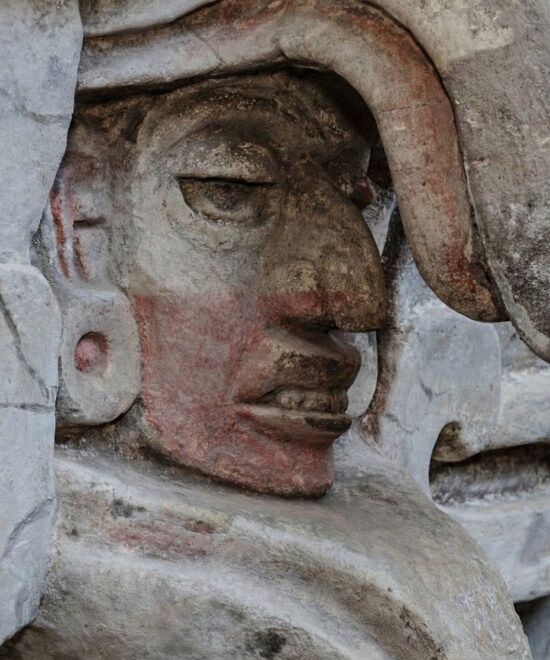
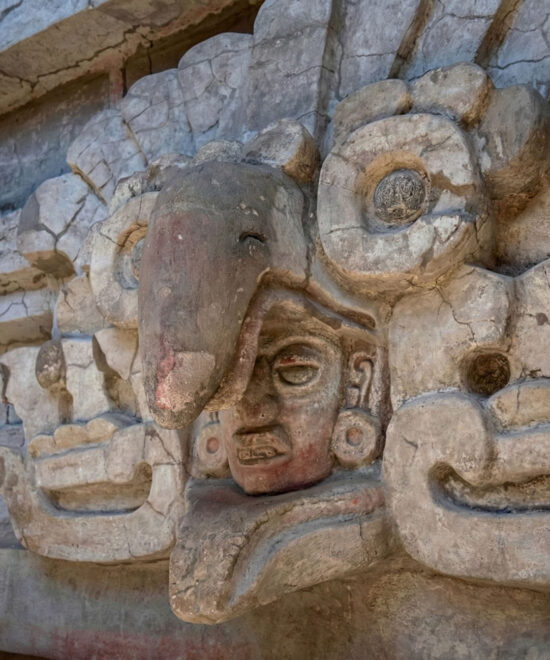
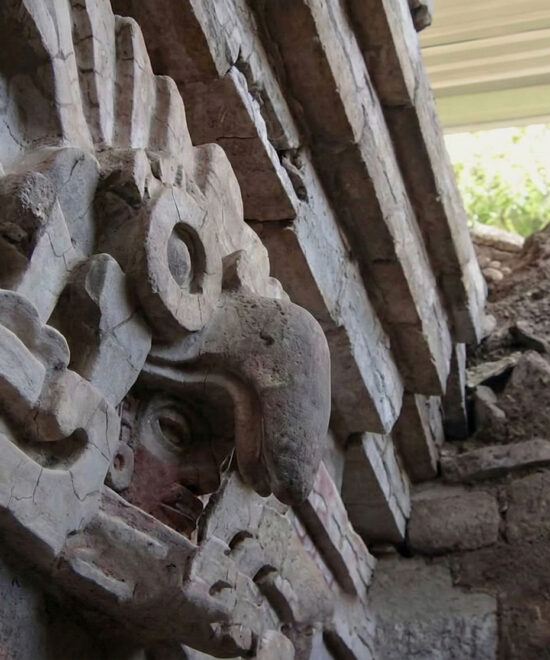
The most distinctive feature of the tomb’s facade is a monumental sculpture of an owl (búho or tecolote) positioned above the entrance to the antechamber. In the Zapotec worldview, the owl was a multifaceted symbol representing the night, death, and the transition into the underworld. However, the Huitzo owl carries a unique iconographic detail: its beak is depicted covering the stuccoed and painted face of a male figure. Archaeologists believe this male face represents a “Señor Zapoteca,” a deified ancestor or the specific lord for whom the tomb was built. The owl acts as a spiritual intermediary or a psychopomp, bridging the gap between the divine forces and the human lineage. This imagery reinforces the concept of ancestor veneration, a core tenet of Zapotec religion where the deceased continued to play an active role in the lives of their descendants. [14] [15]Guardians and Calendrical Inscriptions
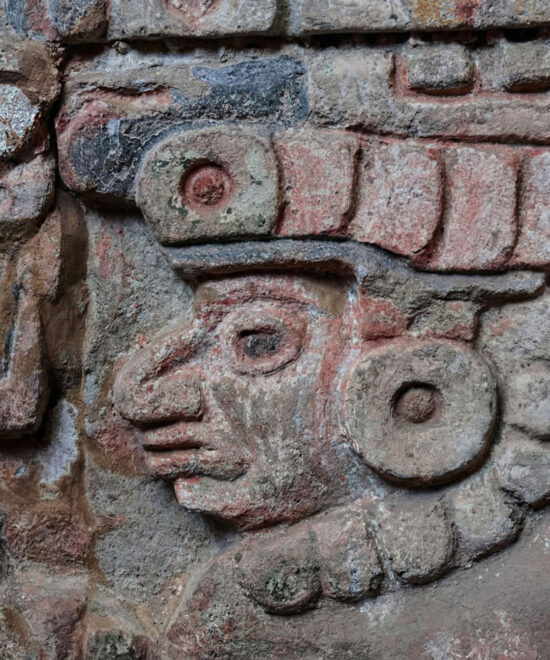
The entrance to Tomb 10 is flanked by a sophisticated sculptural apparatus that identifies the tomb as a sacred and restricted space. On the stone jambs (jambas) framing the doorway, two figures are carved in relief: a man and a woman. Both are depicted wearing elaborate headdresses and holding ritual objects, potentially identifying them as “guardians” of the tomb or as the founding couple of the interred lineage. Above the entrance, a horizontal lintel supports a frieze of stone tablets. These tablets are inscribed with calendrical names, using the ancient Zapotec writing system that predates the Mixtec and Aztec scripts. These glifos (glyphs) likely represent the ritual names or birth dates of the individuals associated with the tomb, such as the famous “12 Monkey” identified in the nearby Tomb 5. This epigraphic evidence is invaluable for researchers attempting to reconstruct the dynastic history of the Huijazoo lordship. [16] [17]The Murals of the Copal Procession
The interior chamber of Tomb 10 contains one of the most remarkable examples of Zapotec mural painting discovered to date. The murals are rendered in a vibrant palette of five primary colors: ochre, white, green, red, and blue. The composition depicts a formal procession of figures who appear to be walking toward the entrance of the tomb. Each character in the procession is depicted carrying a bag of copal (tree resin incense), an essential element in Mesoamerican ceremonies. The burning of copal was believed to facilitate communication with the spiritual realm, its smoke as a medium for prayer. This mural likely represents a perpetual funerary ritual, ensuring that the deceased is eternally honored by a retinue of priests or family members. The presence of these murals in situ allows for the study of Late Classic Zapotec painting techniques, including the use of mineral-based pigments and the application of color over a damp lime substrate.| Pigment / Color | Estimated Origin and Symbolic Association |
|---|---|
| Ochre (Yellow/Brown) | Derived from iron oxides (Limonite/Goethite); associated with the earth and transition |
| Red | Derived from Hematite or Cinnabar; symbol of life, blood, and the sunrise |
| Green | Derived from Malachite or green earth; associated with vegetation, jade, and fertility |
| Blue | Likely “Maya Blue” (Indigo bound to Palygorskite clay); symbol of the heavens and water |
| White | High-purity lime (cal) stucco; the sacred substrate and symbol of purity |
Bioarchaeology and Material Culture Analysis
While the architecture and art provide a symbolic framework, the physical remains found within the tomb offer a direct link to the ancient population. Initial investigations recovered several bone fragments, which are currently being analyzed by specialists in physical anthropology. These studies aim to determine the age, sex, and health status of the individuals interred, as well as their genetic relationship to the Monte Albán elite. In addition to the skeletal remains, archaeologists located several ceramic vessels outside the main chamber. These items are critical for dating the site, as ceramic styles evolved rapidly during the Classic period. Preliminary analysis of the “tiestos” (shards) and intact vessels suggests they are contemporary with the Monte Albán IIIb-IV phase, characterized by fine gray pottery and specialized ritual forms like the vaso de efigie. The presence of “vasijas ceremoniales” and “urnas” within and around the tomb indicates that the burial was accompanied by elaborate offerings of food, drink, and sacred objects meant to sustain the soul in the afterlife. The ongoing laboratory work at the Centro INAH Oaxaca will focus on the residue analysis of these vessels to identify the specific substances—such as chocolate, pulque, or tamales—offered during the funerary feast. [20] [21]Conservation Challenges and the “Capa de Sacrificio”
The preservation of Tomb 10 is as much a technical challenge as it is an archaeological opportunity. After being sealed for over a millennium, the interior environment of the tomb was highly stable. Upon its discovery, exposure to modern humidity levels, temperature fluctuations, and atmospheric pollutants posed an immediate threat to the fragile murals and stucco. Restorers Fanny Magaña Nieto and Cristian Hernández Ortega have identified several specific risks, including the penetration of tree roots through the stone ceiling and the activity of insects within the porous cantera. To stabilize the murals, the team has employed a “capa de sacrificio” (sacrificial layer). This conservation technique involves the application of a thin, reversible layer of lime mortar over the ancient paintings. This layer is designed to absorb the salts and moisture that would otherwise crystallize on the mural surface (a process called efflorescence), thereby “sacrificing” itself to preserve the original art. This intervention allows for a gradual stabilization of the tomb’s microclimate before the eventual removal of the sacrificial layer for public viewing. [22] [23]The Lordship of Huijazoo: A Regional Power Center
The discovery of Tomb 10 has forced a re-evaluation of the lordship of Huijazoo (also spelled Guijazoo or Huijazo). Historically, this lordship was situated between the present-day towns of San Pablo Huitzo and Santiago Suchilquitongo. The site served as a strategic “atalaya” (watchtower) protecting the northern approaches to the Central Valleys. The site complex consists of multiple platforms and mounds arranged in a horseshoe shape, with Building 1 (housing Tomb 5) being the most prominent until now. The identification of Tomb 10 suggests that Cerro de la Cantera was not just a defensive fort but a major administrative and religious “acropolis” where multiple elite families maintained their ancestral crypts.| Site Feature (Huijazoo) | Historical and Archaeological Significance |
|---|---|
| Atalaya de Guerra | Frontier function; defense against Mixtec expansion |
| Tomb 5 | The “Sistine Chapel” of Zapotec art; found in 1985; contains jaguar iconography |
| Tomb 10 | The current discovery; focuses on owl/death cosmology and ritual processions |
| Acropolis Status | High density of elite structures; equivalent to Monte Albán hierarchy |
| Abandonment | C. 800 CE; linked to regional collapse and environmental challenges |
Future Outlook and Public Access
The Mexican government, through the Ministry of Culture and INAH, has committed to a long-term plan for the research, protection, and eventual public dissemination of the Tomb 10 findings. Secretary Claudia Curiel de Icaza stated that the current stabilization works are aimed at opening the tomb for “controlled visits” by late 2026, tentatively in October. The opening will prioritize educational visits, particularly for school children in the Huitzo and Etla regions, to foster a sense of identity and cultural continuity. Furthermore, the announcement of the new “Escuela de Restauración del Sur” in Oaxaca suggests that Tomb 10 will serve as a primary training ground for a new generation of restorers specializing in the unique challenges of Mesoamerican polychrome art. [26] [27]Implications for Zapotec Studies
The discovery of Tomb 10 is not an isolated event but a critical data point that connects several disparate threads of Oaxacan history. It bridges the gap between the monumental early history of San José Mogote and the final, post-Monte Albán flourish of sites like Mitla and Yagul. It demonstrates that even as the central authority of Monte Albán began to wane toward the end of the Classic period, the regional lordships like Huijazoo were undergoing a “Golden Age” of artistic and architectural production. The preservation of Tomb 10, combined with modern scientific techniques like physical anthropology and chemical pigment analysis, promises to provide a much clearer picture of Zapotec life than was possible even twenty years ago. This discovery reaffirms Oaxaca’s status as one of the most archaeologically rich regions in the world and highlights the enduring legacy of the Zapotec people, who continue to be a vital part of Mexico’s cultural tapestry today. The tomb’s iconography of the owl, the intercessor for the deceased, serves as a poignant metaphor for the archaeology itself: a voice from the “House of Darkness” that, once heard, allows the ancestors to speak again to the living, revealing the complexity, beauty, and resilience of their civilization. [28] [29]References
- INAH. “El Gobierno de México anuncia el descubrimiento de una milenaria tumba zapoteca en Oaxaca.” inah.gob.mx.
- Prensa Latina. “México anuncia hallazgo arqueológico más relevante de la década.” prensa-latina.cu.
- Finestre sull’Arte. “Seventh-century tomb discovered in Mexico: for the country, it is the most important find of the last decade.” finestresullarte.info.
- Meteored México. “Patrimonio milenario en Oaxaca: el hallazgo de la Tumba 10 de Huitzo redefine la arqueología zapoteca del siglo VII.” meteored.mx.
- Arkeonews. “Extraordinary Polychrome Mural Reveals 1400-Year-Old Zapotec Tomb in Oaxaca.” arkeonews.net.
- Mexico News Daily. “1,400-year-old Zapotec tomb uncovered in southern Oaxaca.” mexiconewsdaily.com.
- Voces del Periodista Diario. “Trascendente hallazgo arqueológico en Oaxaca; descubren la tumba número 10 en San Pablo Huitzo.” vocesdelperiodista.com.
- El País. “Huitzo rescata el esplendor funerario de los zapotecos en México.” elpais.com.
- Wikipedia. “Monte Albán.” en.wikipedia.org.
- YouTube. “Monte Albán and the rise of the Zapotecs.” youtube.com.
- Indigenous Mexico. “The Mixtecs and Zapotecs: Two Enduring Cultures of Oaxaca.” indigenousmexico.org.
- UNESCO. “Historic Centre of Oaxaca and Archaeological Site of Monte Albán.” whc.unesco.org.
- Wikipedia (ES). “Huijazoo.” es.wikipedia.org.
- Wikipedia. “Suchilquitongo (archaeological site).” en.wikipedia.org.
- Juan Bartigas. “5.-Templo y ex-convento de huitzo,Oax.” juanbartigas.files.wordpress.com.
- Kids Kiddle. “Suchilquitongo (archaeological site) Facts for Kids.” kids.kiddle.co.
- Wikipedia (ES). “San Pablo Huitzo.” es.wikipedia.org.
- Wikipedia. “San Pablo Huitzo.” en.wikipedia.org.
- INEGI. “Compendio de información geográfica municipal 2010. San Pablo Huitzo, Oaxaca.” inegi.org.mx.
- INAH. “Zona Arqueológica de Monte Albán.” inah.gob.mx.
- Lugares INAH. “Cerro la Campana (Huijazoo).” lugares.inah.gob.mx.
- Pueblos Originarios. “Monte Albán, importante hallazgo arqueológico. Los Tesoros de una tumba en Oaxaca, México, revelan la espléndida cultura de los mixtecos. Dr. Alfonso Caso.” pueblosoriginarios.com.
- Scribd. “HUITZO | PDF | Nueva españa | México.” es.scribd.com.
- Sur Acapulco. “INAH: el hallazgo de una tumba zapoteca en Oaxaca habla de una…” suracapulco.mx.
- YouTube. “A fin de año, la Tumba 10 en Huitzo revelará al público el esplendor de sus murales y arquitectura.” youtube.com.
- MILENIO. “Tumba 10 de Huitzo: para quién fue construida y por qué la vigila búho.” milenio.com.
- INAH. “Secretaria Claudia Curiel de Icaza refrenda el compromiso con las comunidades para la preservación de la Tumba 10 de Huitzo.” inah.gob.mx.
- Oaxaca Gobierno. “Zonas Arqueológicas.” oaxaca.gob.mx.
- Gigazine. “Spectacular 1,400-year-old tomb ruins discovered in Mexico, featuring a giant owl sculpture with a human head in its beak.” gigazine.net.
- Cambio de Michoacán. “Tumba zapoteca, “el descubrimiento arqueológico más importante de la última década”.” cambiodemichoacan.com.mx.
- Gulf News. “Ancient Zapotec Tomb Unveiled: Stunning Murals and Giant Owl Sculpture Discovered.” [32].
- TV Azteca. “INAH descubre tumba zapoteca de más de mil 400 años de antigüedad en Huitzo, Oaxaca.” tvazteca.com.
- MDZ Online. “Cómo es la asombrosa Tumba 10, el hallazgo arqueológico más relevante de la última década en México.” mdzol.com.
- Yahoo Noticias. “Hallan en Oaxaca la tumba zapoteca más importante de México en una década.” es-us.noticias.yahoo.com.
- YouTube. “Proyecto Nacional de Conservación de Pintura Mural Prehispánica.” youtube.com.
- INAH Conservación. “Conservación del Patrimonio Prehispánico.” conservacion.inah.gob.mx.
- Biblioteca Digital INAH. “TRABAJOS DE RESTAURACIÓN DE PINTURA MURAL EN EL EXCONVENTO DE SANTO DOMINGO EN OAXTEPEC, MORELOS.” bibliotecadigital.inah.gob.mx.
- YouTube. “Huitzo Tomb 10 discovered after anonymous report of looting.” youtube.com.
- Gobierno de México. “Presidenta Claudia Sheinbaum informa hallazgo de la Tumba 10 de Huitzo en Oaxaca.” gob.mx.
- Códices Oaxaca. “La Tumba 10 de San Pablo Huitzo: un hallazgo que revela la grandeza zapoteca.” codicesoaxaca.mx.
- Revistas INAH. “Descubrimiento de la tumba 5 de Huijazoo.” revistas.inah.gob.mx.
- INAH. “Disertan sobre iconografía y simbolismo de cerámica hallada en ofrenda prehispánica cholulteca.” inah.gob.mx.
- YouTube. “Investigación en el INAH. Charla 94. Cira Martínez López.” youtube.com.
- INAH. “Boletines.” inah.gob.mx.
- INAH Conservación. “Proyecto de rescate, estudio, conservación, protección y difusión de la pintura mural, acabados pétreos y bienes culturales asociados a la tumba prehispánica de Santiago Tillo, Oaxaca.” conservacion.inah.gob.mx.
- EBSCO. “Zapotecs Build Monte Albán | Anthropology | Research Starters.” ebsco.com.
- World Monuments Fund. “Monte Albán.” wmf.org.
- Oaxaca Politico. “La Tumba 10 de Huitzo irrumpe desde el pasado y revela el poder oculto de la civilización zapoteca.” oaxacapolitico.com.mx.
- Códices Oaxaca. “Presentan la Tumba 10 de San Pablo Huitzo en Palacio de Gobierno de Oaxaca.” codicesoaxaca.mx.
- INAH. “Secretaria Claudia Curiel de Icaza refrenda el compromiso con las comunidades para la preservación de la Tumba 10 de Huitzo.” inah.gob.mx.
- SPR Informa. “Revelan Tumba 10 de Huitzo, el hallazgo arqueológico más importante de la última década en México.” sprinforma.mx.
- Revista Fortuna. “INAH revela el hallazgo arqueológico más importante de la última década: descubren Tumba 10 de Huitzo en Oaxaca.” revistafortuna.com.mx.