Ask me anything: Talk to Monte Albán GPT Monte Albán Heritage Center official AI Guide

Stela 9 — Monte Albán (Updated April 5th, 2026)

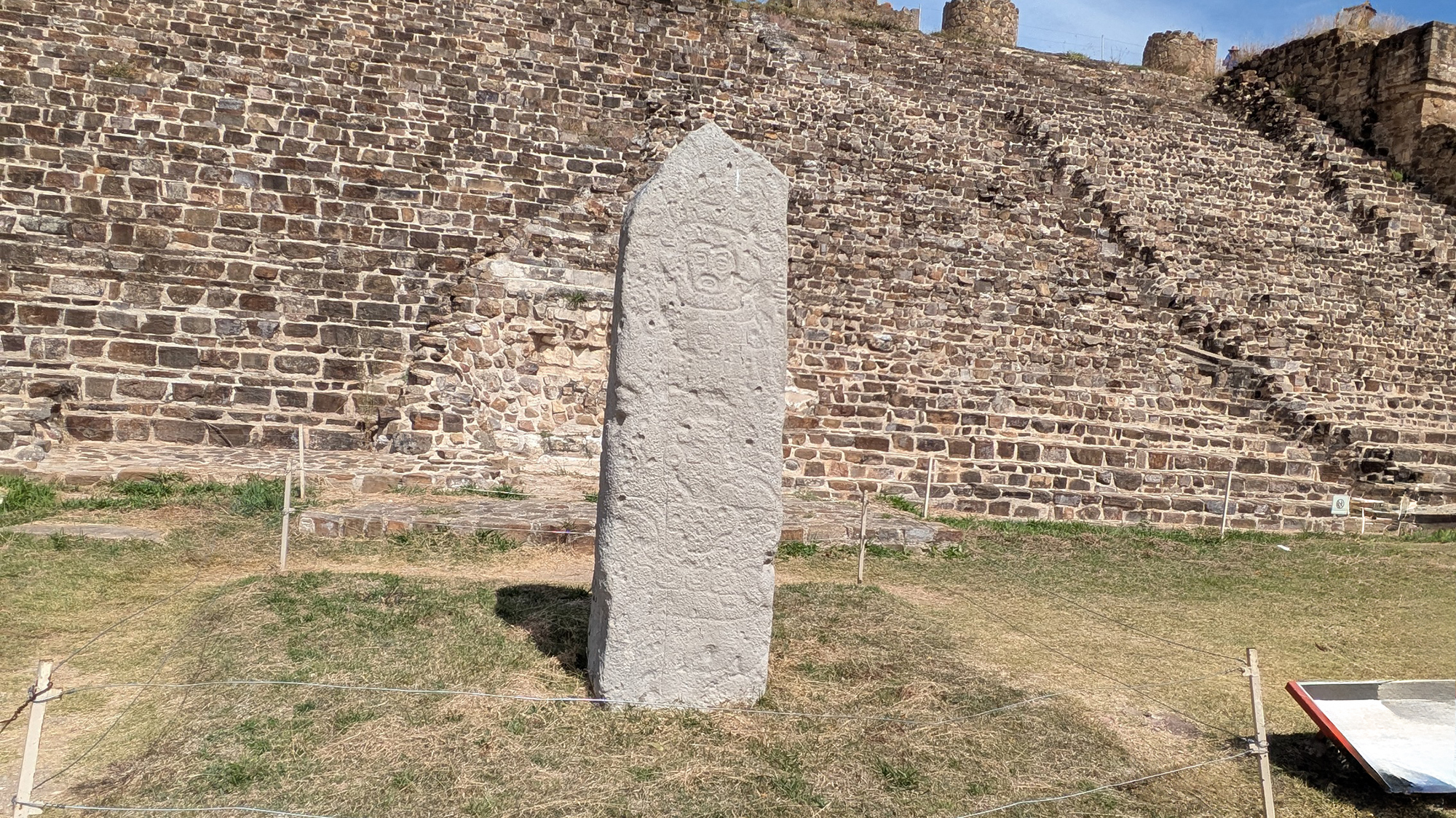
Four-sided Zapotec monument at the foot of the North Platform, carved on all faces with elite portraiture, hieroglyphic texts, calendrical signs, and speech scrolls; one of the most information-dense inscribed monuments at Monte Albán and a key document for understanding Zapotec political legitimacy, ritual performance, and dynastic memory [2] [4] [5].

Stela 9 (Spanish: Estela 9) is one of the most important inscribed monuments at Monte Albán. Standing near the foot of the North Platform, at one of the most symbolically charged points of the Great Plaza, it combines elite portraiture, hieroglyphic texts, calendrical notation, and ritual imagery on all four faces [1] [2] [4]. Because of its unusual density of writing and its four-sided program, Stela 9 has long attracted attention as a monument of dynastic memory and political display, not merely as a carved stone but as a public historical statement anchored at the entrance to Monte Albán’s northern acropolis [4] [5].

The stela is often called “El Obelisco” because of its tall shaft and pointed upper end. That nickname is visually apt, but academically the monument is best understood as a Zapotec inscribed monolith whose placement, iconography, and texts connected it to the ceremonial and ruling activities centered on the North Platform [2] [3]. Older descriptions sometimes compared its many glyphs to “Mayan” signs, but current epigraphic scholarship treats the monument as part of the Zapotec writing tradition, even while acknowledging broader interregional interaction in Classic-period Mesoamerica [1] [5].

Monument description, form, and placement

Stela 9 is a tall monolithic shaft with a roughly rectangular section and a distinctly tapered, pointed top, which explains its popular “obelisk” nickname [3]. Published descriptions vary slightly in the reported dimensions, but they consistently present it as an unusually tall stela for Monte Albán, rising to roughly between 3.1 and 4 meters [3] [5]. Its surfaces are incised rather than sculpted in deep relief, so many details are easiest to read when light strikes the stone at an angle.

Its location is as important as its imagery. The monument stands at the base of the monumental access to the North Platform, a placement that strongly suggests a threshold or gateway function [1] [2]. This was not a casual place to erect a text-heavy monument. The North Platform was one of the most restricted and politically charged sectors of Monte Albán, associated with elite ceremonial architecture, courtly compounds, and major public performances [2] [7]. In that sense, Stela 9 did double duty: it marked space physically while also marking authority ideologically.

Because all four faces are carved, the monument appears to have been designed for circumambulatory viewing. A person moving around it would not encounter a single static image but a sequence of figures, captions, and narrative elements. This sequential viewing is central to later interpretations of how the monument worked in ritual and political theater [4] [5].

Discovery and research history

The monument is associated in the literature with the first major modern investigations at Monte Albán, especially the work initiated by Leopoldo Batres in 1902, when the site began to enter national archaeological discourse in a more systematic way [3] [8]. Its fuller documentation and interpretive importance, however, belong above all to the twentieth-century scholarship of Alfonso Caso, whose studies of Zapotec monuments and inscriptions made Stela 9 one of the key pieces in the broader corpus of Monte Albán carved stones [3] [8].

In more recent scholarship, especially in the work of Javier Urcid, the monument is identified as SP-9, a catalog designation that places it within a more systematic epigraphic and iconographic framework [5]. This shift matters. Earlier studies understandably emphasized description and classification; later work increasingly asked how the monument encoded speech, names, calendrics, reading order, and political memory.

The four carved faces as a unified program

Stela 9 is best read not as four unrelated carvings but as a single multi-faced inscriptional program. Each side contributes a different piece of a larger political and ritual narrative [4] [5].

South face: the ruler and the name “8 Flower”

The south face presents the most overtly centralizing image: a frontally standing male figure wearing elaborate ritual attire and an imposing headdress [3] [4]. Near the base appears the glyph commonly identified as “8 Flower”, rendered through a numeral-and-sign combination that Joyce Marcus interprets as a personal calendrical name, very likely that of a ruler or principal patron associated with the monument [4]. This makes the south face the clearest statement of dynastic identity on the stela.

The figure’s costume has often been understood as signaling high office and cosmological authority. Feline or jaguar-linked attributes have been noted in modern descriptions, though these should be treated with care unless directly visible in the carving or secure drawings [4]. What can be said with confidence is that the figure is presented not as an anonymous human being but as a person whose body, attire, and accompanying signs visually announce rank, legitimacy, and ritualized power.

East face: two ritual specialists and speech scrolls

The east face depicts two standing figures, one placed above the other, commonly interpreted as ritual specialists or priests [3] [4]. Particularly important are the objects associated with them, often identified as copal bags, which connect the scene to incense, offering, and formal ritual activity. Equally striking are the curving signs issuing from the faces, conventionally described as speech scrolls or volutes, which visually encode spoken utterance, recitation, proclamation, or chant [3] [5].

These speech signs are crucial because they show that Stela 9 is not just about who is represented, but about what is being said or performed in the public ceremonial sphere. In other words, the monument preserves not only persons and dates, but the idea of authoritative speech itself.

North face: dialogue and historical text

The north face contains one of the monument’s most complex scenes: two figures facing each other, with glyphic identifiers positioned above them and a longer panel of signs below [3] [4]. Alfonso Caso viewed this and related materials through a conquest-oriented lens, stressing the historical or commemorative nature of the inscriptional content [8]. Later scholarship has kept the historical emphasis but broadened the range of possibilities, allowing for negotiation, alliance, dynastic succession, state events, or formalized diplomatic encounter [4] [5].

What matters most is that the lower register appears to preserve a narrative sequence, not just isolated signs. This is one reason Stela 9 is so often described as a kind of stone codex: it compresses persons, named identity, and event-recording into a public medium durable enough to outlast the speakers themselves.

West face: an elite official or high priest

The west face shows another elaborately dressed figure accompanied by glyphs that likely document status, identity, or role within the governing order [3] [5]. Interpretations vary on whether this person is best identified as a priest, official, lineage member, or some combination of those categories. In a Zapotec courtly context, strict modern separations between political and ritual office may be misleading anyway. The monument seems designed precisely to fuse those domains.

Taken together, the four sides do not merely decorate the stone. They stage a public vision of rulership, ritual speech, elite interaction, and lineage continuity at the threshold to the North Platform.

Epigraphy, calendrics, and the importance of SP-9

For epigraphers, Stela 9 is one of the most valuable monuments at Monte Albán because it preserves both calendrical signs and more difficult non-calendrical glyphs [5]. This makes it a bridge between what can be read more securely in the Zapotec corpus and what remains only partially understood.

The “Glifo W”

One of the key signs discussed in relation to SP-9 is the so-called Glifo W, a recurring sign in early Zapotec writing that has played an important role in debates over Zapotec calendrics [5]. As summarized by Javier Urcid, following work by Justeson and Kaufman, the sign has been interpreted as part of a system tied to a lunar cycle or to a day designation anchored to lunar reckoning [5]. Even where the full reading remains debated, SP-9 is one of the monuments that keeps this issue front and center.

Non-calendrical signs and the rebus principle

SP-9 is also important because it includes non-calendrical sign combinations that may work through the rebus principle, in which a sign evokes a spoken value that contributes to a name or expression rather than simply depicting an object [5]. Urcid notes that one sign cluster on the monument includes the glyphs he labels M and E. Using reconstructed Zapotec lexical values, he suggests readings corresponding to Laa and Xoo, which together can yield the meaning “Rayo Poderoso” or “Powerful Lightning” [5].

This matters for two reasons. First, it shows that elite naming on Stela 9 may extend beyond simple day names into more elaborate personal or titular expressions. Second, it strengthens the broader argument that Zapotec inscriptions at Monte Albán preserve not just calendrical notation but elements of spoken language and dynastic identity.

Interpretation: conquest record, state propaganda, or processional text?

The meaning of Stela 9 has never been exhausted by a single interpretation, and that is exactly why it remains such an important monument.

Alfonso Caso approached Monte Albán’s carved stones with a strong interest in historical content, often emphasizing conquest, named places, and state events [8]. In that framework, Stela 9 belongs to a world in which elite monuments recorded and monumentalized political achievement.

Joyce Marcus, while not rejecting the historical dimension, sharpened the ideological point. For Marcus, Zapotec writing at Monte Albán was a form of statecraft, a durable technology through which rulers and their lineages legitimized authority by fixing names, deeds, and offices in stone at strategic points within the ceremonial core [4]. Stela 9 is almost a textbook example of that process: a literate monument placed exactly where one moved toward the North Platform, the domain of elite power.

Javier Urcid has pushed the conversation further by exploring how such monuments may have been read in relation to movement through built space [5]. Rather than imagining a reader standing still in front of one side, his approach allows for sequences that unfold as one turns around the monument or proceeds nearby. In that sense, the monument’s reading order may have echoed the choreography of plaza movement, ascent, and controlled access. That possibility makes Stela 9 not only a text, but a performative text.

The safest conclusion is that Stela 9 worked simultaneously on several levels: as a monument of elite self-representation, as a historical inscription, as a record of speech and calendrics, and as a threshold marker for one of Monte Albán’s most politically loaded spaces [2] [4] [5].

Broader context within Monte Albán

Monte Albán is a UNESCO World Heritage site celebrated in part for its hieroglyphic monuments and monumental civic-religious planning [7]. Within that larger setting, Stela 9 occupies an especially strategic niche. It is not isolated like a detached museum piece. It remains embedded in the architecture and sightlines of the Great Plaza and North Platform [1] [2].

That architectural embeddedness helps explain why the monument feels more consequential than a simple carved marker. It sits where procession, authority, and visibility converge. From below, it mediates access upward. From above, it presides over the approach. And from close range, it reveals that Monte Albán’s rulers were investing not only in stone architecture, but in the politics of writing itself.

Visiting Stela 9 today

Stela 9 remains one of the most accessible original inscribed monuments for visitors at Monte Albán. Because the relief is relatively shallow, it is easiest to appreciate in early morning or late afternoon light, when raking illumination throws the incised lines into sharper contrast [2]. This is especially useful for seeing details such as the “8 Flower” glyph, facial outlines, and the curving speech-scroll elements.

For photography, one of the best vantage points is from the base area looking upward, where the monument’s pointed shape can be seen against the mass of the North Platform stairway behind it. That view captures exactly why the popular nickname “El Obelisco” has survived: the monument reads as both a text and a vertical sign of authority.

References

  1. INAH, Monte Albán, official site page. Notes the North Platform context and identifies Stela 9 as a monument notable for its many carved glyphs. Link
  2. INAH, Plataforma Norte, official element page. Describes the North Platform as a major ceremonial complex and notes Stela 9 at this sector of the Great Plaza. Link
  3. On-site interpretive signage and published visual documentation for Stela 9, including drawings and descriptive notes on its four carved faces, pointed form, and placement at the base of the North Platform stair approach. See also summary notice in Las estelas zapotecas and site documentation. Google Books record
  4. Marcus, Joyce. 1992. Mesoamerican Writing Systems: Propaganda, Myth, and History in Four Ancient Civilizations. Princeton University Press. Foundational discussion of Zapotec monuments, writing, elite legitimation, calendrical names, and the political use of inscribed stone.
  5. Urcid, Javier. La Escritura Zapoteca. FAMSI text edition. Discusses the monument as SP-9, the problem of non-calendrical glyphs, the Glifo W, and the proposed rebus reading involving Laa and Xoo. Link
  6. Justeson, John, and Terrence Kaufman. Studies on Zapotec writing and calendrics, as summarized and discussed by Urcid, especially regarding the Glifo W and lunar anchoring in Zapotec notational systems.
  7. UNESCO World Heritage Centre, Historic Centre of Oaxaca and Archaeological Site of Monte Albán. Context for Monte Albán’s importance as a monumental ceremonial center with hieroglyphic inscriptions. Link
  8. Caso, Alfonso. Las estelas zapotecas. Classic corpus study of Zapotec stelae and inscriptions, including Stela 9. Google Books record
© MAHC — Monte Albán Heritage Center. Citation-based article built from official site context and major scholarship on Zapotec writing, political monuments, and Monte Albán epigraphy.
Other Wiki Places

Primary Sources. Answer Keys. Full Compliance. One Archive. Already Built.

MAPSA — Monte Albán Primary Source Archive  ·  Institutional Assets & Media Rights

The world's most comprehensive primary source archive for a UNESCO World Heritage Site — pre-built, compliance-ready, and delivered directly inside your LMS. Your institution receives a non-exclusive professional license to deploy the full archive across every course, every semester, from day one.

  • Immersive Audio Briefings — Expert-led narration for every documented structure, ready to assign
  • Human-Verified Transcripts — WCAG 2.1 AA compliant, built for screen readers and academic citation
  • Editable Curriculum Modules — Customizable DOCX lesson plans for direct syllabus integration
  • Dual-Tier Assessments — Student worksheets and faculty answer keys grounded in live archive data
  • Bespoke Field Hours — On-ground research requests fulfilled by our Oaxaca team in 48–72 hours

⚠ DOJ deadline: April 2026. Every asset above was built WCAG 2.1 AA compliant from day one — not retrofitted.

Founding cohort is limited. Onboarding is open now.